
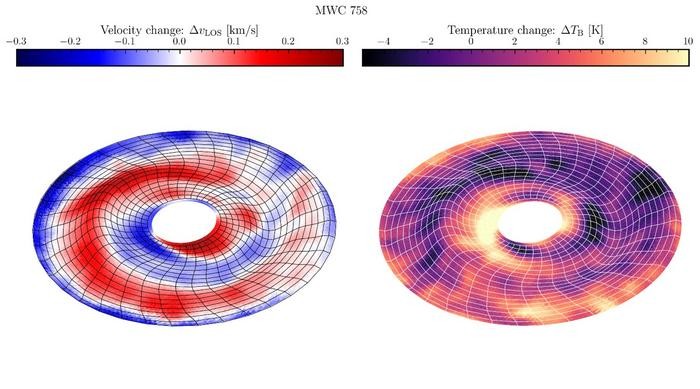
Warped protoplanetary discs change the origin story. In new observations from the Atacama Large Millimetre/submillimetre Array (ALMA), an international team led by Queen Mary University of London reports that many planet-forming discs are not perfectly flat but slightly warped, by about half a degree to two degrees.
The study, published in The Astrophysical Journal Letters, interprets large-scale velocity patterns in carbon monoxide emission as evidence of gentle tilts across the disc, a pattern that mirrors the small misalignments among planets in our own Solar System. The work is part of the exoALMA program and points to messy, dynamic beginnings for worlds.
Not a tidy pancake after all
Before dawn on the Chajnantor Plateau, the air is thin and sharp, the array’s white dishes slowly swiveling. What they recorded is a quiet disruption of a textbook image. Instead of serene, perfectly planar discs, the gas shows m = 1, spiral-like departures from simple Keplerian rotation that a simple warp model can explain. A little tilt here, a little twist there. Small angles, big consequences.
“Our results suggest that protoplanetary discs are slightly warped. This would be quite a change in how we understand these objects…”
That is lead author Andrew Winter of Queen Mary University of London, reflecting on the analysis that links kinematic asymmetries to subtle geometric bends. The team modeled line-of-sight Doppler shifts in CO emission across each disc, fitting the residuals with a radially varying inclination and position angle. Where the pattern had point-antisymmetry, the warp fit snapped neatly into place. For details, see the preprint on arXiv and the journal page at IOPscience.
Why the tilt matters
In systems such as MWC 758, the model not only matches the velocity spirals, it also reproduces temperature ripples of roughly 10 K and broad shadowing features that show up in scattered-light images. If warps steer how gas and dust move, they can change turbulence, exchange of material between rings, and the delivery of solids to planet nurseries. In other words, a small tilt can set the stage for big architecture. The tilt repeats across the disc. The tilt keeps matter talking to the star.
Interestingly, the team finds that the strength of the warp correlates with stellar accretion rate across the exoALMA sample. That hint of a link between inner-disc feeding and outer-disc kinematics suggests that warps could help drive angular momentum transport, a long-standing puzzle in disc physics. External nudges remain on the table too, from unseen companions to late infall of misaligned material. Truth be told, there may be several paths to a warp.
“The warp-like structures challenge the idea of orderly planet formation and pose a fascinating challenge for the future.”
So says Myriam Benisty, who leads the Planet and Star Formation Department at the Max Planck Institute for Astronomy. The challenge now is discriminating between warps and other culprits, like pressure-supported flows or winds that can mimic some of the same signatures. The authors are explicit that their interpretation is not unique, only simple and powerful as a baseline.
How they saw the bends
ALMA’s CO maps act like a cosmic speedometer, measuring tiny Doppler shifts ring by ring. The team compared observed velocities to an idealized, flat, Keplerian disc and then asked a precise question: can gentle, radially varying tilts explain what is left over? In many discs the answer was yes, with coherent, near-sinusoidal changes in inclination and position angle across radius. In a few highly inclined systems, back-side emission complicates the picture, so those were set aside for population-level trends.
For readers who want the nuts and bolts, the authors use a flexible “tilted-ring” style model and validate robustness across isotopologues, finding similar tilt amplitudes in 12CO and 13CO. They also show, with radiative transfer tests, that the same warp geometry can cast broad moving shadows and imprint spirals in brightness temperature. That matters because we have seen those spirals before, with Hubble and now JWST, and they might not require a hidden giant planet every time.
Rewriting the Solar System’s preface
The Solar System’s planets are not exactly coplanar. They are close, but not perfect. A couple of degrees here, a hair there. The new work makes that kind of near-order look less like an accident and more like a natural outcome of slightly warped birth discs. A tidy pancake was always an oversimplification. The universe prefers a slightly bent record.
Authoritative resources: ALMA program overview at almaobservatory.org, and background on disc warps from MPIA at mpia.de.
Journal: The Astrophysical Journal Letters. DOI: 10.3847/2041-8213/adf113
Takeaway: even a modest warp can orchestrate the flow of gas and dust, sculpt spiral structure, and nudge young planets onto slightly misaligned paths. Small angles, lasting effects.
ScienceBlog.com has no paywalls, no sponsored content, and no agenda beyond getting the science right. Every story here is written to inform, not to impress an advertiser or push a point of view.
Good science journalism takes time — reading the papers, checking the claims, finding researchers who can put findings in context. We do that work because we think it matters.
If you find this site useful, consider supporting it with a donation. Even a few dollars a month helps keep the coverage independent and free for everyone.