
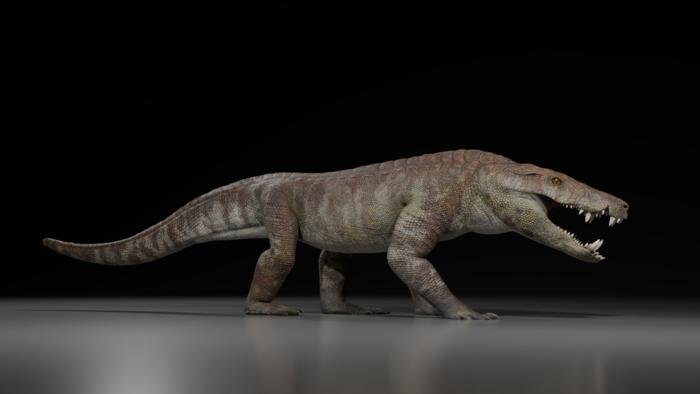
A terrifying predator lurked in prehistoric Patagonia. A newly described species, Kostensuchus atrox, stretched 11.5 feet long, weighed about 250 kilograms, and likely dined on dinosaurs. Unearthed near El Calafate, Argentina, the exquisitely preserved fossil reveals a broad-snouted, hypercarnivorous crocodyliform that roamed the Chorrillo Formation floodplains about 70 million years ago, just before the mass extinction of the dinosaurs. Published in PLOS One, the study identifies this peirosaurid as one of the top predators of the Late Cretaceous ecosystem, second only to the giant megaraptorid theropod Maip.
A Predator Built for Power
The skull of Kostensuchus atrox measures nearly half a meter long, with conical, ziphodont teeth designed for puncturing and slicing flesh. Unlike modern crocodiles, which are mostly ambush predators in water, this crocodyliform seems to have been a terrestrial powerhouse. Its robust jaws and deep lower mandible suggest crushing bite forces, while a stout humerus points to strong, grasping forelimbs.
“The new specimen reveals, for the first time, the anatomy and body plan of a large and broad snouted peirosaurid,” the authors write in PLOS One.
By body mass alone, Kostensuchus dwarfed many other crocodyliforms of its time, which often weighed under 60 kilograms. This sheer size, coupled with knife-edged teeth, implies an apex role in Patagonia’s predator guild, capable of taking down mid-sized ornithischian dinosaurs as well as mammals and reptiles that shared its floodplain habitat.
Patagonia’s Prehistoric Neighborhood
The Chorrillo Formation, a stretch of sedimentary rocks deposited near the end of the Cretaceous, paints a vivid picture of life in southern Patagonia 70 million years ago. It held titanosaurs like Nullotitan, megaraptorids like Maip, armored ankylosaurs, early birds, frogs, turtles, and even monotremes. Into this mix came Kostensuchus atrox, whose name fuses “Kosten,” the Aonikenk word for the fierce Patagonian wind, with “Souchos,” the crocodile-headed Egyptian deity.
This predator now stands as the first crocodyliform known from the formation, and its discovery fills a missing piece in the puzzle of South America’s ancient food webs. Unlike northern Patagonia, dominated by abelisaurid theropods, the southern ecosystems balanced megaraptorids with these broad-snouted crocodyliforms.
Key Findings
- Kostensuchus atrox lived ~70 million years ago in the Maastrichtian Chorrillo Formation of Argentina.
- Fossil includes articulated skull, jaws, and parts of the skeleton, making it one of the most complete peirosaurids found.
- Estimated size: 3.5 meters long, 250 kilograms.
- Adaptations: broad snout, ziphodont teeth, robust forelimbs, suggesting hypercarnivory and apex predator status.
Survivors and Rivals
Comparisons with other South American crocodyliforms show that Kostensuchus evolved alongside baurusuchids, another lineage of hypercarnivores. But its anatomy hints at a different lifestyle. Baurusuchids were strictly terrestrial with erect limbs, while Kostensuchus may have kept a slightly more sprawling gait, perhaps straddling the line between land and water. Either way, this fossil proves peirosaurids had diversified into large-bodied killers by the Cretaceous finale.
“Kostensuchus gen. nov. played the role of a top predator within this end-Cretaceous ecosystem,” the researchers conclude.
The find underscores just how varied predator line-ups were across Patagonia at the time, with southern and northern regions hosting distinct ecological casts. Whether environmental differences or competition drove these patterns is an open question. For now, Kostensuchus atrox takes its place as one of the last and fiercest crocodyliform hunters before the asteroid struck.
Takeaway
A newly described crocodyliform, Kostensuchus atrox, was an 11.5-foot, 250-kilogram hypercarnivore that lived in Patagonia 70 million years ago. Its well-preserved fossil shows it was a top predator with powerful jaws and teeth capable of preying on dinosaurs. The find expands our understanding of crocodyliform evolution and the diverse predator guilds of Late Cretaceous South America.
Journal: PLOS One
DOI: 10.1371/journal.pone.0328561
Discover more from Wild Science
Subscribe to get the latest posts sent to your email.