
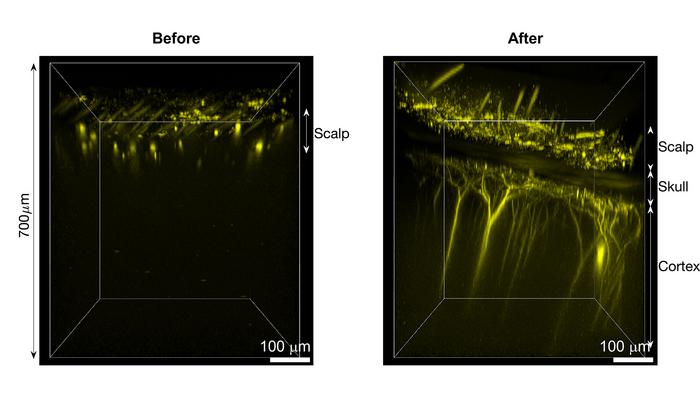
The trick is almost absurdly simple. By rubbing a compound into the scalp of young mice, Stanford scientists have made the skin transparent to visible light, letting them repeatedly image the same animal’s developing brain. The method, published Aug. 26 in PNAS, is reversible, non-invasive, and could become a powerful tool for studying how neural circuits form and falter in development. That matters for research into neurodevelopmental disorders, where timing is everything.
A Clear View Through the Skin
Normally, light scatters at every boundary in tissue, between lipids, proteins, water. That scattering is why skin looks opaque. But the team discovered that adding a compound called ampyrone to water raises the water’s refractive index so it matches the rest of the biomaterials in skin. Suddenly, the fog lifts. The scalp becomes transparent, revealing the glow of fluorescently tagged neurons beneath.
“This opens a literal window to peek into the brain’s development,” said Guosong Hong, senior author and assistant professor at Stanford.
Hong’s group had already shown that dye molecules could make skin transparent to red light, letting researchers view internal organs. But red light leaves out much of the standard toolkit for neuroscience, since green and yellow fluorescent proteins are the workhorses for tagging neural activity. Ampyrone changes that. It absorbs mostly ultraviolet light, leaving the entire visible spectrum open for imaging.
From Physics To Biology
The underlying principle is as much physics as biology. Light bends differently in different materials depending on their refractive index. Skin scatters light because its water and biomolecules bend light differently. Ampyrone tweaks the water so its index aligns better. That basic rule of optics turns into a working biological hack.
“From a physics perspective, we’re basically a bag of water with biomaterials,” said co-author Mark Brongersma. “And the mismatch in their optical properties is why we can’t see through the skin or scalp.”
What is striking is that something so fundamental translates directly into a live animal system. “It wasn’t clear whether the physics and the chemistry and the biology would all line up to make this happen,” Brongersma added. But they did. And the result is scalp that becomes clear within minutes of treatment, then reverts as the solution fades.
Tracking Brain Development In Real Time
Because the approach is reversible, researchers can return to the same mouse over days or weeks. That opens the door to something developmental neuroscientists rarely get: longitudinal imaging of the same neurons as circuits mature. Juvenile mice have skulls thin enough that fluorescence still shines through until about four weeks of age, roughly equivalent to adolescence in humans. Using the method, the team captured neurons firing in response to a puff of air on the whiskers. They could watch activity shift and strengthen as the animals grew.
The technique showed minimal acute or chronic tissue damage in safety studies. It is, in principle, as easy as applying a cream. That makes it attractive for labs without access to invasive surgeries or complex optics. For now, it is limited to young mice, before the skull thickens. But within that window, it offers an unparalleled view of the brain in action.
Implications And Future Directions
For disorders like autism or epilepsy, the timing of circuit formation matters as much as the circuits themselves. Interventions may only work if targeted at the right developmental stage. With scalp transparency, researchers can watch networks assemble in real time in living animals. That gives them a better shot at understanding when things go wrong.
It is a small technical advance with a big ripple. Transparent skin is not just a parlor trick. It is a new lens on development itself. The literal window, as Hong said, may finally let researchers watch the invisible drama of brain growth unfold.
Proceedings of the National Academy of Sciences. DOI: 10.1073/pnas.2504264122
ScienceBlog.com has no paywalls, no sponsored content, and no agenda beyond getting the science right. Every story here is written to inform, not to impress an advertiser or push a point of view.
Good science journalism takes time — reading the papers, checking the claims, finding researchers who can put findings in context. We do that work because we think it matters.
If you find this site useful, consider supporting it with a donation. Even a few dollars a month helps keep the coverage independent and free for everyone.