

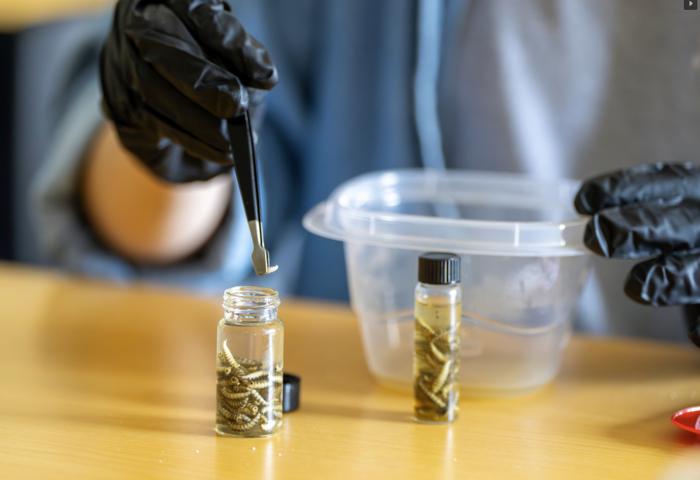
A flashlight-sized scanner can read maggots better than the naked eye. Researchers at Texas A&M say handheld infrared spectroscopy, paired with machine learning, can determine the sex of blow fly larvae found on human remains, a detail that nudges time of death estimates closer to the truth.
In tests on Chrysomya rufifacies, a common forensic species, two models cleared 90 percent accuracy and one topped 94 percent. The work, funded by the National Institute of Justice and published in the Journal of Forensic Sciences, points to a faster, non destructive way to refine the forensic clock at real scenes, not just in a lab.
Here is the forensic headache they are tackling. Male and female flies do not grow at the same pace. Under typical conditions, males can be on the order of nine hours ahead. That gap sounds small until you are reconstructing the last day in a homicide timeline. At the larval stage, you cannot tell sexes apart by eye, and the standard workaround has meant destroying evidence for molecular testing. Not ideal when every specimen may matter later in court.
The Texas A&M team tried something more elegant. Shine mid infrared light at third instar larvae, record the vibrational fingerprint from proteins, lipids, and hydrocarbons, then let algorithms sort the spectra. In training and external validation, Partial Least Squares Discriminant Analysis and a compact neural network did the heavy lifting, achieving about 90 percent and 94.5 percent accuracy, respectively, when the handheld device data were fed the right preprocessing.
“You could use this handheld device out in the field and still be able to conduct further testing back in the lab afterward.”
That portability matters. Investigators work against heat, scavengers, and curious onlookers. A field ready, non destructive scan that preserves larvae for later DNA work preserves chain of custody and buys time. It also aligns with a broader trend in forensics toward faster, more objective measurements that are less dependent on a single examiner’s judgment. And yes, there is a cost angle. A rugged handheld spectrometer and lightweight software are easier to deploy across agencies than a specialized bench setup, and they sidestep consumables tied to destructive assays.
The biology cooperates, too. Blow flies wear chemistry on their sleeves, so to speak. Their cuticles carry hydrocarbon blends linked to sex and behavior. The researchers found consistent spectral differences across peaks near 1053, 1237, 1312, 1340, 1396, 1457, and 1541 cm−1, with males showing higher abundances at many of those bands. It is a reminder that the clock is chemical as much as it is biological.
There is caution here. Models trained on small, tidy lab datasets can stumble in the wild. Crowded maggot masses, mixed sex clutches, temperature swings, and diet can tweak those cuticular signatures. The team acknowledges the need for time series work and tests across temperatures, along with larger, more variable training sets. But the direction of travel is clear. The forensic clock gets sharper when you can tell who is growing faster on the scene, not a week later.
Beyond crime scenes, the method whispers to agriculture and biosecurity. Sex sorting is central to sterile insect technique programs that flood landscapes with non breeding males to suppress pests. Rapid larval sexing could speed rearing lines and reduce waste. It is also timely, given rising attention to the New World screwworm in Mexico and the need for vigilant surveillance just across the border.
“We are taking advanced analytical chemistry and using it for public service. It is a great example of how interdisciplinary work can solve practical problems.”
Turns out, maggots are better witnesses than we give them credit for. With a little light and a little math, they tell investigators which way the clock is leaning. And in cases that hinge on hours, that is not a minor nudge. It is the difference between a guess and a grounded timeline.
Journal: Journal of Forensic Sciences
Paper: Portable Fourier transform infrared spectroscopy and machine learning for sex determination in third instar Chrysomya rufifacies larvae
DOI: 10.1111/1556-4029.70054