
The ocean’s most abundant photosynthetic organism can’t handle the heat. After analyzing 800 billion cells across a decade of research cruises, scientists have discovered that Prochlorococcus, the microscopic cyanobacterium that fuels much of marine life, starts breaking down when water temperatures climb above 28°C (82°F).
This finding upends long-held assumptions about how these tiny organisms will fare in warming oceans. For years, researchers predicted Prochlorococcus would thrive as temperatures rose, given their dominance in tropical waters. Instead, the new study reveals a critical thermal threshold that could trigger massive ecosystem shifts.
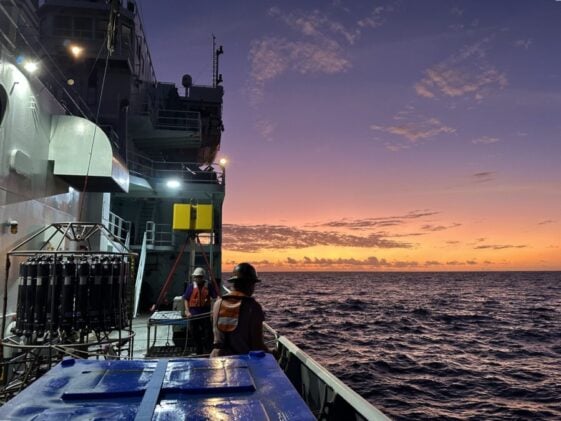
François Ribalet, a University of Washington oceanographer who led the research, spent 10 years deploying a continuous-flow cytometer called SeaFlow on 90 research cruises. The instrument fired lasers through seawater to measure individual cells in real time, without disturbing the natural communities. What emerged was a troubling pattern: cell division rates climbed steadily with temperature until hitting that 28°C wall, then plummeted by nearly two-thirds.
“For a long time, scientists thought Prochlorococcus was going to do great in the future, but in the warmest regions, they aren’t doing that well,” Ribalet explained.
The implications stretch far beyond a single species. Prochlorococcus inhabits over 75% of the world’s sunlit surface waters and accounts for nearly half of tropical phytoplankton biomass. These 0.5-micrometer cells perform about 5% of global photosynthesis, converting carbon dioxide into organic matter that feeds everything from tiny zooplankton to whales.
Evolution’s Double-Edged Sword
The cyanobacterium’s vulnerability stems from an evolutionary trade-off that once made it spectacularly successful. Over millions of years, Prochlorococcus streamlined its genome, shedding genes for stress responses and other “luxury” functions to become the ultimate efficiency machine in nutrient-poor tropical waters. This genetic minimalism allowed it to outcompete larger organisms in the ocean’s desert-like regions.
But that same streamlining now constrains its ability to cope with rapid warming. Unlike its larger cousin Synechococcus, which maintains more complex cellular machinery for handling environmental stress, Prochlorococcus can’t simply retrieve the heat-tolerance genes it discarded eons ago.
The research team’s global ecosystem model paints a stark picture of what’s coming. Under moderate warming scenarios similar to keeping global temperature rise to 2°C, tropical Prochlorococcus production could drop 17%. High-emission pathways leading to more severe warming would slash productivity by 51% in the warmest regions.
“Their burnout temperature is much lower than we thought it was,” Ribalet noted, explaining how previous models assumed exponential growth rates that these organisms simply cannot sustain.
The Western Pacific Warm Pool faces particularly severe impacts, with models predicting near-complete collapse of Prochlorococcus populations in some areas. Even accounting for potential range expansion toward cooler polar waters, global production still declines 10-37% depending on the warming scenario.
Uncertain Replacements
Synechococcus could partially fill the gap left by declining Prochlorococcus populations. The models show this larger cyanobacterium thriving in precisely those tropical regions where Prochlorococcus struggles, suggesting it can handle higher temperatures. But Synechococcus requires more nutrients to survive, and whether marine food webs can adapt to this fundamental shift remains unclear.
The researchers tested a hypothetical scenario involving warm-adapted Prochlorococcus strains with higher temperature tolerance. Even with a generous 2°C increase in thermal optimum, significant production declines persisted in the hottest regions, suggesting evolutionary rescue may not arrive quickly enough to prevent major disruptions.
These findings expose a critical blind spot in climate projections. Most ecosystem models assume phytoplankton growth rates increase exponentially with temperature, an assumption that works well for many species but fails catastrophically for Prochlorococcus. The study’s field observations consistently contradict this exponential relationship, showing real-world division rates that level off and then crash at high temperatures.
The consistency between laboratory cultures and field measurements across different methodologies strengthens confidence in these thermal limits. Even culture isolates from warm regions like the Red Sea show similar patterns, despite being grown under optimal nutrient conditions that should maximize heat tolerance.
What makes this particularly concerning is Prochlorococcus’s lack of functional redundancy. No other organism fills quite the same ecological niche in nutrient-poor tropical waters. Its decline could disrupt relationships with partner bacteria like SAR11, alter carbon cycling patterns, and ripple through food webs in ways that are difficult to predict.
The tropical oceans may be heading for a biological transformation unlike anything seen in human history. Whether marine ecosystems can adapt to a world with fewer Prochlorococcus remains an open question, one that will be answered in the coming decades as ocean temperatures continue their relentless climb.
https://doi.org/10.1038/s41564-024-01826-3
ScienceBlog.com has no paywalls, no sponsored content, and no agenda beyond getting the science right. Every story here is written to inform, not to impress an advertiser or push a point of view.
Good science journalism takes time — reading the papers, checking the claims, finding researchers who can put findings in context. We do that work because we think it matters.
If you find this site useful, consider supporting it with a donation. Even a few dollars a month helps keep the coverage independent and free for everyone.