

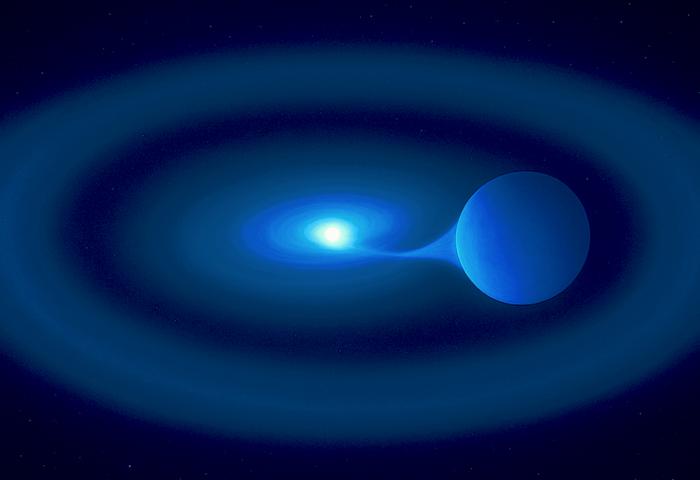
The universe has served up a celestial feast of epic proportions. V Sagittae, a binary star system 10,000 light-years from Earth, features a white dwarf star consuming its companion at an unprecedented rate, creating one of the most luminous stellar cannibalization events ever observed.
Using the European Southern Observatory’s Very Large Telescope in Chile, an international team led by Dr. Pasi Hakala from the University of Turku has captured this cosmic carnage in unprecedented detail. Their findings, published in the Monthly Notices of the Royal Astronomical Society, reveal a system so extreme it could reshape our understanding of stellar death throes.
A Dance Of Destruction
The two stars orbit each other every 12.34 hours in an increasingly tight gravitational embrace. But this isn’t your typical stellar waltz. The white dwarf, a super-dense stellar remnant, is stripping material from its larger companion at such a ferocious pace that it’s sustaining thermonuclear burning on its surface.
“V Sagittae is no ordinary star system – it’s the brightest of its kind and has baffled experts since it was first discovered in 1902,” explains Professor Phil Charles from the University of Southampton. The system’s extreme brightness stems from the white dwarf “sucking the life out of its companion star, using the accreted matter to turn it into a blazing inferno.”
The research team discovered something unexpected: a massive ring of gas encircling both stars, formed from the debris of this messy stellar feast. This circumbinary ring, spinning at velocities of roughly 150-180 kilometers per second, provides crucial clues about the system’s mass and dynamics.
Rewriting The Stellar Obituary
V Sagittae challenges conventional wisdom about binary star evolution. The system exhibits properties suggesting it’s undergoing Eddington-limited accretion, where the white dwarf is consuming matter at the theoretical maximum rate possible. This places it firmly in the category of supersoft X-ray sources, extremely rare and short-lived evolutionary phases.
The team’s analysis indicates the total system mass is likely below 2.1 solar masses, significantly lower than previous estimates. This finding casts doubt on mass measurements dating back to 1965 and suggests astronomers may need to reconsider the fundamental parameters of this enigmatic system.
Perhaps most intriguingly, the researchers documented dramatic velocity shifts in the broad emission components of spectral lines, variations that persist for years before “flipping” to opposite states within just days. Dr. Pablo Rodríguez-Gil from Spain’s Instituto de Astrofísica de Canarias suggests this chaotic behavior reflects the inner accretion disk’s response to intense irradiation.
The white dwarf can’t consume all the material being transferred, creating the observed ring structure. “The speed at which this doomed stellar system is lurching wildly, likely due to the extreme brightness, is a frantic sign of its imminent, violent end,” notes Hakala.
But here’s the kicker: this isn’t sustainable. The matter accumulating on the white dwarf will likely trigger a nova outburst in coming years, making V Sagittae visible to the naked eye. Eventually, when the stars finally collide, the resulting supernova explosion could be bright enough to see during daytime from Earth.
Turns out, some of the universe’s most spectacular light shows come from its most violent episodes of stellar cannibalism.