

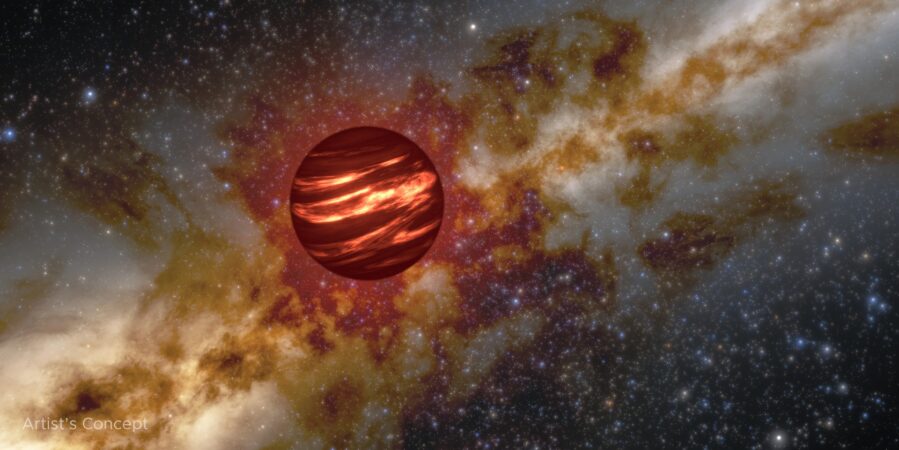
A cosmic oddball discovered by accident has solved a puzzle that has stumped astronomers for decades. Scientists using NASA’s James Webb Space Telescope found the first-ever detection of silane gas in the atmosphere of a brown dwarf nicknamed “The Accident,” providing crucial insights into why silicon remains mysteriously hidden in Jupiter and Saturn’s atmospheres.
The detection represents a significant step forward in understanding atmospheric chemistry across gas giant planets, brown dwarfs, and potentially habitable exoplanets. Published September 4 in Nature, the research reveals how metallicity and atmospheric mixing shape the chemical signatures we can observe in these distant worlds.
A Celestial Time Capsule
“The Accident” formed between 10 to 12 billion years ago when the universe was much younger and contained mostly hydrogen and helium, with only trace amounts of heavier elements like silicon. This ancient brown dwarf, located about 50 light-years from Earth, has a metallicity less than 1% of our sun’s composition.
“Sometimes it’s the extreme objects that help us understand what’s happening in the average ones,” said Jacqueline Faherty, lead author from the American Museum of Natural History.
The brown dwarf’s unusual properties initially made it difficult to classify. Even among hard-to-categorize objects, The Accident displays a perplexing mix of features typically seen in both young and ancient brown dwarfs, causing it to slip past detection methods until citizen scientist Dan Caselden spotted it in 2020 through the Backyard Worlds: Planet 9 program.
Webb’s powerful infrared capabilities revealed an unexpected molecule in The Accident’s atmosphere. Initially unidentified, the absorption feature turned out to be silane (SiH4), a simple silicon molecule that researchers have long expected but never been able to find in gas giant atmospheres.
The Missing Silicon Problem
Silicon ranks among the most abundant elements in the universe, yet it has remained largely undetected in the atmospheres of Jupiter, Saturn, and gas planets orbiting other stars. Scientists suspected silicon existed in these atmospheres but remained hidden, bound to oxygen in compounds like quartz that form clouds deep below observable layers.
The research team’s atmospheric analysis revealed silane at an abundance of 19 parts per billion in The Accident’s atmosphere. Their chemical modeling suggests this silane abundance results from quenching at approximately kilobar pressure levels, just above silicate cloud layers where vertical atmospheric mixing can transport the molecule to observable heights.
The key difference lies in metallicity. When The Accident formed billions of years ago, far less oxygen existed in the universe to bond with silicon. Without abundant oxygen gobbling up available silicon, the element could instead bond with hydrogen to form silane. In contrast, modern gas giants like Jupiter and Saturn contain much more oxygen, which readily combines with silicon to create oxides that sink into unobservable atmospheric depths.
“We weren’t looking to solve a mystery about Jupiter and Saturn with these observations,” explained Peter Eisenhardt from NASA’s Jet Propulsion Laboratory. “A brown dwarf is a ball of gas like a star, but without an internal fusion reactor, it gets cooler and cooler, with an atmosphere like that of gas giant planets.”
The discovery demonstrates how atmospheric composition, cloud formation, and vertical mixing interact to determine what molecules remain visible in planetary atmospheres. Brown dwarfs often provide easier study targets than exoplanets because their light isn’t drowned out by nearby stars, offering clearer views of atmospheric chemistry.
The findings extend beyond academic curiosity. Understanding atmospheric complexity in brown dwarfs helps prepare scientists for future analyses of potentially Earth-like planets, where distinguishing between different atmospheric compositions could indicate habitability signs.
The research team plans additional observations using Webb’s mid-infrared capabilities, which should reveal another strong silane absorption feature between 10 and 12 micrometers, confirming their initial detection.
This cosmic accident has opened a new window into understanding how planetary atmospheres evolve over billions of years, linking the chemistry of ancient worlds to mysteries in our own solar system.