

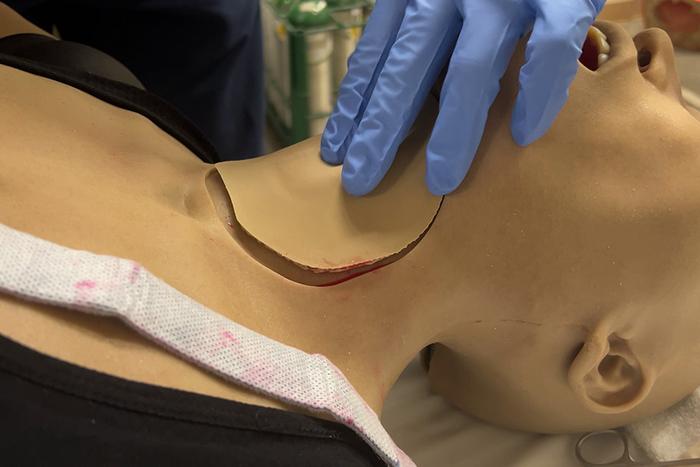
Paramedics and surgeons may soon have access to more lifelike training materials, thanks to University of Minnesota researchers who have developed a method for 3D printing synthetic human tissue that mimics the directional strength and flexibility of real skin and organs.
The innovation addresses a critical gap in medical education, where high-stakes procedures like emergency cricothyrotomies – lifesaving airway surgeries performed when conventional intubation fails – occur too rarely for most clinicians to gain hands-on experience. These “cannot-intubate, cannot-oxygenate” situations happen in just 0.2 to 0.3% of hospital cases, yet jump to 12% in combat settings where split-second decisions matter most.
Beyond Simple Silicone Models
Traditional tissue simulants, manufactured through casting processes, fail to replicate the anisotropic mechanical properties that characterize human tissue. Real skin exhibits directional strength variations up to 6:1 in certain locations, with collagen fibers creating a network that stiffens differently depending on the direction of applied force.
The Minnesota team’s approach exploits the inherent directionality of extrusion-based 3D printing, using overlapping orthogonal print lines to create cellular voxel structures. By manipulating the dimensions and spacing of these microscopic building blocks, researchers can dial in specific mechanical responses that mirror natural tissue behavior.
“This approach opens the door to creating more realistic training models for surgery, which could ultimately improve medical outcomes,” said Adarsh Somayaji, first author of the study and recent Ph.D. graduate from the University of Minnesota Department of Mechanical Engineering.
The mathematical model developed by the team allows precise prediction of mechanical anisotropy based on print parameters. Testing confirmed that synthetic tissues could achieve the full range of directional properties found in human bodies, from relatively isotropic muscle tissue to highly anisotropic skin.
Bleeding on Demand
Perhaps more intriguingly, the researchers solved the challenge of incorporating simulated blood into their printed tissues. Rather than manually injecting fluids after manufacturing, they developed water-oil-water double-emulsion capsules containing red-dyed glycerol solutions that mimic blood’s viscosity and appearance.
These microscopic capsules, roughly 680 micrometers in diameter, are embedded within a sacrificial gel matrix during printing. Once the silicone tissue cures, the gel dissolves away, leaving blood-filled capsules positioned throughout the structure. When a scalpel cuts the synthetic skin, the capsules rupture and release their contents, creating realistic bleeding.
“The development of medical simulators provides an avenue for using animal tissue or synthetic skin as an analog while training for surgical cricothyrotomies,” the researchers noted, explaining that while animal tissue offers superior realism, it remains expensive and difficult to obtain.
A comparative study involving 13 paramedics from King County Medic One found the 3D-printed simulants significantly outperformed conventional cast models. Participants rated the printed tissues as more realistic when palpating skin, cutting through layers, and observing bleeding patterns. The anisotropic properties appeared particularly important for tactile authenticity.
The technique extends beyond emergency airway procedures. The research team has successfully applied their methods to aortic valve models and other complex anatomical structures, suggesting broad applications across surgical specialties.
Current limitations include the serial nature of 3D printing, which limits mass production, and reduced accuracy on surfaces inclined more than 45 degrees. The team plans to address these constraints while expanding into tubular and spherical tissue geometries, incorporating materials compatible with electrocautery tools, and developing automated capsule loading systems.
For medical institutions struggling with limited access to cadavers and the logistical challenges of animal tissue, these synthetic alternatives could democratize high-fidelity surgical training. The work represents a significant step toward closing the realism gap between simulation and actual human tissue, potentially improving surgical outcomes through better-prepared clinicians.