
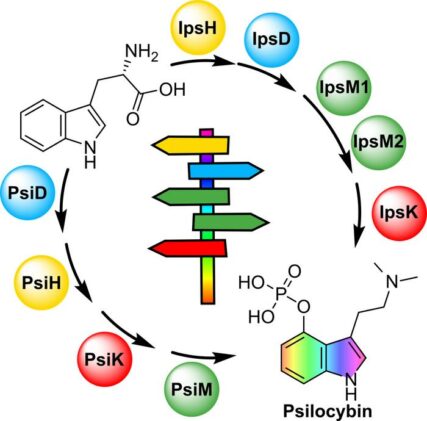
Nature has pulled off something unexpected in the world of psychedelic fungi. Scientists have discovered that different types of “magic mushrooms” independently evolved completely separate biochemical pathways to produce the same mind-altering compound, psilocybin. The finding represents a rare example of convergent evolution in the molecular kitchen of natural product synthesis.
The discovery emerged from research led by Tim Schäfer and Professor Dirk Hoffmeister at Friedrich Schiller University Jena, who were investigating how fiber cap mushrooms (Inocybe species) manufacture psilocybin. What they found defied expectations about fungal chemistry.
“It was like looking at two different workshops, but both ultimately delivering the same product. In the fiber caps, we found a unique set of enzymes that have nothing to do with those found in Psilocybe mushrooms. Nevertheless, they all catalyze the steps necessary to form psilocybin.”
The research, published in Angewandte Chemie International Edition, reveals that while Psilocybe mushrooms use one set of molecular tools, fiber cap mushrooms employ an entirely different biochemical arsenal to reach the same destination. The two pathways share not a single chemical reaction, yet both produce psilocybin with remarkable efficiency.
Two Roads to the Same Destination
The team’s investigation centered on Inocybe corydalina, a fiber cap species that produces psilocybin alongside the more familiar Psilocybe varieties. Through detailed laboratory analysis, they characterized five different enzymes that work together in sequence, but in a completely different order than their Psilocybe counterparts.
Most surprisingly, the fiber cap pathway operates in reverse order compared to Psilocybe species. Where Psilocybe mushrooms first remove a chemical group then add a hydroxyl group, fiber caps do the opposite. The methylation and phosphorylation steps also occur in switched sequence, creating what researchers describe as a “mirror image” biosynthetic pathway.
This discovery adds complexity to our understanding of how psychoactive compounds evolved in fungi. The two mushroom types inhabit different ecological niches – Psilocybe species typically grow on decomposing organic matter like wood and dung, while Inocybe species form symbiotic relationships with tree roots in forest environments.
Implications for Medicine and Evolution
The findings arrive as psilocybin gains attention as a potential treatment for therapy-resistant depression, with advanced clinical trials showing promising results. Having two distinct enzyme toolkits could prove valuable for biotechnology applications aimed at producing psilocybin for pharmaceutical use.
“Now that we know about additional enzymes, we have more tools in our toolbox for the biotechnological production of psilocybin.”
But the research raises deeper questions about why these mushrooms evolved to produce psilocybin at all. Hoffmeister’s team suspects the compound serves as a chemical defense mechanism, potentially deterring predators through its psychoactive effects or through toxic breakdown products that form when mushroom tissue is damaged.
The discovery also highlights the sophisticated chemistry occurring in forest ecosystems. Fiber cap mushrooms don’t just produce psilocybin – their pathway also generates baeocystin, another psychoactive compound, creating a branched chemical assembly line that can potentially shift production between different end products.
This represents only the second confirmed example of convergent evolution in natural product biosynthesis within the same taxonomic order of organisms. The rarity makes the finding particularly significant for understanding how chemical diversity arises in nature.
The research team is now working with industrial partners to explore whether these newly discovered enzymes could enable more efficient production of psilocybin in laboratory bioreactors, potentially supporting future pharmaceutical applications as the compound moves through clinical development.
The work was supported by the German Research Foundation and conducted within the Cluster of Excellence “Balance of the Microverse” at Friedrich Schiller University Jena, representing an international collaboration spanning Germany and Austria.
Angewandte Chemie International Edition: 10.1002/anie.202512017
ScienceBlog.com has no paywalls, no sponsored content, and no agenda beyond getting the science right. Every story here is written to inform, not to impress an advertiser or push a point of view.
Good science journalism takes time — reading the papers, checking the claims, finding researchers who can put findings in context. We do that work because we think it matters.
If you find this site useful, consider supporting it with a donation. Even a few dollars a month helps keep the coverage independent and free for everyone.