

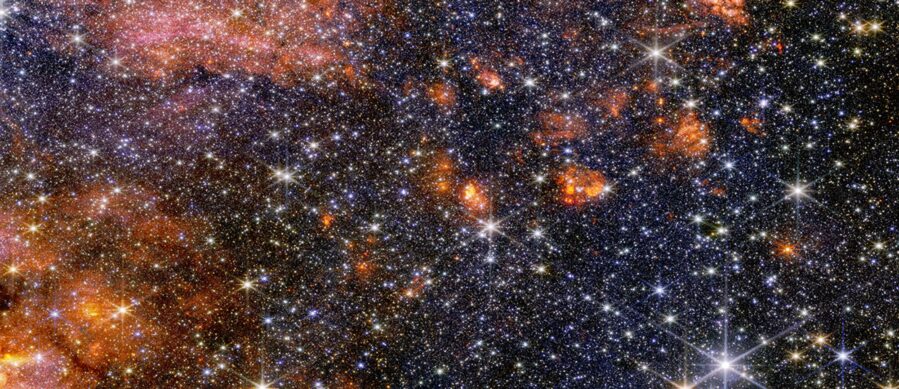
In a cosmic puzzle that challenges our understanding of stellar birth, NASA’s James Webb Space Telescope has revealed why the galaxy’s most massive star-forming region dramatically outperforms its neighbors. The Sagittarius B2 molecular cloud, despite containing just 10 percent of the galactic center’s raw materials, somehow manufactures half of all new stars in that chaotic region near our galaxy’s supermassive black hole.
The findings expose a striking paradox at the heart of the Milky Way, where vast reserves of star-making gas and dust sit largely idle while one particular cloud works overtime. Webb’s infrared vision has penetrated the thick cosmic fog surrounding Sagittarius A*, the 4-million-solar-mass black hole that anchors our galaxy, revealing details that previous telescopes couldn’t capture through the dense interstellar medium.
“Webb’s powerful infrared instruments provide detail we’ve never been able to see before, which will help us to understand some of the still-elusive mysteries of massive star formation and why Sagittarius B2 is so much more active than the rest of the galactic center,” said astronomer Adam Ginsburg of the University of Florida, principal investigator of the program.
Dark Clouds Hide Future Stars
What makes Webb’s imagery particularly striking are the areas it cannot see through at all. These seemingly empty black voids represent regions so dense with gas and dust that even the space telescope’s sensitive instruments hit a wall. Those impenetrable cocoons harbor the raw ingredients for future stellar generations, compressed into volumes where gravity will eventually ignite nuclear fusion.
The telescope’s dual-instrument approach reveals dramatically different perspectives of the same cosmic real estate. Webb’s Near-Infrared Camera captures a colorful stellar census, showing mature stars punctuated by bright gas clouds. Switch to the Mid-Infrared Instrument, however, and those same stars largely vanish while warm dust heated by young, massive stellar newborns dominates the view.
Located just a few hundred light-years from Sagittarius A*, the Sagittarius B2 region operates within one of the galaxy’s most extreme environments. Intense magnetic fields, gravitational forces from the central black hole, and radiation from countless nearby stars create conditions unlike anywhere else in the Milky Way’s spiral arms.
Galactic Center’s Stellar Drought
The efficiency disparity between Sagittarius B2 and its surroundings represents one of astronomy’s persistent mysteries. Traditional models suggest that regions packed with gas should be stellar factories, yet the galactic center’s overall productivity lags far behind theoretical predictions. Something appears to be suppressing star formation across most of the inner galaxy while allowing Sagittarius B2 to thrive.
Webb’s Mid-Infrared Instrument has revealed Sagittarius B2 North, the reddest region in the telescope’s imagery, with unprecedented clarity. This area ranks among the most molecularly complex regions known to science, containing dozens of different chemical compounds that serve as building blocks for planetary systems and potentially life itself.
“Humans have been studying the stars for thousands of years, and there is still a lot to understand,” said Nazar Budaiev, a graduate student at the University of Florida and the co-principal investigator of the study. “For everything new Webb is showing us, there are also new mysteries to explore, and it’s exciting to be a part of that ongoing discovery.”
The research team plans to analyze the masses and ages of individual stars within Webb’s high-resolution images, data that could reveal whether Sagittarius B2’s burst of activity represents a recent trigger event or a sustained process spanning millions of years. Understanding the timeline could explain why this particular cloud succeeds where others struggle.
These observations mark another step in Webb’s broader mission to decode stellar birth across cosmic history. The telescope’s ability to peer through dust that blocks visible light has already revolutionized our understanding of how the first stars formed in the early universe. Now it’s applying those same capabilities closer to home, revealing that even our own galaxy harbors fundamental mysteries about how stars come to life.