

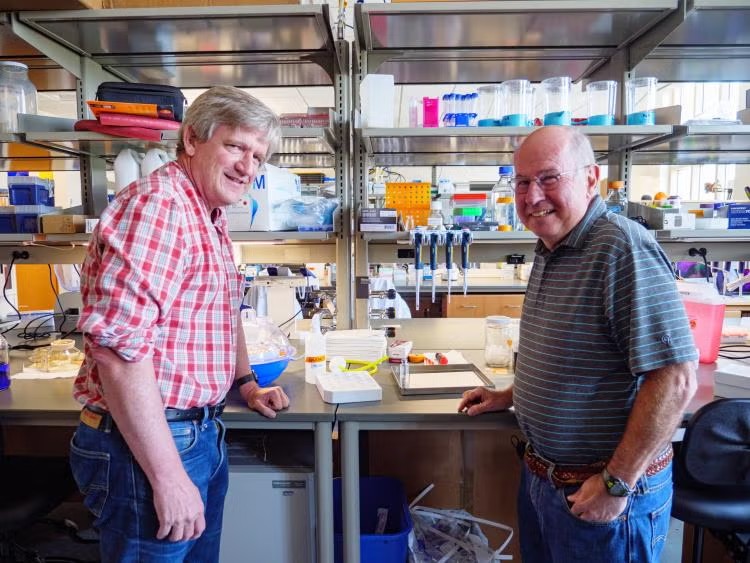
What if a life-saving vaccine could survive a power outage in rural India, withstand 104-degree heat for months, and work with just one injection instead of five? That’s exactly what researchers at the University of Colorado Boulder have accomplished with their revolutionary approach to rabies prevention.
The team has developed what they playfully call “sapphire-coated Jolly Ranchers” – vaccine particles that could transform how the world fights a disease that kills 60,000 people annually, mostly in developing countries where traditional vaccines can’t survive without refrigeration.
The Cold Chain Problem
Current rabies vaccines face a brutal reality: they must stay cold or they turn into useless protein clumps. Ted Randolph, a professor in CU Boulder’s Department of Chemical and Biological Engineering who led the research, puts it bluntly: “The proteins basically want to make cheese. You have to keep them from making cheese for long enough that you can manufacture the vaccines, get them to pharmacies and hospitals, and get them to patients.”
This refrigeration requirement, known as the cold chain, creates an impossible barrier in regions lacking reliable electricity. A single power outage can destroy vaccine supplies for entire communities. Even worse, traditional rabies treatment requires three to five separate doses at precise intervals – a logistical nightmare in areas where reaching a clinic once is already challenging.
The new approach sidesteps these problems entirely. Published in the Journal of Pharmaceutical Sciences in August 2025, the method creates vaccines that remain stable at temperatures up to 104 degrees Fahrenheit for at least three months.
The manufacturing process reads like science fiction. Researchers spray sugar solutions containing inactivated rabies viruses through specialized nozzles, creating a fine mist that dries into candy-like microparticles. The virus proteins become trapped in this glassy coating, preserved like insects in amber.
“We’re basically making sapphire-coated Jolly Ranchers,” Randolph said.
The real innovation comes next. Using atomic layer deposition – a precise coating technique developed by CU Boulder colleagues Alan Weimer and Steven George – the team wraps each particle in a nanoscopic layer of aluminum oxide, essentially sapphire. This coating dissolves slowly once injected, releasing vaccine doses over days or weeks depending on the coating thickness.
Better Than the Original
The results from mouse studies suggest these engineered vaccines aren’t just more convenient – they’re more effective. Single injections of the spray-dried, sapphire-coated particles generated immune responses nearly ten times stronger than multiple doses of conventional liquid vaccines.
“You can now take these vaccines to places without refrigeration, and even to places that get hot,” Randolph said. “So transportation through rural India or wherever you’re going is no longer a problem.”
The implications extend far beyond rabies. The same technology could potentially be applied to vaccines for human papillomavirus (HPV) and HIV, addressing similar distribution challenges that limit global health initiatives.
Randolph and his colleague Robert Garcea have formed VitriVax, a startup company aimed at bringing this decades-long research project to market. Human clinical trials remain at least two years away, but the early animal results have exceeded expectations.
The timing couldn’t be more crucial. While rabies deaths are rare in developed countries thanks to widespread pet vaccination and post-exposure treatment availability, the disease remains a persistent threat in rural Asia and Africa. Most victims are children who encounter infected dogs or bats and cannot access the multi-dose treatment regimen in time.
This temperature-stable, single-dose approach could finally make rabies prevention accessible in the world’s most vulnerable regions. As Randolph reflects on the 25-year journey from concept to potential product: “It’s the kind of thing that does require long-term dedication, work and funding. We think the implications of this are huge.”
The next challenge will be proving these impressive laboratory results translate to human protection – but for communities where vaccine storage has been impossible, even the possibility represents hope for a disease that has claimed lives for millennia.
Journal of Pharmaceutical Sciences: 10.1016/j.xphs.2025.xx.xxx