

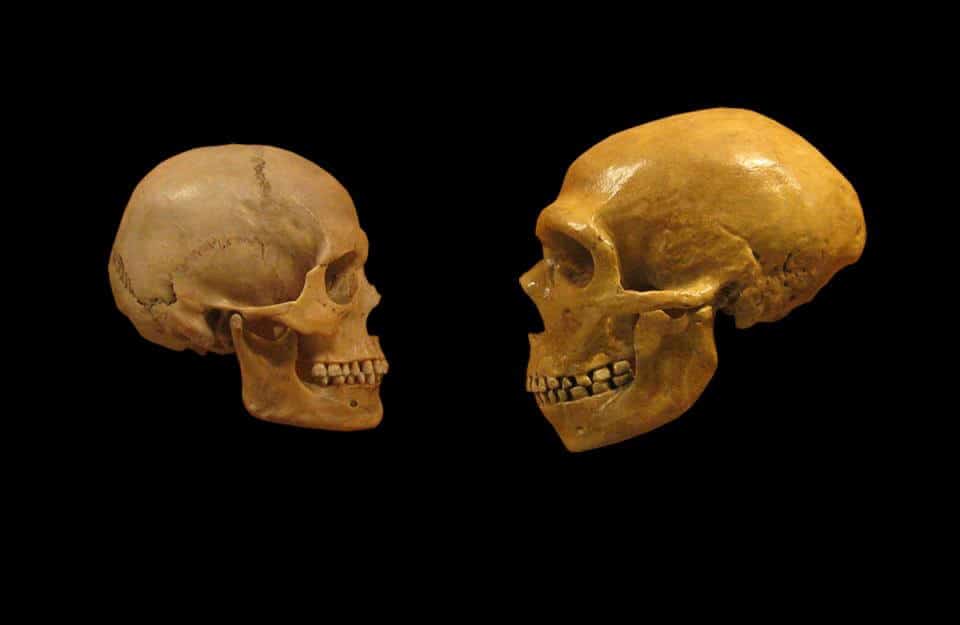
For decades, scientists have wondered how our faces became so distinct from those of our ancient cousins. A new study offers an elegant clue, showing that a handful of Neanderthal DNA changes can subtly alter gene activity during facial development, shaping the size of the lower jaw. The research, published today in Development, bridges ancient genomics and developmental biology to trace how small genetic tweaks may have sculpted evolutionary differences in hominin faces.
Researchers at the MRC Human Genetics Unit at the University of Edinburgh focused on a 3,000-letter stretch of DNA that controls a powerful developmental gene called SOX9. Although this region contains no genes itself, it acts as a genetic switch that determines when and where SOX9 turns on, particularly in tissues that form the jaw. By comparing modern human and Neanderthal DNA, the team discovered three single-letter differences that change how strongly the switch activates. To test the effect, they inserted both versions into zebrafish embryos, whose transparent bodies reveal facial structures as they form in real time.
“It was very exciting when we first observed activity in the developing zebrafish face in a specific cell population close to the developing jaw, and even more so when we observed that the Neanderthal-specific differences could change its activity in development,” said study leader Hannah Long.
The Neanderthal DNA sequence consistently drove higher gene activity than the human version. In practical terms, that means the Neanderthal enhancer was better at boosting SOX9 in cells that eventually form cartilage and bone. When the researchers mimicked this effect by providing zebrafish embryos with extra SOX9, the animals developed slightly larger jaw precursors. The finding suggests that Neanderthal faces may have evolved in part from subtle increases in SOX9 activity during a narrow developmental window.
Ancient Clues Hidden in Regulatory DNA
Unlike mutations in protein-coding genes, which often have dramatic effects, changes in regulatory DNA tend to shift development with finer precision. The three Neanderthal variants occur within a region known as EC1.45, a cluster of enhancers located 1.45 megabases upstream of SOX9. Deleting this region in humans causes Pierre Robin sequence, a congenital disorder marked by an unusually small lower jaw. That connection helped the Edinburgh team zero in on EC1.45 as a candidate region where small evolutionary differences could have large aesthetic consequences.
Using a dual-color fluorescent system, the scientists tracked where and when each enhancer turned on during zebrafish development. Both human and Neanderthal versions activated in neural crest cells—the migratory progenitors that build most of the face—but the Neanderthal enhancer glowed more intensely. Single-cell RNA sequencing confirmed that these active cells expressed markers linked to cartilage formation. The increased enhancer strength appears to arise from altered transcription factor binding, possibly involving SOX9 itself or related regulators.
“By studying extinct species, we can learn how our own DNA contributes to face variation, development and evolution,” said Long. “We hope this will inform our understanding of sequence changes in people with facial conditions and inform diagnosis.”
How Small Differences Shaped Distinct Faces
The implications extend beyond ancient anthropology. The work illustrates how three small mutations, preserved across millennia, can modulate the choreography of gene regulation to influence anatomy. Neanderthals’ pronounced jaws and robust facial bones may reflect precisely this kind of fine-tuned genetic adjustment. Because SOX9 plays roles in cartilage and bone formation across vertebrates, its regulation offers a powerful lens into both normal variation and craniofacial disease.
The study also underscores how developmental enhancers act like dimmer switches, not on-off buttons. Slightly brighter activity at the wrong moment or in the wrong tissue can subtly change shape without disrupting function—a process evolution has exploited repeatedly. For humans, inheriting just one such tweak from our Neanderthal ancestors could have left faint molecular traces in our own facial diversity.
As the researchers expand their work, they plan to test additional Neanderthal variants scattered throughout the SOX9 locus and beyond. Each might tell a small part of the larger story of how genes sculpted the faces staring back at us from ancient fossils—and, perhaps, in the mirror.