
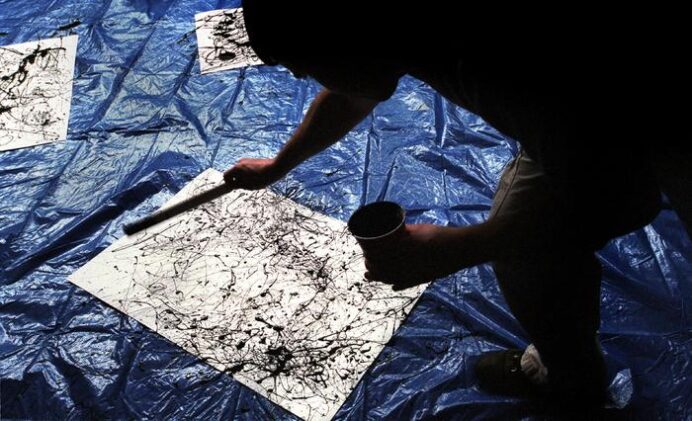
In a quiet physics lab, paint arced through the air and spattered onto paper, revealing something unexpected about how children move, balance, and create. New research from the University of Oregon shows that when kids try Jackson Pollock’s famous pour painting technique, the hidden structures in their splashes look uncannily close to the artist’s own.
The experimental study, published in Frontiers in Physics by a US based team, compared pour paintings from 18 children aged four to six and 34 adults aged 18 to 25 using fractal and lacunarity analysis, two mathematical tools for describing complex patterns. Led by University of Oregon physicist and artist Prof Richard Taylor, the team found that children produced simpler trajectories, larger gaps between paint clusters, and more clustered fine scale structures. Adults created denser, more varied paint paths. The core finding was that children’s pattern signatures aligned more closely with those measured in a Pollock painting than the adults’ did.
The Strange Signatures Hidden in a Splash of Paint
“Our study shows that the artistic patterns generated by children are distinguishable from those created by adults when using the pouring technique made famous by Jackson Pollock.”
Participants stood over large sheets of paper and used diluted vinyl paint dropped from mixing sticks to recreate Pollock like pours. Because adults have more developed biomechanical balance and produce frequent fine scale corrective motions, their splatters contained richer, more intricate fractal structures. Children, whose balance systems are still developing, tended to create long, smooth, one dimensional lines with fewer directional changes.
Lacunarity analysis revealed even more striking differences. Children’s works had higher lacunarity values, meaning their splatter fields contained bigger and more variable gaps. Adults’ patterns were more uniformly filled. When these signatures were compared to two historical works Jackson Pollock’s “Number 14” and Max Ernst’s poured “Young Man Intrigued by the Flight of a Non Euclidean Fly” Pollock’s landed just inside the adult range, close enough to the children’s distribution that his limited biomechanical balance, noted by art historians, offered a plausible explanation.
Why Children’s Pollock Like Paintings Feel Pleasant to Look At
“Remarkably, our findings suggest that children’s paintings bear a closer resemblance to Pollock paintings than those created by adults.”
A separate perception experiment added a human dimension. When adults rated a subset of the pour paintings for complexity, interest, and pleasantness, works with more open gaps and less dense fractal detail scored higher on pleasantness. Since the children’s paintings naturally exhibited those qualities, the researchers suggest that young artists may unintentionally create patterns that resonate with the visual fluency our brains developed through exposure to nature’s fractals.
The results also hint at deeper questions. If movement, balance, and motor development shape the invisible geometry of poured paint, then an artist’s physical constraints may imprint themselves onto their work in subtle ways. Pollock’s own challenges with balance, like Monet’s cataracts or van Gogh’s psychological struggles, become part of the story of how masterpieces are made. The authors hope future experiments using motion sensors will directly test those biomechanical links and expand lacunarity analysis to other artists who worked in this unconventional medium.
Frontiers in Physics, DOI 10.3389/fphy.2025.1673780
ScienceBlog.com has no paywalls, no sponsored content, and no agenda beyond getting the science right. Every story here is written to inform, not to impress an advertiser or push a point of view.
Good science journalism takes time — reading the papers, checking the claims, finding researchers who can put findings in context. We do that work because we think it matters.
If you find this site useful, consider supporting it with a donation. Even a few dollars a month helps keep the coverage independent and free for everyone.