

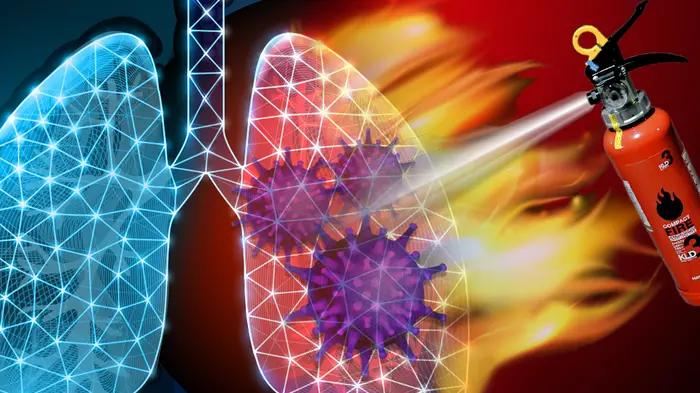
The antibiotic era is starting to fray at the edges, and the lungs are one of the places where that rupture shows up fastest. In a new study in Nature Biotechnology, researchers at the Icahn School of Medicine at Mount Sinai describe an experimental mRNA therapy that helps mouse and human lung tissues clear multidrug-resistant pneumonia while dialing down the inflammation that usually tears those tissues apart.
Rewriting The Rules Of Antimicrobial Peptides
Antimicrobial peptides (AMPs) are the immune system’s pocket knives. They are broad spectrum, hard for bacteria to outsmart, and already scattered through our tissues and secretions. Yet in practice, they have mostly been stuck in the realm of topical creams and lab experiments, held back by short half-lives, toxicity worries, and poor targeting in deep organs like the lung.
The Mount Sinai team did not simply inject more of the same molecules. Instead, they rebuilt AMPs into a new format they call a peptibody. Each peptibody stitches together three pieces: an AMP that can puncture bacterial membranes, a cathelin domain that keeps that AMP switched off until it reaches an inflamed infection site, and a fragment crystallizable (Fc) domain that resembles the tail of an antibody.
The design is intentionally modular. Proteases released by neutrophils and macrophages at infection sites cleave the cathelin domain, freeing the AMP only where bacteria and inflammation are already raging. At the same time, the Fc domain engages Fc receptors on immune cells such as macrophages and neutrophils, encouraging them to engulf and destroy bacteria more efficiently.
In head-to-head tests against multidrug-resistant Staphylococcus aureus and Pseudomonas aeruginosa, a panel of ten peptibodies showed broad antibacterial activity once activated. The team settled on one based on the human AMP LL37, dubbed PB9, for deeper study. PB9 bound tightly to both bacterial species, boosted phagocytosis by alveolar macrophages, and drove roughly 50 percent clearance of intracellular bacteria at 6 and 12 hours, while the original LL37 peptide showed only limited intracellular killing.
“Our work suggests there may be a new path to tackling antibiotic-resistant infections by supporting the immune system more directly,” said Xucheng Hou, PhD, a lead author of the study at Icahn Mount Sinai.
Those gains depended on the Fc domain doing its job. In macrophages that lacked Fc receptors, phagocytic uptake and intracellular killing dropped, underscoring that PB9 is not just a more stable AMP, but a way to recruit cellular immunity into the fight.
A Dual-Action Attack In Diseased Lungs
Engineering a smarter peptide still leaves a familiar obstacle: getting it into the right lung cells, in the right amounts, without setting off the very inflammation the therapy aims to tame. Here, the group leaned on the same basic playbook used in COVID-19 vaccines, but with a twist.
They encoded PB9 as mRNA and packaged it inside a custom lipid nanoparticle called TS41S. This particle not only ferries mRNA into lung cells after intratracheal delivery, it also scavenges reactive oxygen species, the small, destructive molecules that help drive runaway inflammation in severe pneumonia.
Across mouse lung epithelial cells, endothelial cells, macrophages, and neutrophils, TS41S nanoparticles delivered far more mRNA than several clinically used lipids, while largely confining expression to the lung. In animals with pneumonia induced by multidrug-resistant S. aureus and P. aeruginosa, TS41S treatment lowered reactive oxygen species in neutrophils and macrophages, reduced neutrophil influx into the airspaces, and cut levels of proinflammatory cytokines including interleukin 1 beta, interleukin 6, tumor necrosis factor, and interferon gamma.
Expression kinetics favored the peptibody as well. In mouse lungs, LL37 mRNA produced a quick early spike that faded by 48 hours. PB9 mRNA peaked later but reached higher concentrations and remained detectable at about 6 micrograms per lung two days after dosing, yielding a 5.4-fold greater overall exposure than LL37.
Most importantly, those molecular gains showed up where it matters: survival and bacterial counts. In an acute S. aureus pneumonia model, mice treated with TS41S PB9 mRNA lost the least weight and had 80 percent survival over 14 days. All animals that received PBS, ciprofloxacin, or control luciferase mRNA reached the endpoint within 48 hours, and only one of five survived in the LL37 mRNA group. Lung bacterial loads dropped to 3.3 × 10^4 colony-forming units per milliliter, about four orders of magnitude lower than in LL37-treated mice, and far below ciprofloxacin and other controls.
In a harsher coinfection model with both S. aureus and P. aeruginosa, more than 75 percent of PB9 mRNA treated mice were still alive at 14 days, compared with complete mortality within 36 hours in PBS and ciprofloxacin groups. Histology told the same story: lungs from treated animals showed preserved alveolar architecture and far less inflammatory cell infiltration, resembling healthy controls.
Repeated dosing raised the obvious safety questions. Here too the results were reassuring in mice: three intratracheal doses of TS41S PB9 mRNA produced minimal systemic cytokine changes, normal liver and kidney markers, no detectable anti-cathelicidin antibodies, and no tissue damage in lung or other major organs on histology.
Hint Of Human Translation, And A Flexible Platform
To push beyond mouse models, the team turned to human lung slices and blood derived macrophages. TS41S nanoparticles carrying GFP mRNA lit up about 27 percent of CD45 negative cells and nearly 9 percent of CD45 positive immune cells in human lung tissue ex vivo, with no signal in untreated slices. In parallel, PB9 enhanced killing of S. aureus and P. aeruginosa by human monocyte derived macrophages and protected those cells under oxidative stress better than a comparator lipid.
“This is the first evidence that an mRNA-encoded antimicrobial peptide can directly kill bacteria while also turning on the immune system’s protective responses,” said senior author Yizhou Dong, PhD.
The authors are careful to frame this work as a starting point rather than a ready made drug. They sketch out obvious next steps that stay within the same design logic: codon optimization and circular RNA to fine tune and prolong expression of different peptibodies, tweaks to lipid components or surface ligands to target organs beyond the lung, and deeper studies of inhalation delivery, long term safety, and immune responses with repeated dosing.
Still, the core idea is already clear. Instead of asking existing antibiotics to do ever more heroic work against resistant bacteria, this strategy uses mRNA and nanomaterials to let the lung make its own engineered antimicrobial proteins, then pairs that with direct control over the inflammatory damage that usually follows. It is an experiment in teaching the immune system a new trick, right where multidrug-resistant pneumonia hits hardest.
Journal: Nature Biotechnology
Article: “Antimicrobial peptide delivery to lung as peptibody mRNA in anti-inflammatory lipids treats multidrug-resistant bacterial pneumonia”
DOI: 10.1038/s41587-025-02928-x