

Sometimes the path to smarter machines begins with a single photon making a different choice. In a new study in the journal “Advanced Photonics,” an international team shows how a photonic quantum convolutional neural network, or PQCNN, can be built from existing hardware and gently steered by a simple adaptive trick called state injection. The result is a light based quantum network that classifies tiny images with better than 90 percent accuracy while using far fewer operations than its classical cousins.
Convolutional neural networks are the workhorses of modern pattern recognition, from image search to voice assistants. A quantum version aims to use quantum states instead of classical bits, potentially gaining speed or efficiency. Photons are attractive carriers for that job, since they are fast, relatively robust, and can be routed through compact interferometer chips. The difficulty is that standard photonic circuits behave linearly. They mix light, but they do not easily condition their behavior on intermediate results, which is exactly what a neural network wants to do.
Turning Linear Optics Into A Quantum Neural Network
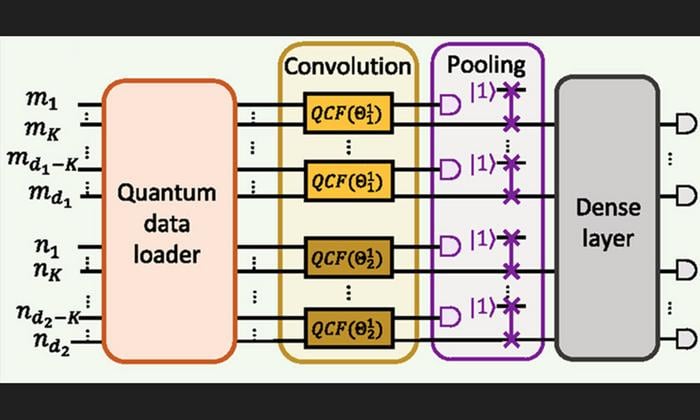
The new architecture, called a photonic quantum convolutional neural network, starts with a quantum data loader. Classical data, in this case simple 4 × 4 pixel images of horizontal or vertical bars, are encoded into the amplitudes of single photons spread across different optical modes. This tensor encoding creates a structured quantum state that still remembers the layout of pixels across rows and columns.
From there, the PQCNN mirrors the structure of a classical convolutional neural network. Linear optical layers of beam splitters act as quantum convolutional filters, redistributing photon amplitudes in ways that correspond to learned feature extraction. Because the scheme preserves photon number, it aligns with a class of Hamming weight preserving quantum circuits that are known to train more reliably, avoiding the “barren plateau” problem where gradients vanish and learning stalls.
The key twist arrives in the pooling layer. Instead of simply discarding information, the circuit measures selected modes and, when a photon is detected, conditionally injects a new photon into a neighboring mode. That measurement based state injection provides an effective nonlinearity without abandoning linear optics as the underlying platform. It also keeps the photon count low, so the architecture remains compatible with noisy intermediate scale devices rather than hypothetical large scale fault tolerant machines.
The introduced PQCNN establishes a direct relationship between the features of Hamming weight preserving circuits, which provide advantages against the barren plateaus often affecting the training of quantum machine learning protocols, and linear optical ones, equipping the latter with nonlinearities coming from the recently introduced photonic state injection technique.
“This work provides both a theoretical framework and a proof-of-concept implementation of a photonic QCNN,” says senior author Fabio Sciarrino. “We expect these results to serve as a starting point for developing new quantum machine learning methods.”
Building And Testing A Modular Quantum Network In Light
To move beyond theory, the team implemented their PQCNN on a hybrid platform they call QOLOSSUS 2. Single photons were generated from a quantum dot source housed in a cryostat and then routed through a temporal to spatial demultiplexer that synchronized them into multiple paths. Those photons were injected into two programmable integrated interferometers, one with eight modes and one with twelve, fabricated by femtosecond laser writing and controlled by dozens of thermo optic phase shifters.
Because current integrated devices cannot yet perform fast, low loss switching with full coherence, the researchers emulated adaptive state injection through a careful post selection procedure. They ran separate experiments for the different pooling outcomes, such as zero, one, or two photons detected in pooling modes, and then combined the resulting distributions with the correct probabilities. That work around reproduces the statistics of genuine adaptive behavior while staying within the reach of existing chips and detectors.
At each stage, from the quantum data loader through the convolutional and pooling layers to the dense output layer, the team compared experimental photon statistics with theoretical predictions. Similarities were consistently high, often above 0.97, which indicates tight control over the optical circuits. When the full PQCNN was trained on a customized bars and stripes dataset, it reached training accuracies around 91 percent and test accuracies around 93 percent, closely matching classical simulations of the same architecture.
Polynomial Speedups And A Path To Scalable Hardware
Beyond the proof of concept, the work analyzes how the photonic architecture scales. Classical convolutional networks require a number of operations that grows with both the filter size and the total number of pixels. In contrast, the PQCNN’s convolutional layer scales only with the filter dimension, and its pooling and dense layers can be designed so that the total number of quantum operations grows more gently with problem size. The authors argue that this yields a polynomial advantage in resource complexity over comparable classical networks, especially as input tensors get higher dimensional.
The current experiment classifies tiny images with just two photons and a single pooling step. The same design principles, however, can be extended to larger images and more complex datasets, and the team has already simulated performance on 8 × 8 versions of MNIST style digits. The main hardware hurdles are familiar ones in photonic quantum computing. Future devices will need low loss, coherent connections between chips, faster reconfigurable elements, and rapid optical switching that can respond in real time to single photon detections without destroying the delicate quantum state.
For now, the message is that a single adaptive ingredient can turn otherwise linear photonic hardware into a functioning quantum neural network. The photons still travel through interferometers and beam splitters, but at key moments the circuit listens to what they say and quietly changes course. That modest form of feedback may be enough to bring practical quantum machine learning a step closer.
Study: “Photonic quantum convolutional neural networks with adaptive state injection,” Advanced Photonics (2025), DOI 10.1117/1.AP.7.6.066012.
