

Feeling too sick to socialize might not just be exhaustion talking. According to new research, it is a precisely wired conversation between the immune system and a specific set of brain cells that tells animals to pull away from the group.
In a study published in Cell on November 25, 2025, scientists at MITs Picower Institute for Learning and Memory and collaborators at Harvard Medical School describe how the immune molecule interleukin 1 beta (IL 1β) acts on IL 1 receptor 1 expressing neurons in the brains dorsal raphe nucleus to shut down social behavior in mice. By tracing this signal through its downstream circuit, they show that social withdrawal during sickness is an actively generated behavior, not just a side effect of feeling awful.
A Cytokine That Makes Mice Walk Away
The team started with a basic puzzle. Infections are known to change behavior across the animal kingdom, often leading to isolation that can protect the group from contagion. But is that withdrawal imposed by others, or is it a self generated choice the brain makes when the body is inflamed?
To get specific, lead author Liu Yang and colleagues injected 21 different cytokines directly into the brains of mice, one at a time, and watched how the animals behaved in a sociability test. Only one molecule, IL 1β, reproduced the full sickness like pattern they see when mice are given lipopolysaccharide (LPS), a standard way of mimicking bacterial infection. After IL 1β, the animals became sluggish, but they also made a striking choice: they stopped spending time near another mouse and instead drifted toward an inanimate object.
That dissociation became crucial. Another cytokine, IL 1α, slowed the mice down but did not make them less social. So whatever IL 1β was doing, it was not just turning down locomotion. It was changing the animals interest in company.
Finding The Neurons That Hear The Immune System
Next the researchers needed to locate which brain cells were listening to IL 1β. Using a knock in mouse line that tags IL 1 receptor 1 expression with fluorescent markers, they mapped where the receptor appears. Several regions lit up, but one stood out: the dorsal raphe nucleus, or DRN, a midbrain hub known to modulate social behavior and to be bathed in cerebrospinal fluid that can carry cytokines.
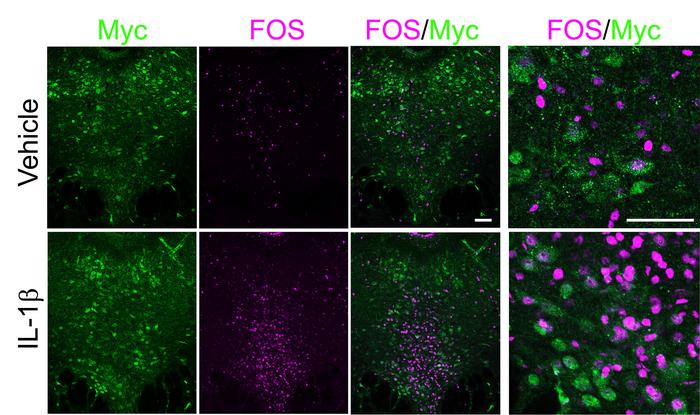
Within the DRN, most IL 1R1 positive neurons turned out to be serotonergic cells, the kind that produce the neuromodulator serotonin. When the team delivered IL 1β into the DRN, these neurons showed robust activation, measured by a surge in the immediate early gene FOS and by calcium imaging signals that spiked and stayed elevated after the cytokine hit.
From there, the experiments became a series of causal tests. Using chemogenetic tools that allow precise activation of specific neurons, the scientists turned on IL 1R1 expressing DRN serotonergic cells without giving any cytokine at all. Mice with these neurons artificially switched on abruptly reduced the time they spent near another mouse and showed the same social withdrawal pattern seen with IL 1β.
“Our findings show that social isolation following immune challenge is self imposed and driven by an active neural process, rather than a secondary consequence of physiological symptoms of sickness, such as lethargy,” said study co senior author Gloria Choi, associate professor in The Picower Institute and MITs Department of Brain and Cognitive Sciences.
In the reverse experiment, the team used inhibitory chemogenetic receptors to silence IL 1R1 DRN neurons while giving mice IL 1β. Now, even though the animals still moved less, they no longer abandoned the social zone. Knocking out the IL 1 receptor specifically in DRN serotonergic neurons produced the same rescue of social behavior after IL 1β or LPS.
A Circuit For Self Imposed Isolation
Identifying the neurons was only half the story. The next question was where they send their signals. By expressing light sensitive proteins in IL 1R1 DRN neurons and tracing their axons, the scientists found projections into several regions associated with social behavior, including the nucleus accumbens, the central amygdala, and a structure called the intermediate lateral septum.
Optogenetic tests made the key connection. Activating the DRN cells own bodies reduced sociability and movement, as expected. But when the team selectively stimulated only their projections in different downstream targets, only one pathway reliably shut down social behavior without affecting locomotion: the projection from IL 1R1 DRN neurons to the intermediate lateral septum.
Finally, the group asked what happens in a more naturalistic setting, where mice live with familiar cage mates in a home cage with shared shelters. After IL 1β or LPS, subject animals gradually stopped huddling with others and spent long stretches alone, often outside the shelters, even though cage mates did not push them away. Activating IL 1R1 DRN neurons chemogenetically produced the same pattern of isolation. Silencing those neurons, or deleting IL 1R1 from them, pulled sick animals back into the group.
“Collectively, these results reveal a role for IL 1R1 expressing DRN neurons in mediating social withdrawal in response to IL 1β during systemic immune challenge,” the researchers wrote.
Separating Lethargy From Loneliness
One of the most important threads running through the study is the clean split between social behavior and other sickness symptoms. Hyperthermia from IL 1β rose quickly, while social withdrawal appeared later. Lethargy persisted even when IL 1R1 DRN neurons were silenced. Other cytokines, including TNF alpha, interferon alpha, and IL 6, were upregulated and may help drive reduced activity.
By contrast, the DRN pathway to the lateral septum seemed tuned specifically to social withdrawal. That specificity matters because it suggests the brain is not passively shutting down all functions when the body is inflamed. It is making targeted choices about which behaviors to suppress and which to preserve, potentially balancing the need to conserve energy, fight infection, and protect the social group.
The work leaves open questions about how serotonin signaling and different receptor subtypes shape these responses, and whether IL 1R1 DRN neurons act as a broader coordinator of sickness related behaviors beyond social withdrawal. But it already reframes something very familiar. The next time infection makes an animal or a person pull back from others, this study suggests that a small population of cytokine sensitive neurons in the dorsal raphe nucleus may be quietly deciding that solitude is the safest move.
Journal: Cell
DOI: 10.1016/j.cell.2025.10.040