

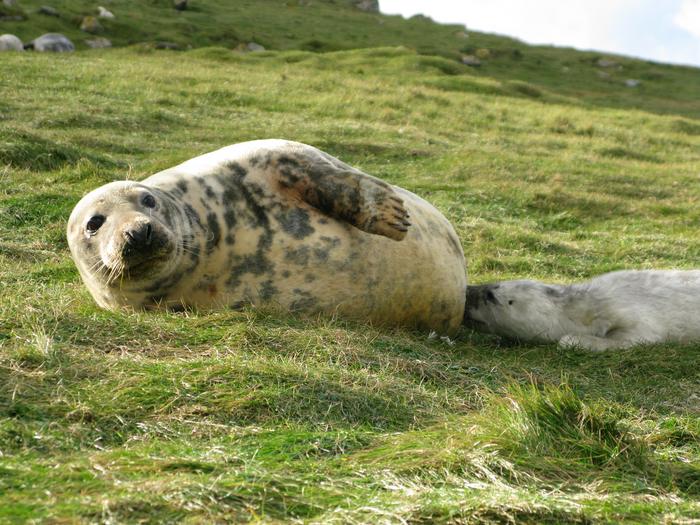
A grey seal pup has just 17 days to drink its way into a dangerous ocean, and its mother’s milk is wired for that deadline. In a new Nature Communications study, researchers at the University of Gothenburg show that Atlantic grey seal milk carries roughly one third more distinct sugar molecules than human breast milk, including many giants never seen before, and that its chemistry shifts in lockstep with the pup’s crash course in survival.
These sugars, known as milk oligosaccharides, are not about calories. They are intricate carbohydrates that help train the immune system, feed gut microbes, and keep pathogens at bay. Human milk has long been treated as the pinnacle of this molecular engineering. The new work argues that wild marine mammals, living fast under brutal pressure, have been quietly running an even more elaborate program.
A 17-Day Crash Course In Survival
The team followed five wild Atlantic grey seals off the coast of Scotland through their entire lactation period. Grey seal mothers nurse for about 17 days, then abruptly wean, leaving pups alone on stormy beaches while they finish molting and face the North Atlantic with no further help. That compressed timeline makes every molecular decision in the milk count.
Using a battery of high-resolution mass spectrometry methods, the researchers built a structural map of the “free” milk oligosaccharides that float in the watery fraction of the milk rather than being attached to proteins. Across 20 samples, they catalogued 332 distinct structures and fully resolved 240 of them. Human milk, by comparison, is currently known to contain about 250 unique oligosaccharides overall, and any one sample holds fewer than that.
“Our analysis shows that grey seal milk is extraordinary. We identified 332 different sugar molecules, or sugars, compared to about 250 in breast milk. Two-thirds were completely unknown previously. Some of these molecules had a previously unseen size of 28 sugar units, which exceeds the largest known sugar units in breast milk, which are 18 units in size,” says Daniel Bojar, senior lecturer in bioinformatics.
Those giant structures, some stretching to 28 linked sugar building blocks, are among the largest non-polymer glycans reported in any mammal. Many are heavily branched chains built from repeating lactose-like units that are then decorated with fucose, sialic acid, and sulfate. The result is a forest of potential binding sites for viruses, bacteria, and immune receptors, all suspended in a liquid the pup swallows in gulps.
Milk Chemistry That Moves With Time
Because the same seals were sampled repeatedly, the team could ask not just what is in the milk, but how that molecular library changes day by day. When they clustered the data, samples grouped almost perfectly by lactation day rather than by individual mother, a sign that a shared program is at work.
Some classes of sugars appeared only in early milk, then faded. Others remained stable throughout. A third set was almost absent at the start and rose sharply toward weaning. Late-appearing structures included sulfated, keratan sulfate-like chains that resemble the glycans used in mucosal barriers and growth factor signaling, hinting at a shift toward protecting tissues and tuning development as the pup nears independence.
The researchers also had metabolomics data from the very same milk, covering hundreds of lipids and small molecules. When they compared the two layers, features of the glycome strongly tracked changes in the metabolome. Certain oligosaccharide motifs correlated tightly with membrane lipids and fatty acid derivatives, suggesting that energy delivery via milk fat and immune or developmental cues via sugars are being co-regulated rather than drifting independently.
Yet when they asked which dataset best predicted where a sample fell in the 17-day window, the sugars won. The overall pattern of oligosaccharides carried more information about lactation stage than the broader metabolome, despite the metabolome having many more features. In simple terms, the fine structure of the milk’s sugars seems to be one of the clearest signatures of where a pup is in its brief nursing life.
Sugars That Talk To Immune Cells And Bacteria
To test what some of these newly highlighted motifs actually do, the team stepped out of the seal system and into a human cell model. They focused on LacdiNAc, a two-sugar unit that appeared frequently in seal milk and has been popping up in other mammals’ milk glycans as well. LacdiNAc is almost chemically identical to the better known LacNAc, differing by only one N-acetyl group, but that tiny tweak turned out to matter.
When the researchers added LacdiNAc-containing structures to human macrophages that had been pushed into a pro-inflammatory state, the cells dialed up anti-inflammatory cytokines such as IL-10 and CCL17. In macrophages steered toward a different activation state, the same motif damped production of classic inflammatory mediators including IL-12 and IL-23. LacNAc did not show the same pattern. The study suggests that immune receptors on these cells are tuned closely enough to tell those two sugar motifs apart and respond differently.
They then turned to bacteria. In lab dishes, LacdiNAc significantly reduced biofilm formation by Staphylococcus aureus and Streptococcus agalactiae, and both LacdiNAc and LacNAc disrupted biofilms of Klebsiella pneumoniae, without slowing bacterial growth. That is an intriguing combination for future therapies, because it suggests a way to block the sticky communities that make infections hard to treat, without directly selecting for resistance in the same way antibiotics do.
Other newly described seal milk sugars, such as glucuronyl-lactose, also showed anti-biofilm effects in some strains. The pattern, across assays, is that minute structural edits to a sugar can flip its biological behavior, and wild mammal milk is full of such edits.
“The study highlights the untapped biomedical potential hidden in understudied wild species. Our research group is the only one in the world to analyse milk sugars from these uncharacterized mammals using mass spectrometry in that depth. We have done this for ten different mammals, and we find unique sugar molecules every time. We will continue. We have milk from another 20 mammals in the freezer,” says Daniel Bojar.
The work reframes human milk as one remarkable example in a much larger landscape. In the Atlantic grey seal, at least, milk oligosaccharides reach human-level complexity, move in a tightly choreographed pattern across an intense 17-day lactation, and carry molecules that can tune immune responses and disarm bacterial biofilms. For infant nutrition, infection control, and gut health, the next wave of ideas may come not from domestic animals or engineered libraries, but from frozen vials of milk collected on cold coasts and patiently decoded one sugar at a time.
Journal: Nature Communications