

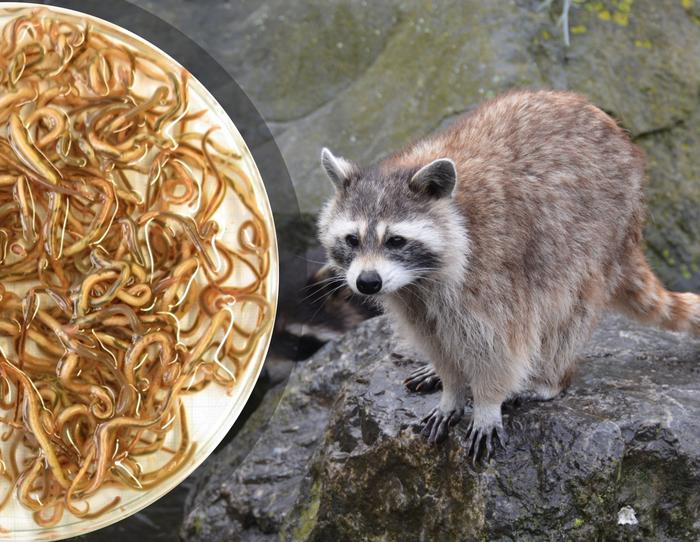
Urban raccoons rummaging through garbage bins are now a common sight in German cities. What’s not visible is what they leave behind: microscopic roundworm eggs that can survive in soil for years and cause devastating neurological damage in humans who accidentally ingest them.
New research from Goethe University Frankfurt tracking Baylisascaris procyonis across Europe reveals infection rates exceeding 96 percent in some German raccoon populations. The parasite has established itself in wild populations across nine countries, with documented cases in Austria, Czech Republic, Denmark, France, Italy, Luxembourg, the Netherlands, Poland, and Germany. Three additional countries have detected infections in captive animals.
The study, published in Parasitology Research, combined necropsy data from 146 raccoons collected between 2022 and 2024 with decades of surveillance records. In Hesse, 77.4 percent of examined raccoons carried the parasite. Thuringia and North Rhine-Westphalia showed rates of 51.1 percent and 52.9 percent respectively.
Each infected raccoon sheds the problem daily. Adult roundworms living in a raccoon’s intestine release up to 180,000 eggs per day into the environment. These accumulate at raccoon latrines, preferred defecation sites that animals return to repeatedly. The eggs become infectious within weeks and remain viable for extended periods, creating persistent contamination zones in parks, gardens, and residential areas.
What Happens When the Larvae Reach Your Brain
Human infection occurs through accidental ingestion of eggs from contaminated soil, water, or surfaces. Once inside the body, larvae hatch and begin migrating through tissues in a process called larva migrans. They don’t belong there, and the body has no effective way to stop them.
When larvae reach the eyes or central nervous system, outcomes turn severe. Vision loss, neurological damage, and in rare instances, death can result. Europe has documented only three human cases so far. All three resulted in permanent visual impairment.
“If the larvae enter the central nervous system, the disease can have severe consequences. Due to frequent hand-to-mouth contact, young children are primarily affected,” Anne Steinhoff, first author of the study, explains.
That figure of three cases almost certainly underestimates the true burden. Symptoms can be nonspecific, and Europe lacks widely available diagnostic tests. Definitive diagnosis currently requires specialized testing only available at North American centers, meaning European cases may go unrecognized or misattributed to other conditions.
The Problem Is Moving Into Cities
Raccoons are adapting to urban environments with remarkable success. They den in attics, forage in trash bins, and establish latrines in yards and playgrounds. That proximity matters because transmission requires direct or indirect contact with contaminated surfaces.
A child playing in a sandbox where a raccoon defecated the previous night. A gardener working soil near a latrine site. These scenarios are becoming more common as raccoon populations expand and overlap with human activity.
The research team argues that surveillance hasn’t kept pace with the parasite’s spread. Large portions of Europe with established raccoon populations remain understudied. Infection rates are likely higher than current data suggest, and the parasite is probably present in areas where it hasn’t been formally documented.
Professor Sven Klimpel, senior author of the study, noted that results show both geographic expansion of the roundworm’s range and persistently high infection levels in German raccoon populations. As raccoons continue establishing themselves across Europe, understanding what travels with them has shifted from wildlife curiosity to public health necessity.