

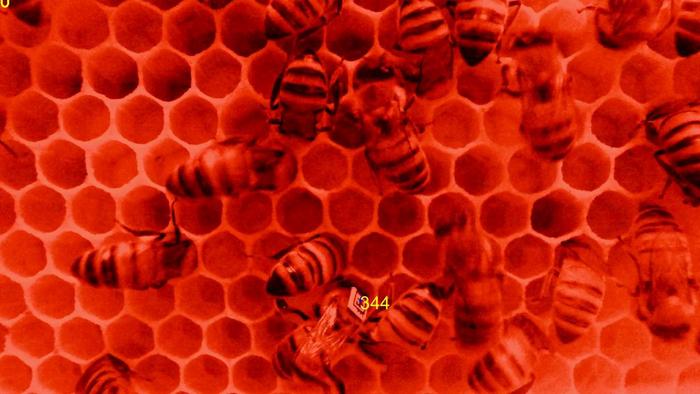
Male honeybees can’t feed themselves. They can’t digest pollen, the colony’s main protein source, so they depend entirely on worker bees to process food and hand it over through a ritualized exchange called trophallaxis. This isn’t passive waiting. Drones must approach workers, perform a specific begging sequence, and persist long enough to get fed. Miss the timing or fail to ask correctly, and starvation becomes a real possibility.
Researchers at Heinrich Heine University Dusseldorf have now traced that entire survival routine to a single gene. The study, published in Nature Communications, shows that a transcription factor called fruitless, or fru, programs how male bees coordinate the social behaviors required to secure food. When scientists disrupted the gene using CRISPR-Cas9, mutant drones lost their ability to beg effectively, even though they could still fly, groom, and sense their environment normally.
The gene is active only in males and only in a small network of about 1,800 neurons scattered across sensory processing regions of the brain. These cells bridge early sensory input from smell, taste, touch, and vision to higher-order decision-making centers. When fru was switched off, those neural circuits still formed, but the behaviors they coordinate broke down. The bees could detect other bees but failed to translate that information into the right social response.
What Breaks When the Gene Fails
The team, led by evolutionary geneticist Martin Beye, wanted to know whether complex cooperative behaviors are genetically hardwired or improvised through learning. They created knockout drones lacking functional fru and tracked their behavior inside experimental colonies. The mutants approached other bees less often, begged for food less frequently, and spent less time in successful food-sharing interactions. As a result, they received significantly less nourishment.
“Such cooperative behaviour is a complex matter in the animal kingdom, as it requires close coordination between social partners,” Beye explains. “In our research, we ask ourselves what is required to orchestrate this interaction.”
Crucially, the gene disruption didn’t make the bees clumsy or confused. They walked normally, responded to pheromones, and even performed mating-related behaviors with only limited impairment. What failed was something more specific: the mental timing and persistence needed to initiate and sustain the social actions required to get fed. Using advanced brain imaging, researchers confirmed that mutant drones could still detect odors, including queen pheromones, just as well as wild-type bees. Their physical bodies and chemical signatures remained unchanged. The disruption was purely in the neural circuitry managing social decision-making.
An Old Gene With a New Job
The evolutionary angle adds another layer. In fruit flies and other insects, fruitless is best known for hardwiring courtship and mating behaviors. In honeybees, the same gene appears to have been repurposed to support cooperation inside the colony. Evolution didn’t invent a brand-new gene for social living. Instead, it adapted an existing genetic program, originally used for reproduction, to help coordinate cooperation in densely populated societies.
By tagging fru-expressing neurons with fluorescent markers, the researchers mapped exactly where the gene operates. The labeled cells form a dedicated network in areas that process sensory information and connect to behavioral output systems. This suggests that being a team player in a superorganism isn’t learned or improvised. It’s built into the nervous system from the start, controlled by a genetic switch that sets the rate and duration of social approaches.
For a drone bee, survival depends not just on being fed, but on having the right gene to know how to ask. The findings offer rare experimental evidence that some social roles are genetically specified rather than emerging purely from group dynamics or individual learning. In the hive’s darkness, cooperation runs deeper than instinct. It’s written into the code.