

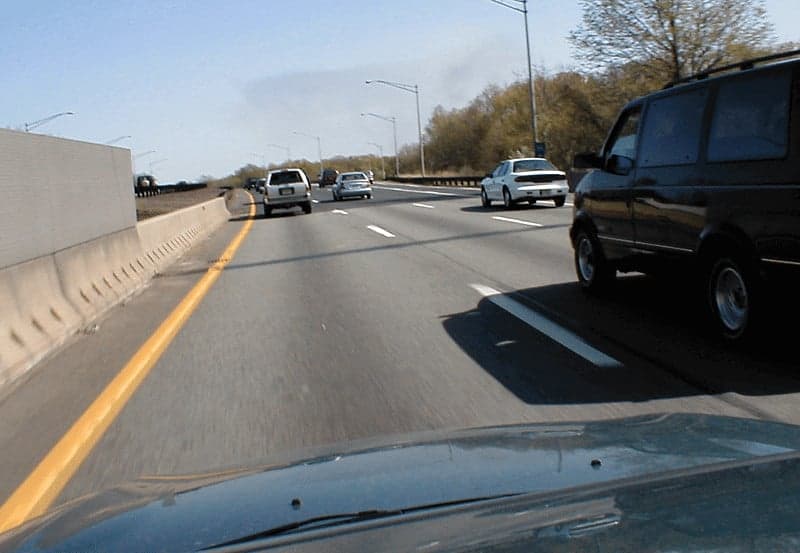
You’re mid-sentence, explaining weekend plans to your passenger, when brake lights flash two cars ahead. Your eyes need to jump there instantly, but they don’t. The delay isn’t dramatic, maybe half a second, but on a highway at 65 mph, you’ve already traveled an extra 48 feet blind. New research from Japan reveals that this lag happens not because you’re distracted from seeing the hazard, but because talking physically slows the machinery of looking itself.
Scientists at Fujita Health University measured how conversation interferes with saccades, the rapid eye movements that snap our gaze from one point to another dozens of times per minute while driving. Their study, published in PLOS ONE, found that talking doesn’t just compete for attention after you’ve spotted a threat. It gums up the works earlier, delaying the eye’s ability to even start moving toward new visual information. Since vision supplies roughly 90 percent of the data drivers use to navigate, even small hiccups in this system cascade through everything that follows.
The team tested 30 adults who tracked targets flashing on a screen while answering questions like “What’s the capital of Italy?” or recalling what they wore yesterday. Talking consistently slowed three distinct phases: the time needed to initiate eye movement after a target appeared, the time to physically reach that target, and crucially, the time to stabilize gaze once the eye arrived. That final phase, adjusting time, more than doubled—jumping from 549 milliseconds in silence to 1,227 milliseconds while speaking. Listening passively to a story caused no such delays, suggesting the cognitive work of forming sentences is what drains resources from the visual system.
The Lag Hits Hardest Looking Down
Targets appearing below the participants’ central field of view took even longer to lock onto, a detail that matters because drivers frequently scan the lower portion of their vision for road debris, potholes, or animals. Humans are already naturally slower to react to stimuli in the lower visual field, a quirk of biology that becomes more dangerous when conversation ties up the brain’s processing capacity. The researchers noted this vulnerability isn’t unique to driving; it reflects a broader limitation in how we allocate neural resources between competing tasks.
“Our results demonstrate that talking-associated cognitive loads are likely to have a strong enough impact to interfere with neural processes for initiating and controlling eye movement,” Shintaro Uehara explains.
What makes these findings unsettling is their specificity. Earlier studies showed that drivers talking on phones miss exits or brake late, but the assumption was that distraction occurred at the recognition or decision stage. This work pushes the problem backward in time, to the moment before recognition is even possible. If your eyes haven’t finished moving and settling on a target, your brain hasn’t truly processed what’s there. The conversation doesn’t prevent you from seeing danger after you’ve looked at it; it prevents you from looking at it in the first place.
Hands-Free Doesn’t Mean Brain-Free
The study complicates the narrative around hands-free devices, which are often marketed as safer alternatives to handheld phones. If the danger lies not in manual interference but in the cognitive load of conversation itself, then switching to Bluetooth doesn’t solve the core problem. Your hands may be on the wheel and your eyes technically on the road, but the neural systems responsible for launching and guiding those eye movements are busy elsewhere, tied up in the work of retrieving words and structuring sentences.
This creates a particularly insidious form of risk. Drivers who feel alert and focused—who can repeat back what the other person just said—may believe they’re safely multitasking. But the data suggests otherwise. The interference happens at a level too fast and too automatic to notice consciously. You don’t feel your eyes moving more slowly or taking longer to settle. You just fail to see the thing that was there all along.
“These results indicate that the cognitive demands associated with talking interfere with the neural mechanisms responsible for initiating and controlling eye movements, which represent the critical first stage of visuomotor processing during driving,” Uehara notes.
The research leaves open questions about how different types of conversation might affect gaze behavior. Complex problem-solving chats may interfere more than small talk, or emotional discussions might drain resources differently than factual ones. What’s clear is that the simple act of talking aloud while driving quietly degrades performance before you’ve even had a chance to react. The eyes slow down first. Everything else follows.