

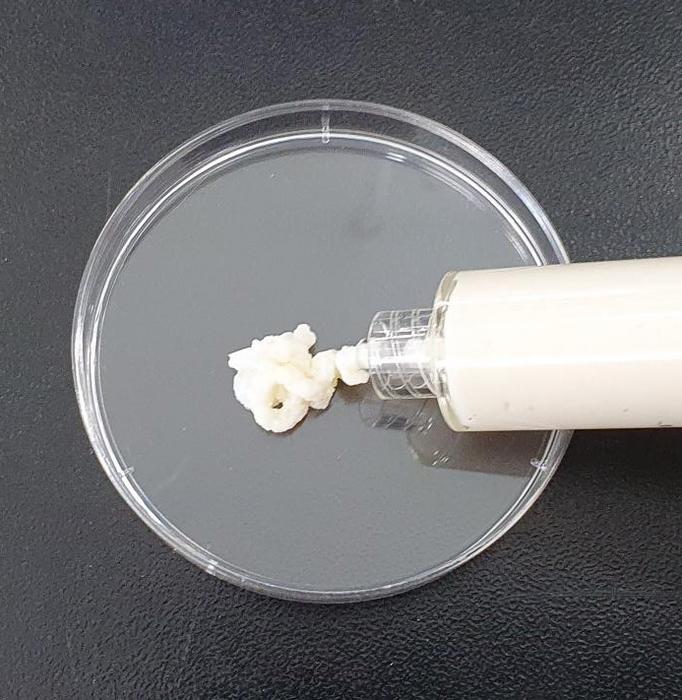
Breast cancer treatment often leaves behind a gap, a hollow reminder of surgery that can’t be ignored. Traditional reconstruction offers ways to fill that space, but the options come with trade-offs: moving tissue from elsewhere on the body, enduring new scars, facing long recoveries, or dealing with the body’s rejection of foreign implants. Now researchers have developed something different: a thick, injectable paste made from processed human skin that aims to restore volume with far less invasiveness.
The material, described in ACS Applied Bio Materials, works like biological caulk. Scientists led by Pham Ngoc Chien and Chan-Yeong Heo transformed donated skin into what’s called an acellular dermal matrix, or ADM. They stripped away living cells while preserving the structural proteins, then froze and pulverized the tissue into microscopic particles. Mixed with water, it becomes a paste that can be injected directly into irregular spaces left after tumor removal.
ADM already exists in reconstructive surgery, typically as flat sheets used to repair tendons or support tissue. But sheets don’t conform well to the complex cavities left by breast-conserving procedures. By creating an injectable version, the team aimed to give surgeons a filler that molds to any shape and integrates smoothly with surrounding tissue.
“By promoting blood vessel growth and tissue remodeling while keeping inflammation low and reducing capsular contracture, the injectable acellular matrix could make breast reconstruction safer, less invasive and more accessible, thereby improving long-term comfort and cosmetic outcomes for patients,” Pham Ngoc Chien explains.
Why the body might actually accept this
Traditional implants trigger a predictable response: the body detects something foreign and tries to wall it off with thick, fibrous tissue. This process, capsular contracture, can make breasts feel hard or painful. In tests on rats, the new paste seemed to sidestep this problem entirely. After six months, animals showed no adverse health effects, and crucially, the tissue layers forming around the injection sites were significantly thinner than those triggered by existing commercial ADM products.
The material doesn’t just sit inert. It’s designed as a temporary scaffold that the body gradually replaces with its own tissue. New blood vessels grow into the area, and remodeling continues steadily over months. The preserved collagen, elastin, and growth factors within the processed skin help drive this integration, while low levels of inflammatory triggers like residual DNA keep the immune response manageable. Instead of inserting something the body must tolerate indefinitely, surgeons could inject a framework the body already knows how to use.
The gap between animals and patients
The results point toward a future where breast reconstruction involves a syringe rather than extensive surgery, but the researchers are clear about where they stand now: this is preclinical work. Longer safety trials are needed, along with more complex testing to confirm the paste behaves predictably over years rather than months. There’s also the question of whether the material might interfere with future cancer screenings or obscure potential recurrences.
If those hurdles clear, the injectable implant could offer a middle path in post-cancer care. It would give patients a way to restore their silhouette through a needle rather than a scalpel, potentially reducing both physical trauma and recovery time. For now, it remains a prototype with promising early data, suggesting that sometimes the best solution to a complicated surgical challenge is helping the body rebuild itself.