

Key Takeaways
- Researchers at ETH Zurich developed a fire-resistant composite from sawdust and struvite, a mineral derived from wastewater.
- The composite uses an enzyme from watermelon seeds to control struvite crystallization, enhancing mechanical strength.
- This new material significantly outperforms untreated spruce in fire resistance, taking over 51 seconds to ignite compared to 15 seconds.
- The composite is lighter and more sustainable than traditional cement-bonded particleboards, making it a better choice for construction.
- Recycling is feasible; the composite can be reprocessed without significant loss of properties, potentially using struvite from sewage treatment as a raw material.
For two days, a block of compressed sawdust sits quietly in a mould, doing something rather remarkable. Tiny crystals are growing inside it, encouraged by an enzyme extracted from watermelon seeds, threading themselves into the wood fibres, filling the microscopic pores, locking into the jagged surfaces of each individual particle. When the block emerges from the mould and dries at room temperature, it has become something quite different from what went in. Apply a flame and it does not catch. It chars, seals, resists. The spruce it once was would have ignited in roughly 15 seconds; the new material holds out for more than fifty.
Every year, somewhere between hundreds of millions and several hundred million tonnes of sawdust accumulates as a byproduct of the global timber industry, and most of it is simply burned. Useful, in a narrow sense, as an energy source, but burning releases back into the atmosphere all the carbon the tree spent decades absorbing. The wood industry’s emissions problem is not only in the forests it harvests. It is also in the piles behind the mill.
The material coming out of ETH Zurich and Empa is, in essence, an attempt to stop that loop. Ronny Kürsteiner, a doctoral researcher at ETH Zurich’s Chair of Wood Materials Science, has spent his thesis developing a process that binds sawdust into a stable, fire-resistant composite using a mineral called struvite, a crystalline ammonium magnesium phosphate that has been known for some time to carry useful fire-protection properties. The difficulty was always the same: struvite’s crystallisation behaviour made it stubbornly difficult to combine with wood particles in any way that produced a mechanically functional material. Conventional precipitation methods yielded small, disorganised crystallites that failed to grip the sawdust and hold it together.
The solution arrived, somewhat unexpectedly, via watermelon seeds. Watermelon seeds contain a stable natural source of urease, an enzyme that catalyses the breakdown of urea and releases ammonium ions in a slow, controlled stream. By extracting these protein bodies from ground seeds and adding them to a suspension of the mineral precursor newberyite, Kürsteiner’s team found they could coax struvite to crystallise gradually, under confinement, producing large well-defined crystals that grew to conform to the exact surface topography of the sawdust particles, right down to microscopic features like bordered pits in the cell walls. Strong mechanical interlocking rather than chemical bonding is what holds the composite together, and the result is a material that, under the right compression, exceeds the strength of the original spruce. “The material is stronger under compression perpendicular to the grain than the original spruce timber,” says Kürsteiner.
The fire behaviour is, perhaps, where the material earns its most interesting properties. Struvite is not simply non-combustible; it actively participates in protecting a burning surface. When the mineral heats up, it decomposes endothermically, releasing water vapour and ammonia. That process draws heat from the surrounding material, cooling it. The gases produced are non-combustible and displace the oxygen that fire needs, and the combination drives char formation faster than it would otherwise occur, building a protective inorganic crust on the surface that insulates the wood beneath. “The struvite sawdust panels essentially protect themselves,” Kürsteiner says.
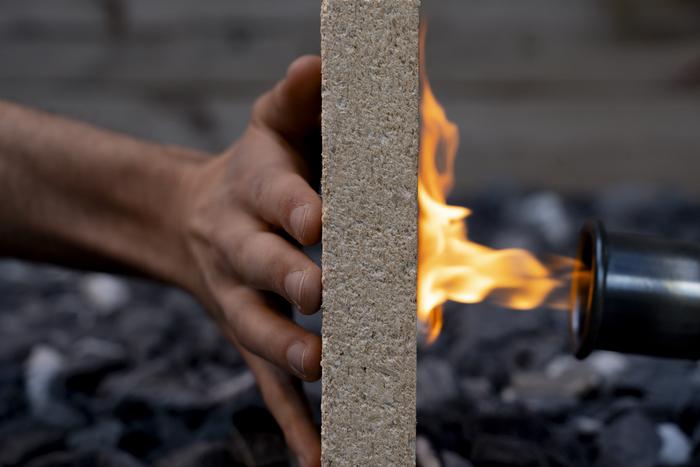
In standardised cone calorimeter tests, which simulate a material’s early-stage response to fire, the composites took an average of 51 seconds to ignite under a heat flux replicating real fire conditions, compared to roughly 15 seconds for untreated spruce. After ignition, the peak heat release rate was about 118 kilowatts per square metre, and smoke production was extremely low, a total smoke release of around 74 square metres per square metre. After the test, 88 per cent of the panel’s original mass remained. In a separate flame penetration test, exposing the surface of the panel to roughly 900 degrees Celsius from a butane torch for five minutes, the back surface of the panel stayed below 30 degrees throughout. Multivariate analysis of the calorimetry data suggests the material would likely qualify for Euroclass B fire classification, which would put it in the same bracket as conventional cement-bonded particleboards currently used in interior wall systems for fire-protection applications.
The struvite mineral binder actively interferes with combustion rather than simply being non-flammable itself. When heated, struvite decomposes and releases water vapour and non-combustible gases, which cool the material’s surface and displace the oxygen a fire needs. The result is rapid char formation that seals the surface and protects the wood underneath, so most of the panel remains physically intact even after exposure to intense heat.
Conventional cement-bonded particleboards, widely used for fire protection in interior walls, contain sixty to seventy per cent cement by weight, making them heavy and carrying a significant carbon footprint from cement production. The struvite sawdust composite uses roughly 40 per cent binder by weight, is meaningfully lighter, and is fully recyclable at end of life, which cement boards are not. The raw materials, sawdust and potentially struvite from wastewater, are also largely byproducts of other processes rather than virgin-manufactured inputs.
That’s one of the more interesting aspects of the research. Struvite accumulates as an unwanted deposit in wastewater treatment infrastructure, where it clogs pipes and costs facilities money to remove. The ETH team’s process can use wastewater-derived struvite as a precursor, which would potentially convert a persistent maintenance problem into a construction material feedstock and improve the cost economics of the composite considerably.
Watermelon seeds contain a naturally stable form of urease enzyme, packaged in protein bodies that remain active even under the harsh conditions of mineral crystallisation. Added to the mineral precursor suspension, the enzyme controls the release of ammonium ions, slowing struvite crystal growth so that large, well-formed crystals develop gradually and conform to the exact surface of each sawdust particle. Without this enzymatic control, struvite crystallises too fast and produces small, loosely connected crystallites that cannot hold the composite together mechanically.
The recycling process is relatively mild: the composite is broken apart, heated briefly to just above 100 degrees Celsius to decompose the struvite, and the mineral component is separated, dissolved, and re-precipitated as a fresh precursor. Composites made with the recycled binder achieved compressive strengths very close to those of the original, around 4.45 megapascals compared to 4.71 for virgin-binder panels. Whether this holds at industrial scale and over multiple recycling cycles remains to be tested.
Those cement-bonded boards are, incidentally, rather heavy things. They contain sixty to seventy per cent cement by weight, and cement production is notoriously energy-intensive. The struvite composite uses about 40 per cent binder by weight, making it meaningfully lighter and carrying a considerably better carbon footprint, at least in terms of binder production. The researchers worked with colleagues at the Polytechnic University of Turin on the fire testing, and acknowledge that larger-scale flame retardancy tests are still needed before the material can be formally classified. The cost of struvite remains a practical obstacle; it runs more expensive than conventional polymer binders or cement at current market prices. Whether the economics work depends partly on the scale of production and partly on where the struvite comes from.
That last point is where the story loops back on itself. Struvite is not only a laboratory-synthesised mineral. It accumulates in large quantities in sewage treatment plants, where it precipitates out of wastewater and clogs pipes with a regularity that wastewater engineers find intensely frustrating. That unwanted deposit is, chemically, exactly what the ETH team needs. “We could use these deposits as a raw material for our building material,” Kürsteiner says. Wastewater struvite turns out to be a suitable precursor for the process, which would convert a persistent infrastructure nuisance into a construction ingredient, and potentially improve the economics considerably.
Recyclability is built into the system in a way that few construction materials can claim. When a struvite-bonded panel reaches the end of its useful life, the composite can be broken apart mechanically, heated briefly to just over 100 degrees Celsius to decompose the struvite and drive off its ammonia, and the components sifted out. The reclaimed mineral precursor can then be dissolved and re-precipitated as fresh newberyite, ready to be mixed with new sawdust. Composites made from this recycled binder performed essentially as well in strength testing as those made from virgin material, reaching compressive strengths of around 4.45 megapascals compared to 4.71 for the originals. The sawdust recovered from the process could either be burned for energy, the fate it was heading for anyway, or potentially used to make new composites.
There are genuine limits to what has been demonstrated. The mechanical properties data comes from laboratory-scale specimens. The fire-classification prediction is based on statistical modelling rather than full Euroclass testing. And scaling up enzymatic processes is rarely as straightforward in practice as it looks in a paper. Struvite crystal formation depends sensitively on concentration, pH, temperature, and the presence of competing ions; controlling all of those variables consistently at industrial scale will take significant engineering.
What stays with you, though, is the elegance of the biological step. Urease extracted from watermelon seeds, themselves an agricultural byproduct, controlling mineralisation inside a wood byproduct, producing a material that could displace an energy-intensive cement product. The chain of waste-to-resource conversions is three steps long before the panel even goes into a wall. Whether that chain is robust enough for industrial adoption is a question the next phase of research will have to answer, but the concept is demonstrably sound. Sawdust, it turns out, had better options than the boiler.
DOI / Source: https://doi.org/10.1016/j.checir.2025.100004