

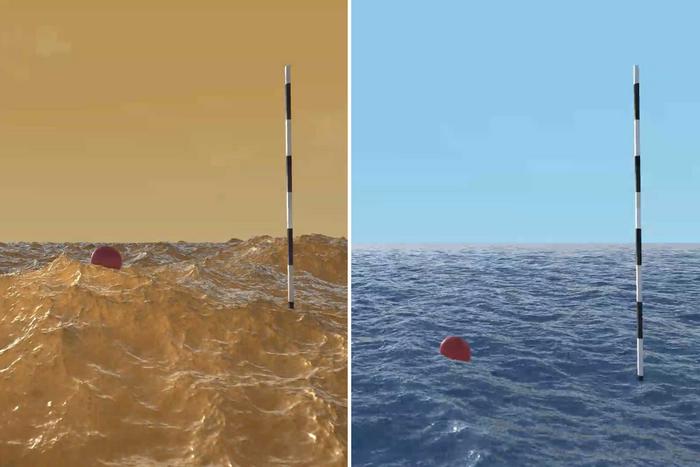
A gentle wind, barely enough to ruffle your hair, is blowing across the surface of a methane lake on Saturn’s largest moon. Nothing alarming. And yet the lake in front of you is building walls of liquid hydrocarbon three metres tall, rolling in slow motion toward the shore where you’re standing. This is not how waves work on Earth, and for a long time nobody could say precisely how they worked on Titan either. That changed earlier this month, when a team at MIT published a wave model flexible enough to work on any planet in the universe, or beyond it.
Key Takeaways
- MIT’s PlanetWaves model predicts wave behavior across various planetary bodies by considering gravity, liquid composition, and atmospheric pressure.
- On Titan, weak winds can generate surprisingly large waves due to low-viscosity liquids and a dense atmosphere.
- The model also explores wave history on Mars, suggesting changing atmospheric conditions affected ancient lake dynamics.
- PlanetWaves might help future missions to Titan design instruments that can withstand wave energy during landings.
- The model has implications for understanding wave patterns on exoplanets with extreme conditions, like 55-Cancri e.
The model, which the researchers have called PlanetWaves, is the first physics-based system to account simultaneously for gravity, liquid composition, atmospheric pressure, and surface tension when calculating how waves form and grow. Previous efforts tended to borrow from Earth-calibrated equations, adjusting for a planet’s gravity while leaving everything else roughly terrestrial. That shortcut, it turns out, misses quite a lot.
The core insight driving PlanetWaves is almost childishly simple once stated: waves are not just a product of wind strength. They are a negotiation between the wind above and the liquid below, mediated by the weight of the atmosphere pressing down, the stickiness of the surface, and how much the liquid itself resists being disturbed. Change any one of those variables and the whole negotiation shifts. “There have been attempts in the past to predict how gravity will affect waves on other planets,” says Una Schneck, a graduate student at MIT and lead author of the study. “But they don’t quantify other factors such as the composition of the liquid that is making waves. That was the big leap with this project.”
To build and validate the model, the team worked with 20 years of wave height data collected by buoys on Lake Superior, one of the largest lakes on Earth and a reasonable analogue for the kind of contained water bodies found on other worlds. The model reproduced the buoy measurements closely enough to proceed with confidence to stranger territory.
Titan was the obvious first destination. It is the only other body in the solar system currently known to have stable liquid on its surface, and Cassini’s radar images have long shown lake formations near the poles. What Cassini could not show, frustratingly, was whether those lakes had waves. The surface appeared smooth at the radar’s resolution, which has led to ongoing debate about whether Titan’s winds are simply too calm to generate any appreciable wave action. PlanetWaves suggests the answer is more interesting than that. The lakes are filled with a mixture of liquid methane and ethane, which is lighter and less viscous than water. Combined with Titan’s weak gravity and its dense, nitrogen-rich atmosphere, that means almost any wind at all can stir the surface. The model puts the threshold at around 0.6 metres per second, roughly a gentle drift. On Earth, you need wind speeds closer to 2.2 metres per second before lakes begin to respond.
“Imagine a completely still lake,” says Andrew Ashton, associate scientist at the Woods Hole Oceanographic Institution and a co-author on the paper. “We’re trying to figure out the first puff that will make those first little tiny ripples, on up to a full ocean wave.”
On Titan, that first puff arrives very easily, and what follows is strange by any Earth standard. A wind of 4 metres per second, roughly what you’d feel walking briskly on a calm day, would generate waves on Earth about 20 centimetres high. On Titan the same wind would produce waves around 3 metres tall, moving more slowly because the gravity pulling them back down is weaker. “It kind of looks like tall waves moving in slow motion,” Schneck says. “If you were standing on the shore of this lake, you might feel only a soft breeze but you would see these enormous waves flowing toward you, which is not what we would expect on Earth.” The paper includes rendered visualisations of this scenario; they are, to put it mildly, unsettling.
The model also reaches back into Mars’ past. Jezero Crater, currently being explored by NASA’s Perseverance rover, is believed to have once been a lake of liquid water before Mars lost most of its atmosphere. PlanetWaves predicts that as Martian atmospheric pressure declined over billions of years, the waves in those ancient crater lakes would have shrunk accordingly. At 200 kilopascals of pressure (roughly twice Earth’s current atmosphere), waves would have started forming at wind speeds of about 1.2 metres per second and grown substantially larger than anything on an equivalent Earth lake. As the atmosphere thinned toward 50 kilopascals, the threshold crept up and the waves dropped. The implication is that Martian shorelines were shaped by very different wave energies at different points in the planet’s history, a complication that geologists trying to reconstruct past Martian climate will need to account for.
Beyond the solar system, the team applied PlanetWaves to three exoplanets chosen to represent radically different surface conditions. On LHS 1140b, a super-Earth with liquid water but roughly twice Earth’s gravity, waves are suppressed; the same wind produces much smaller swells because there’s more force pulling the water flat. On Kepler 1649b, an exo-Venus likely covered in sulfuric acid oceans, the liquid’s high density means waves need strong winds to get started at all, though once established they grow to roughly Earth-like heights. And then there is 55-Cancri e, a planet possibly covered in liquid rock, where the surface tension of molten andesite is so high and the gravity so strong that the model’s predicted wave generation threshold sits at 37 metres per second. Hurricane force, for what might amount to a few centimetres of lava ripple.
Whether waves of any kind actually exist on these exoplanets is, for now, beyond any instrument’s ability to confirm. But their presence or absence affects how light scatters off a planet’s surface, and that scattering is measurable in principle with next-generation telescopes. A wavy ocean and a glassy one look different from a great distance; PlanetWaves gives astronomers a reason to look for the difference.
The practical applications closer to home are perhaps more immediate. Any spacecraft sent to land on or operate near Titan’s lakes would need to survive the wave environment it encountered. “You would want to build something that can withstand the energy of the waves,” Schneck says. “So it’s important to know what kind of waves these instruments would be up against.” NASA’s Dragonfly mission, a rotorcraft lander, is headed for Titan and will pass over its lake regions. Whether future missions might attempt to touch down on those hydrocarbon surfaces is still an open question, but if they do, the engineers will have a model to consult.
Taylor Perron, the senior author on the study, is thinking about something subtler. Titan has rivers and coastlines but almost no river deltas, which is strange because deltas form wherever rivers deposit sediment at the shore. On Earth, waves rework that sediment constantly, redistributing it along the coast rather than letting it pile up at river mouths. If Titan’s waves are energetic enough to do the same, that could explain the missing deltas. “These are the kinds of mysteries that this model will help us solve,” Perron says. Whether a methane shore on a distant moon follows the same rules as a beach in Devon is, it turns out, precisely the kind of question that now has an answer.
DOI: https://doi.org/10.1029/2025JE009490
It comes down to a combination of factors working together. Titan’s hydrocarbon lakes are filled with light, low-viscosity liquid methane and ethane, which resist wind disturbance far less than water does. The moon’s dense nitrogen atmosphere also transfers more energy to the surface than a thinner atmosphere would. Lower gravity then allows waves that do form to grow taller before being pulled back down. The result is a system tuned to amplify even faint winds into surprisingly large waves.
Possibly, though it’s proved difficult so far. NASA’s Cassini mission saw the lakes as radar-smooth, which could mean the winds were calm during its flybys, or that the waves were simply too small for the instrument to resolve. PlanetWaves suggests even a slight breeze should produce waves well above that detection threshold, so the smoothness remains something of a puzzle. Any future lander or low-altitude drone near Titan’s lakes would have a much clearer answer.
In principle, yes, though 55-Cancri e would need sustained hurricane-force winds before the surface of its liquid rock ocean rippled at all. The model predicts a wind threshold of around 37 metres per second just to generate even small waves, because molten andesite is dense, highly viscous, and has strong surface tension. Whether winds anywhere near that speed exist on 55-Cancri e is unknown; the planet’s atmosphere remains poorly characterized. But if they do, the waves would be comparatively small despite the effort required to create them.
When Mars had a thicker atmosphere, its crater lakes would have supported a more energetic wave environment than its lower gravity alone might suggest. As atmospheric pressure fell over billions of years, those waves would have become smaller and harder to generate. That means the erosion patterns and sediment deposits left behind in places like Jezero Crater were shaped by conditions that changed dramatically over time, something that simple gravity-based models of Martian wave action couldn’t capture.