

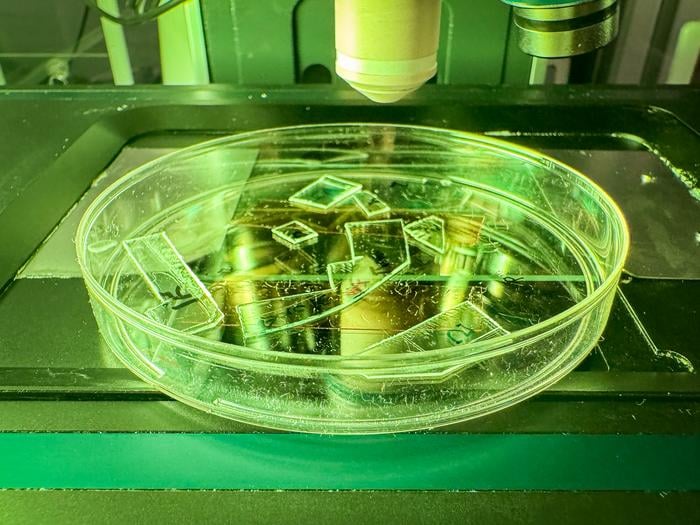
Zoom in far enough on a piece of clear acrylic and something strange appears. The surface isn’t smooth at all. It’s covered in columns, each one roughly the diameter of a flu virus, packed together so tightly there’s barely room to breathe between them. When a virus settles onto that surface, those columns don’t pierce it. They do something rather more unsettling: they stretch it, pulling the outer membrane in multiple directions simultaneously until the whole structure ruptures. The virus, in effect, is pulled apart by the surface it tried to land on. Within an hour, about 94% of the viral particles that contact the film are either destroyed or damaged so badly they can no longer cause infection.
Researchers at RMIT University in Melbourne have developed this nanotextured acrylic film, publishing their findings in Advanced Science earlier this year. The approach is notable not just for what it does but for how: no chemicals, no coatings that wear off or leach into the environment, no antiviral compounds that might degrade or, worse, encourage resistance. Just geometry.
The nanostructures themselves, called nanopillars, are fabricated using a process borrowed from electronics manufacturing. An aluminium template is chemically etched to produce a mould with precisely-spaced holes, and then acrylic resin is pressed against it under ultraviolet light. The result is a flexible, transparent film patterned with rows of pillars, each somewhere between 60 and 185 nanometres tall, spaced (in the most effective configurations) about 60 nanometres apart at their centres. That spacing, it turns out, is the critical variable. Not the height of the pillars. Not their shape. How close together they sit.
This surprised even the researchers. The intuitive assumption was that taller, sharper pillars would be more deadly, on the logic that a spike pierces better than a stump. But that’s not quite what’s happening here.
“By tweaking the spacing and height of the nanopillars, we discovered how tightly they are packed together is far more important than how tall they are for breaking viruses apart,” said Samson Mah, the PhD candidate who led the work. The mechanism, he explained, depends on collective action: “When the nanopillars are closer together, more of them can press on the same virus at once, stretching its outer shell past breaking point.” A single pillar poking at a virus achieves roughly nothing. It’s the coordinated grip of dozens of pillars bearing down simultaneously that generates the stresses needed to rupture the outer membrane.
The team confirmed this computationally, running finite element simulations of viral particles settling onto surfaces with different nanopillar geometries. At 60-nanometre spacing, the model shows stress concentrations exceeding 10 megapascals at points where the viral envelope stretches between adjacent pillars. That’s above the estimated rupture threshold for the enveloped viruses tested. Widen the spacing to 100 nanometres and the effect weakens, becoming sensitive to pillar height. At 200 nanometres, the virus simply slips between the pillars without generating meaningful stress anywhere. The effect essentially disappears.
A Pattern Borrowed From Nature
The idea of killing microorganisms with surface texture rather than chemistry isn’t new. Researchers have known since at least the early 2010s that cicada wings and shark skin can kill bacteria on contact, and there’s been considerable work since then on engineering nanostructured surfaces to mimic that effect. What’s less understood is how those principles translate to viruses, which are considerably smaller than bacteria and structurally quite different. The RMIT work specifically tests a human parainfluenza virus (hPIV-3), a common respiratory pathogen responsible for bronchiolitis and pneumonia, particularly in children and elderly people. No approved vaccine or antiviral treatment exists for it.
Earlier experiments showed that nanostructured silicon could damage viruses, but silicon is rigid, expensive, and very hard to make in large quantities. The appeal of acrylic is precisely its ordinariness: it’s already everywhere, in phone screens, automotive interiors, contact lenses, dental restoratives. The manufacturing route the RMIT team describes involves roll-to-roll processing, the same basic technique used to produce cling film. “Our mould can be adapted to roll-to-roll manufacturing, meaning antiviral plastic films could be produced at scale with existing factory equipment,” Mah said.
One detail worth noting: the viral RNA remained intact on all tested surfaces, confirmed by PCR analysis. This matters for understanding the mechanism. If the acrylic were releasing some chemical agent that degraded the virus, you’d expect the genetic material to show damage too. It didn’t. The genome was preserved; it was the virus’s structural shell that failed. That’s consistent with a purely mechanical kill, which also means the surface won’t lose potency as an active ingredient depletes. The pillars don’t get used up.
The Geometry Problem
There is, however, a complication the team is open about. The viruses tested (hPIV-3) are what’s known as enveloped, meaning they’re wrapped in a fatty outer membrane derived from their host cell. That membrane is relatively soft and vulnerable to mechanical stress. Non-enveloped viruses, by contrast, have protein shells that are considerably tougher. Whether the same nanotextured surface would work against noroviruses, enteroviruses, or other non-enveloped pathogens remains an open question. The team plans to test this. Similarly, the current experiments use flat surfaces, and the researchers note that surface curvature affects nanopillar spacing in ways that need further investigation before films could be applied to, say, the curved edges of a phone.
Distinguished Professor Elena Ivanova, who co-authored the study, said the team is actively seeking industry partners to push the technology further: “We think this texturing is a strong candidate for everyday use and we’re ready to partner with companies to refine it for large-scale manufacturing.” The applications they have in mind range from hospital surfaces and medical equipment to consumer electronics. “We could one day have surfaces like phone screens, keyboards and hospital tables covered with this film, killing viruses on contact without using harsh chemicals,” Mah said.
Perhaps the most interesting aspect of this work isn’t any single finding but the underlying principle it reinforces: that physical structure, arranged at the right scale, can substitute for chemistry in ways we’re only beginning to exploit. Viruses are, in one sense, just physical objects. They have a membrane with a certain mechanical tolerance. They have a size. They respond to forces. The question the RMIT work poses, quietly, is how many other surfaces we interact with every day could be redesigned, at a scale too small to see, to become quietly, persistently hostile to pathogens. No refilling required.
Source: https://advanced.onlinelibrary.wiley.com/doi/10.1002/advs.202521667
Frequently Asked Questions
Could this antiviral film work on phone screens and other curved surfaces?
Possibly, but not yet demonstrated. The research so far has focused on flat acrylic samples, and the team acknowledges that curvature changes the effective spacing between nanopillars in ways that need further testing. The manufacturing process is designed to be adaptable, so curved applications aren’t ruled out, just not proven at this stage.
Why doesn’t the surface just wear out like a chemical disinfectant?
Because the mechanism is purely mechanical, not chemical. The nanopillars rupture viruses by stretching their outer membranes past a physical breaking point, no active ingredient is consumed in the process. As long as the nanopillar geometry remains intact, the surface should retain its antiviral properties. The researchers confirmed this by showing that viral RNA remained undamaged, ruling out any chemical degradation as the cause of inactivation.
Would this work against tougher viruses like norovirus?
That’s the key unanswered question. The tests used hPIV-3, an enveloped virus with a relatively fragile fatty outer membrane. Non-enveloped viruses such as norovirus have much harder protein shells, and it’s not clear whether the same mechanical stress would be sufficient to rupture them. The RMIT team has flagged this as the next phase of testing.
How close is this to being a real product?
Closer than most lab-stage research, given that the manufacturing method is adapted from existing industrial roll-to-roll processes already used to make flexible plastic films. The researchers are actively seeking industry partners, though the remaining unknowns around curved surfaces, non-enveloped viruses, and long-term durability mean commercial deployment is probably still some years away.