

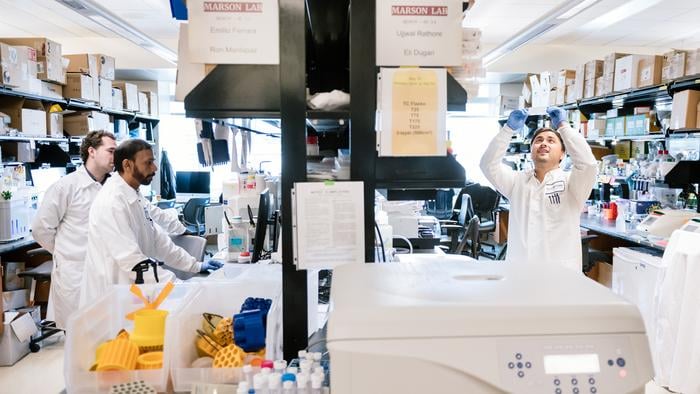
For decades, the problem was the cells themselves. Human CD4+ T cells, the immune sentinels that HIV dismantles so methodically, turned out to be almost impossibly difficult to infect in a laboratory dish. A typical experiment yielded infection in perhaps one or two percent of them, not nearly enough to run the kind of sweeping genetic analysis that might finally reveal which of your roughly 20,000 genes actually matter during a viral attack. The virus thrived in cancer cell lines, the workhorse of HIV research, but cancer cells aren’t really like your cells, and so for years the genetic picture of HIV infection stayed smudged, provisional. Ujjwal Rathore spent about a decade being annoyed by this.
His group at the Gladstone Institutes in San Francisco has now solved it. They’ve pushed infection rates in primary human T cells up to 70 percent, and then used that platform to run the most comprehensive genetic screen of HIV-host interactions ever attempted in physiologically relevant cells.
The result, published this week in Cell, is something like a complete map of the war between HIV and the human genome. Two CRISPR techniques swept across nearly every gene in sequence: one disrupting each gene in turn to reveal which ones the virus needs to survive, the other boosting each gene’s activity to expose proteins capable of fighting back. Hundreds of factors emerged, both proviral (genes that help HIV) and antiviral (genes the body can deploy against it). Many were entirely unknown in this context. Several turned out to be surprisingly, almost embarrassingly, potent. “This was the first genome-wide effort to show how human genes affect HIV infection in cells taken directly from human blood samples,” says Nevan Krogan, director of the HIV Accessory and Regulatory Complexes Center at UCSF. “Our findings could eventually lead to new treatments that help the body’s immune system resist the virus.”
Finding What the Virus Has Been Hiding
The gain-of-function arm of the screen, in which gene activity was amplified using CRISPR activation rather than knocked out, turned out to be particularly revealing. HIV has had some 40 years to evolve strategies for neutralising the human immune response, so simply looking for antiviral genes at their natural expression levels tends to miss the ones the virus has effectively quieted. Turn the volume up, though, and they reappear.
“Over-activating the genes gave us a wealth of information,” says Eli Dugan, a scientist in Marson’s lab and co-first author of the study. “We discovered natural antiviral proteins that were previously invisible because the virus could effectively silence them. By ramping up the levels of these genes in T cells, we could finally see them win the fight against HIV.” Two proteins in particular stopped the team cold: PI16 and PPID, neither of which had any previously established connection to HIV infection.
Two Proteins the Virus Never Worried About
PI16 is a sort of strange case. It’s barely expressed in most T cells under normal conditions (roughly 15 to 20 percent of unstimulated cells carry any detectable surface protein at all), which is presumably why it had escaped notice in prior screens, and it has putative roles in prostate cancer and cardiac remodelling that don’t obviously suggest anything about viruses. But when researchers cranked up PI16 levels artificially, it slashed infection rates by more than tenfold. The mechanism turned out to involve HIV’s entry step: PI16, it seems, physically latches onto the molecular machinery the virus uses to fuse with a cell, including components of the Arp2/3 actin remodeling complex that helps HIV’s capsid core get inside. No fusion, no infection. Rather elegant, really.
PPID is stranger and in some ways more remarkable. It belongs to a family of proteins called cyclophilins, proline chaperones that help fold other proteins and regulate their behavior. One of its closest relatives is CypA, which has been studied for years as a proviral factor: CypA binds the HIV capsid, stabilizes it during transit to the nucleus, and helpfully shields it from an immune sensor called TRIM5-alpha. PPID and CypA share about 62 percent of their amino acid sequence and their three-dimensional structures are strikingly similar. But PPID, it turns out, does something quite different with the capsid it binds. Instead of shepherding HIV to the nucleus, it blocks the virus from getting there. The antiviral activity depends on a structural region unique to PPID called the TPR domain, which CypA lacks, and which appears to recruit additional cellular machinery against the incoming viral core. So two proteins, nearly identical in shape, one helping the virus and one working against it. The evolutionary arms race made visible.
The team went further, probing which parts of PPID drive its restriction activity by systematically mutating individual amino acids, then testing whether each change made the protein better or worse at fighting HIV. Primate evolution provided hints: PPID shows signatures of positive selection in non-human primates, and when the researchers compared PPID from several species, gorilla excepted (gorillas are fellow hominids), all the non-hominid variants restricted HIV substantially better than the human version. Seven individual amino acid substitutions drawn from these primate sequences each enhanced human PPID’s antiviral potency when introduced into the protein. “We found ways to tweak PPID in the lab and make it 10 times more effective at stopping HIV,” Dugan says. The implication, which nobody quite states this baldly but which hangs over the data, is that HIV has been shaping the human version of PPID for perhaps millions of years, eroding its potency generation by generation.
The team also pulled off something fairly audacious: they took CypA, the pro-HIV cyclophilin, and grafted on PPID’s TPR domain to create a chimeric protein. CypA binds HIV capsid more promiscuously than PPID; could PPID’s antiviral machinery work through a different capsid-binding module? It could. The hybrid protein suppressed HIV infection significantly, converting a natural ally of the virus into a weapon against it. It’s a proof of concept more than a clinical strategy, but it demonstrates that the antiviral mechanism is, in principle, portable.
Testing Against the Oldest Strains
To test whether any of this held up against real-world viral diversity, Alex Marson’s lab reached out to Jay Levy, a professor emeritus at UCSF who was among the scientists who first isolated the HIV virus in 1983 and who still has samples of strains collected during the earliest years of the AIDS crisis. Both PI16 and PPID restricted infection by these primary isolates, including a highly cytopathic dual-tropic strain called SF33. “We found that increased levels of PPID or PI16 could reduce HIV infection in these human T cells,” Rathore says, “proving that the new proteins could stop even the most aggressive, natural strains of HIV.”
For all the excitement around the newly identified antiviral proteins, the researchers emphasize that the value of the work extends well beyond any two candidates. The full dataset, deposited in public repositories, amounts to a resource for the whole HIV field: a systematic accounting of hundreds of human genes with measurable effects on infection. Many implicate mechanisms nobody has thought to study in this context; some are expressed primarily in myeloid cells, suggesting the screens have uncovered antiviral biology relevant to macrophages and dendritic cells as well. The platform could, in principle, be trained on HIV latency, the dormant viral reservoirs that persist even in patients on long-term antiretroviral therapy. “We haven’t had a good model to identify the important players in HIV latency,” Rathore says. “Now, we have the platform to ask the biggest questions in the field and hopefully learn how to eliminate hidden HIV that current drugs can’t reach.”
Whether PPID or PI16 could ever be translated into therapies, directly or indirectly, remains genuinely open. Gene therapies that boost specific protein levels in T cells are no longer science fiction; several are in clinical development for HIV already. But the cleaner near-term contribution is probably just the map itself. Forty-odd years in, the war between the human genome and HIV is still being charted.
Frequently Asked Questions
What did this study actually find that previous HIV research had missed?
Earlier genetic screens for HIV host factors were largely conducted in immortalized cancer cell lines rather than actual human T cells, which meant they missed proteins whose importance only shows up in physiologically realistic conditions. By developing a method to infect real human CD4+ T cells at high rates, then running genome-wide CRISPR screens in those cells, this study identified hundreds of factors that prior work overlooked, including two particularly potent antiviral proteins, PI16 and PPID, neither of which had any known connection to HIV before. The screens also revealed that many natural antiviral proteins are effectively silenced by the virus at normal expression levels, making a gain-of-function approach essential for finding them.
Why does PPID restrict HIV if its close relative CypA actually helps the virus?
Both PPID and CypA bind to the same region of the HIV capsid, but they have very different consequences for what happens next. CypA stabilizes the capsid and helps it reach the nucleus intact, acting as a proviral factor. PPID, despite sharing around 62 percent of its amino acid sequence with CypA, carries an additional structural region called the TPR domain that CypA lacks, and this domain appears to recruit cellular machinery that blocks the viral core from completing nuclear import rather than assisting it. When researchers fused the TPR domain from PPID onto CypA, the resulting chimeric protein gained antiviral activity, showing that the restriction mechanism is modular and operates independently of which protein is doing the capsid binding.
Could PPID or PI16 be turned into actual HIV treatments?
That remains an open question, though the biology is suggestive. Gene therapies that engineer HIV resistance into T cells are already in clinical development, and in principle a therapy that elevated PPID or PI16 levels in a patient’s T cells could be conceived along similar lines. The finding that seven amino acid substitutions, drawn from non-human primate versions of PPID, each enhanced its antiviral potency in human cells raises the intriguing possibility of engineering an optimized version of the protein. More immediately, the detailed mechanism for how PI16 disrupts HIV fusion could point toward small-molecule drug targets. None of this is imminent, but the molecular handles are now visible in a way they weren’t before.
What does “positive selection” mean in the context of PPID, and why does it matter?
Positive selection is an evolutionary signal indicating that a gene has been changing faster than random mutation alone would predict, typically because variants that alter the protein’s function are conferring survival advantages. In host-virus conflicts, this pattern often appears in genes encoding proteins that directly interface with pathogens, because any mutation that improves defense (or, from the virus’s perspective, evasion) gets rapidly selected for. The finding that PPID shows signatures of positive selection in simian primates, and that non-hominid primates carry PPID variants that restrict HIV more effectively than the human version, suggests an ongoing evolutionary tug-of-war between hominid ancestors and lentiviruses over many millions of years, with HIV apparently winning enough rounds to blunt PPID’s potency in our lineage specifically.
What does this research mean for efforts to cure HIV rather than just manage it?
Current antiretroviral therapies suppress viral replication effectively but cannot eliminate latent HIV reservoirs, pockets of dormant virus that persist in resting T cells and other tissues essentially indefinitely. The screening platform developed in this study was designed to find factors relevant to active infection, but the same methodology could in principle be turned on the latency problem: running screens specifically designed to identify which host genes control whether HIV stays dormant or reactivates, or which ones govern the establishment of latent reservoirs in the first place. The researchers are explicit about this as a next step. Understanding HIV latency at the genome level could eventually reveal targets for the “kick and kill” or “block and lock” strategies that cure research depends on.
