

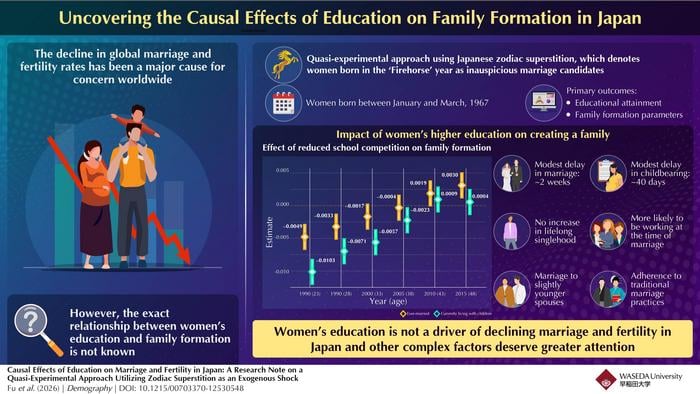
Japan’s total fertility rate fell to 1.20 in 2024. Record low. The pension system creaks, economists fret, government ministers announce fresh subsidies for childcare, and somewhere in a cabinet meeting or a family dinner or a tabloid column, someone says the quiet part loud: women are too educated now, too career-focused, too much of something to settle down and have children. It is one of the most persistent narratives in East Asian demography. It also turns out to be, at best, a significant exaggeration. A new study published in the journal Demography has found causal evidence that more education leads Japanese women to delay marriage by roughly two weeks and first childbirth by about 40 days. Not years. Weeks.
The research, led by Rong Fu of Waseda University in Tokyo, is the kind of study that demographers dream about: a natural experiment that fell out of ancient superstition and the peculiarities of the Japanese school calendar.
The Horse That Changed a Generation
Every 60 years, the Chinese zodiac cycles to a combination called Hinoeuma, or the Year of the Firehorse. Women born in this year are, according to tradition, possessed of fierce, headstrong temperaments likely to bring marital discord and, in some versions of the lore, to shorten their husbands’ lives. In 1966, the last Firehorse year, a great many Japanese parents took this rather seriously. The birth rate plunged about 25 percent that year as couples delayed or avoided conception. The result was one of the sharpest single-year demographic contractions in Japan’s postwar history, and it set in motion an unintended chain of consequences that researchers are still unpicking today.
The children not born in 1966 had, of course, to start school eventually. Japan’s academic year begins in April, which means children born between January and March of any given year are grouped with the prior year’s cohort for educational purposes. So children born in the first three months of 1967 sat in school classes that were thinned out by all those babies who had not been born in 1966. Less competition for places at junior colleges and universities. Marginally better odds of reaching higher education. Fu and her colleagues at the National University of Singapore and Kanagawa University of Human Services identified these women, roughly 450,000 of them, as a natural comparison group: more educated than they might otherwise have been, yet entirely untainted by Firehorse stigma because they were born in the calendar year 1967, not 1966.
The Mismatch That Made the Experiment
To isolate what education actually does to family formation, the team ran a difference-in-differences analysis across approximately 1.8 million women, using three decades of Japanese Census records, national vital statistics on marriage, and birth registries from 1983 to 2018. The methodological elegance here is worth pausing on. By comparing the January-to-March 1967 women against their April-to-December 1967 counterparts, and doing the same comparison for 1968, the researchers could strip away the effects of being the youngest in a school year (which tends to disadvantage academic performance) as well as any broader differences between the 1967 and 1968 birth cohorts. What remained, after all that statistical scrubbing, was a remarkably clean signal of what higher education actually causes.
The educated women in the mismatch cohort were, at age 23, about 7.8% more likely to have attended university than their peers. That is not a trivial gain. And it translated into what one might expect: they married a bit later, they had their first child a bit later. The delay in first marriage was roughly two weeks. The delay in first childbirth was about 40 days, nearly three times larger than the marriage delay, which suggests education shapes the strategic timing of childbearing within marriage as much as it delays entry into marriage itself. By their mid-40s, though, these women were essentially indistinguishable from their less-educated counterparts. Same likelihood of being married. Same likelihood of living with children. Education had deferred family formation. It had not derailed it.
“As the Year of the Firehorse returns in 2026 for the first time in 60 years,” Fu said, “our study uses the previous Firehorse year of 1966, which caused a dramatic baby bust driven by zodiac superstition, as a natural experiment to answer a question at the heart of East Asia’s demographic crisis: Is women’s education really to blame for declining marriage and fertility?”
What Education Actually Changed
The picture that emerges from the marriage data is perhaps the most interesting part of the whole study, and the most politically uncomfortable. More-educated women entered marriage with greater labour force participation; they were more likely to be employed at small or large enterprises when they wed, less likely to be listed as not working. They also tended to marry partners who were slightly younger than average, a subtle shift in the traditional spousal age hierarchy that researchers see as a possible indicator of changing power dynamics within relationships. What did not change, however, was essentially everything else about how they married. Rates of cohabitation before marriage: unchanged. Whether women kept their surnames after marriage: unchanged. These women were adapting economically while largely conforming to established social scripts. They were, in a sense, threading a needle, gaining independence in the labour market while meeting the expectations of the marriage market.
This asymmetry is, according to the researchers, rather important for understanding why Japan’s fertility rate keeps setting new records of the wrong kind. If education were the culprit, fixing it would be straightforward, or at least well-defined. You would slow down educational expansion, or channel women into shorter programmes, or do something along those lines. Most policymakers would find that unthinkable, but at least the lever would be clear. Instead, the evidence points elsewhere: to workplaces that penalise mothers, to a division of childcare and housework that barely budges when women earn more qualifications, to a near-total absence of genuine flexibility in how careers can be paused and restarted. Education is not what is trapping Japan’s birthrate at 1.20. Institutional structures are.
This is not a new hypothesis. But it now has considerably stronger causal evidence behind it than most previous work could offer. The bulk of prior research relied on observational data, which cannot separate the effect of education itself from the characteristics of women who pursue higher education in the first place; women who go to university may differ from those who do not in all sorts of ways that independently affect when they marry and whether they have children. The Firehorse design sidesteps that problem almost entirely, because the variation in educational attainment it exploits was essentially random, driven by the accidents of birth timing rather than individual choice or family circumstance.
Fu is also alert to a rather neat coincidence in the paper’s timing. 2026 is, again, a Firehorse year, and there are already reports from Japan of some parents hoping to avoid giving birth in it. If those patterns recur at scale, they will generate, almost automatically, another natural experiment: a new mismatch cohort, a new quasi-experiment, but this time under gender norms and economic conditions vastly different from the late 1960s. “If superstitious birth avoidance recurs in 2026,” Fu observed, “it would create another natural experiment, allowing researchers and policymakers to examine whether the same dynamics play out under today’s very different gender norms and economic conditions.” Whether the next generation of Firehorse women will show the same catch-up pattern by their mid-40s, or whether something has shifted enough that the gap simply stays open, is a question the data will eventually answer on its own.
Frequently Asked Questions
What is the Firehorse year and why did it cause a baby bust in Japan?
The Firehorse, or Hinoeuma, is a combination in the 60-year Chinese zodiac cycle that is considered especially inauspicious for women born during it, as tradition suggests they will have difficult, domineering personalities that make marriage turbulent. In 1966, the last Firehorse year before 2026, many Japanese couples deliberately avoided having children, causing Japan’s birth rate to drop by roughly a quarter in a single year. This left the next few school cohorts unusually small, which is precisely what the Waseda University researchers exploited to study how education affects family formation.
How does this study prove that education causes delayed marriage rather than just correlating with it?
Most studies comparing educated and less-educated women cannot rule out that women who pursue higher education differ in other ways that also affect when they marry. The Firehorse design gets around this because the women who received more education in this study did so due to the accident of being born in early 1967, not because of personal ambition or family background. The researchers verified that parental education levels were the same across comparison groups, which rules out the main alternative explanation. The result is causal evidence rather than a mere association.
If educated women eventually marry and have children at the same rates, why does Japan still have a fertility crisis?
The study finds that education itself causes only modest, temporary delays in family formation. The persistent low fertility rates in Japan are more likely driven by structural factors: workplaces that effectively penalise women for taking career breaks after childbirth, an unequal domestic division of labour that places most childcare and housework on women regardless of their employment status, and a lack of affordable, high-quality childcare. These barriers affect educated and less-educated women alike, and they are what the research suggests policymakers should be targeting.
Could the findings from women born in the 1960s still apply today?
The researchers acknowledge this is a limitation. Japan’s gender norms and economic landscape in the late 1960s were considerably more conservative than today, and the study’s findings strictly describe education’s effects in that institutional context. However, the researchers note that 2026 is itself another Firehorse year, meaning that if birth avoidance occurs again, a new natural experiment will emerge, this time among women navigating a very different Japan. That future cohort could allow direct comparison of how the education-family relationship has changed across six decades.
Do these findings apply to other countries in East Asia with low fertility rates?
The study focuses specifically on Japan, which has some distinctive institutional features including an extremely strong link between marriage and childbirth (fewer than 2.5% of births occurred outside marriage during the study period) and relatively stable gender norms through the study cohort’s reproductive years. South Korea, Taiwan, and Singapore face similar fertility challenges and broadly similar gender dynamics, but differ in their institutional arrangements and social norms. Whether the same moderate causal effect of education holds there would need separate investigation, though the structural barriers the study identifies are widely documented across the region.