

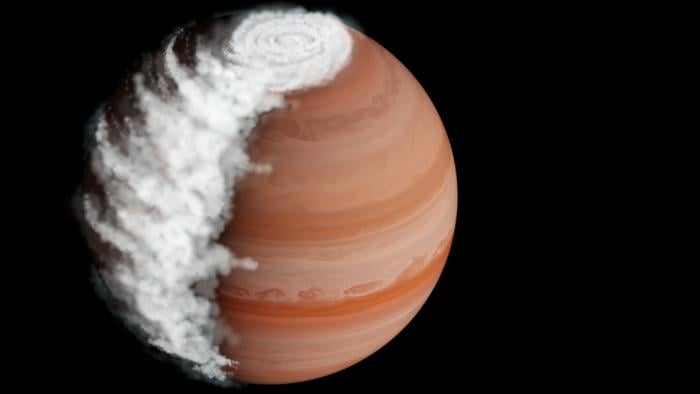
On a world some 700 light years away, the wind never stops. WASP-94A b spins one face toward its star forever, so a single hemisphere bakes at well over 1,000 degrees while the other freezes in permanent night. Between the two there’s a band where day is always breaking and another where night is always falling, and now astronomers can tell you what the weather looks like on each. Cloudy mornings. Clear evenings. Every single day.
The finding, published in Science by Sagnick Mukherjee, David Sing and colleagues, is the first proper daily weather report from a Hot Jupiter, and the clouds in question are not made of water.
They’re made of rock. Specifically magnesium silicate, the same mineral that turns up in the olivine pebbles you can sometimes scoop out of a riverbed. On WASP-94A b, droplets of the stuff condense in the cold of the planet’s night side, drift round to the dawn terminator on equatorial winds, and then get blowtorched out of existence as they cross into the day. By the time the local “evening” rolls round, the sky is clear enough that starlight can pass through and pick up the fingerprint of water vapour beneath. Which is precisely how the team caught them in the act.
It’s worth saying why this is hard. For two decades, the dominant signal in the atmosphere of any close-in gas giant has been a kind of murk.
“I’ve been looking at exoplanets for 20 years, and general cloudiness has been a thorn in our side,” says Sing, of Johns Hopkins University, who led the JWST programme. Hot Jupiters, he adds, are known to be pervasively cloudy; observing one has tended to feel like peering through a foggy window. The Hubble Space Telescope could see the murk perfectly well; what it couldn’t do was tell you what was murk and what was air.
JWST changes that. As WASP-94A b drifted across the face of its host star, the team used the telescope’s NIRISS instrument to take two separate snapshots, one at ingress when the leading edge first occluded the starlight, and one at egress when the trailing edge slid off. Because the planet is tidally locked, those two limbs aren’t equivalent. The leading edge is the morning side, where air arrives from the cold night. The trailing edge is evening, where air departs into it.
The two spectra turned out to be wildly different. On the morning limb the signal was flat and sloped, the tell-tale signature of high-altitude particles muting everything underneath; on the evening limb the absorption lines of water leapt out, clean as anything. Statistically, an asymmetric model beat a symmetric one by 6σ, which is to say comfortably. And when the team modelled the temperature profiles, the morning side came out roughly 450 kelvin colder than the evening; easily enough to drive condensation on one and vaporisation on the other. Two flavours of cloud chemistry could explain it. Either powerful day-night winds were dragging the droplets downward into the planet’s hot interior before lunchtime, burying them out of sight, or the droplets were simply boiling away at altitude as the air swept into the heat. The team can’t yet say which.
What they can say is that nobody was expecting the contrast to be this stark. Sing has called it a real dichotomy between the two sides, a difference in cloud cover so pronounced it changes the whole picture of the planet.
And that picture had been a bit of an embarrassment. Earlier analyses, working from the blurred average that Hubble could manage, had pegged WASP-94A b at roughly a hundred times the oxygen and carbon abundance of Jupiter, a result that no model of planet formation could comfortably explain. “With the Hubble telescope, when we used to do this type of observation, we got an average view of the whole planet with data from the clouds and the atmosphere squished together and indistinguishable,” says Mukherjee, now at Arizona State University and the paper’s first author. Once the team could look at the evening limb on its own, that hundred dropped to roughly five. The planet, in other words, was never weird. The clouds had been making it look weird.
The Bias Hiding in Every Hot Jupiter Spectrum
That correction matters well beyond this one world. The same trick that misread WASP-94A b has almost certainly been distorting measurements of dozens of other planets, because almost every transmission spectrum on the books treats a planet as a uniform sphere. Mukherjee and colleagues calculate that an unrecognised day-night cloud cycle would dilute a planet’s water absorption signal by a factor of about two, biasing every downstream estimate of metallicity, carbon-to-oxygen ratio and atmospheric mixing. The team have already gone back to eight other hot gas giants in their archive and found two more, WASP-39 b and WASP-17 b, showing the same morning-cloud, evening-clear pattern. It is starting to look less like a quirk of one planet and more like the default condition of the class.
What Happens When the Telescope Knows Where to Look
There’s also a stray signal in the data that didn’t quite fit anywhere else: a sliver of metastable helium at 1.083 microns, the wavelength at which a planet whose atmosphere is bleeding into space tends to give itself away. WASP-94A b, it appears, is losing mass. How much, and over what timescale, is a question for a different paper.
Sing’s team is now turning the same limb-resolved approach loose on a much wider sample, including, intriguingly, an eccentric gas giant whose orbit dips through its star’s habitable zone. The notion that you can do meteorology on a world you can’t even resolve as a single pixel, that you can tell the morning from the evening, would have sounded faintly absurd a decade ago. It doesn’t any more.
https://doi.org/10.1126/science.adx5903
Frequently Asked Questions
What is WASP-94A b actually made of?
It’s a gas giant a bit lighter than Jupiter, dominated by hydrogen and helium with about five times Jupiter’s abundance of heavier elements like oxygen and carbon. The exotic feature is its clouds, which are droplets of magnesium silicate, essentially rocky vapour that condenses high in the atmosphere. Earlier Hubble-era estimates of its bulk composition were wildly inflated because they couldn’t separate cloud effects from gas absorption.
Why are the clouds only on the morning side?
The planet is tidally locked, so one hemisphere is in permanent day at over 1,000 degrees and the other in permanent night. Cloud droplets form in the cold of the night side and ride equatorial winds onto the dawn terminator, where they’re still intact. Once they cross into the day side they either evaporate at altitude or get dragged down into the hot interior. Either way, by the time air reaches the evening terminator the sky is clear.
How does the James Webb Space Telescope tell morning apart from evening on a planet it can’t even see directly?
It uses the geometry of the transit. As the planet starts to cross its star, only its leading edge, the morning side, is silhouetted; as it finishes crossing, only the trailing edge, the evening side, is. By splitting the light curve into ingress and egress with enough precision, JWST extracts two separate atmospheric spectra. Hubble could see the transit but not split it cleanly enough to pull this off.
Does this discovery change what we know about other exoplanets?
Yes, and that’s arguably the bigger story. The team has shown that ignoring morning-evening asymmetry can bias estimates of a planet’s chemical composition by more than a factor of two. Since most exoplanet atmospheres on record were measured assuming uniform spheres, many published abundances may need revising. The same pattern has already turned up on at least two other hot Jupiters.
What’s next for this kind of research?
Sing’s group has a larger JWST programme underway to apply the same limb-resolved approach across a wide variety of exoplanets, including a gas giant on an eccentric orbit that passes through its star’s habitable zone. The technique should also work in principle for smaller worlds like sub-Neptunes, which are expected to carry their own thick aerosol layers. The era of single-pixel weather forecasting has, in a sense, already started.