

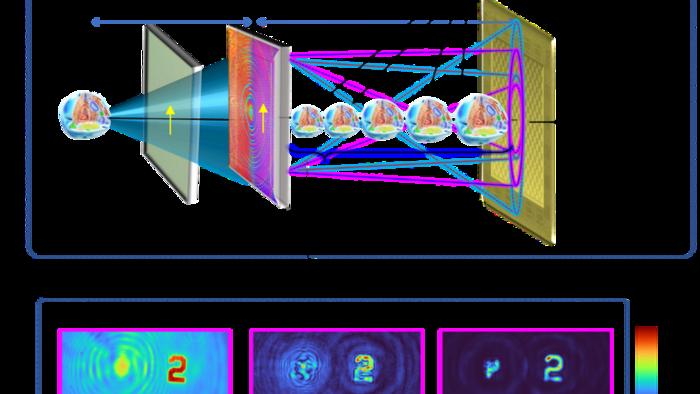
Two digits etched into a standard optics test target, a “2” and a “4”, each thinner than a human hair. The problem: they’re sitting on different planes, one of them 12 millimetres farther from the camera. Under a conventional microscope, you pick one to focus on. The other turns to mush.
Twelve millimetres is nothing, really. Barely wider than a fingernail. But in microscopy, depth of focus is ruthlessly shallow, and that sliver is more than enough to lose an object entirely.
Shivasubramanian Gopinath at the University of Tartu in Estonia reckons he’s found a way past this. Working with Joseph Rosen at Ben Gurion University in Israel and Vijayakumar Anand at Swinburne University of Technology in Melbourne, Gopinath has developed a technique that lets you record a batch of holograms and then, after the fact, computationally stitch them together to extend the depth of focus about fivefold. The key bit is that “after the fact” part. You record your holograms, walk away from the bench, and decide later how much depth you want. Nobody has been able to do that with this type of holography before.
The method builds on something called FINCH — Fresnel incoherent correlation holography — which has been kicking around since 2007. In FINCH, light from your sample gets split into two beams by a spatial light modulator, a sort of programmable optical screen. Each beam is focused at a different distance, the two interfere, and you get a hologram. It already beats a standard microscope for lateral resolution and depth of focus. But once you’ve captured your FINCH hologram, the imaging characteristics are fixed. Locked in.
Gopinath’s version, which the team have dubbed PEAR-FINCH (post-engineering of axial resolution in FINCH — yes, the acronym is a stretch), sidesteps that constraint. Rather than capturing one hologram, they record a library. Each entry uses a slightly different focal length on the spatial light modulator, giving it unique depth characteristics. Afterwards, you cherry-pick from the library and combine selected holograms into a synthetic composite that covers a far greater depth range than any single recording could manage.
The snag is noise. Stitching holograms from different conditions mixes sharp and blurred reconstructions together, which muddies things up. So the team bolted on a two-step cleanup: first a numerical back-propagation (essentially running light backwards through a virtual copy of the optical setup), then a deconvolution step using something called the Lucy-Richardson-Rosen algorithm. Takes about 1.2 seconds, all told.
It works, too. In tests reported in the Journal of Physics: Photonics, PEAR-FINCH resolved both test digits clearly where standard FINCH and direct imaging couldn’t. When the objects sat 6 mm apart, structural similarity improved by roughly 15 per cent over FINCH. At 12 mm separation, about 35 per cent. And the experiments used diffuse illumination scattered through ground glass — the sort of messy, incoherent light you’d actually get from a biological specimen, not the tidy laser beams that make lab demos look suspiciously clean.
“This level of post-recording flexibility has not been reported before,” says Gopinath, who adds that the method is “consistently outperforming both conventional direct imaging systems and standard FINCH”.
There are trade-offs, mind. PEAR-FINCH needs roughly three times as many recordings as regular FINCH, which is fine for a static sample on a bench but poses obvious difficulties for anything that moves. The team are already looking at reducing that to a single shot.
Where it could really prove useful is biological microscopy. Neurons threading through tissue, bacteria colonising surfaces at different depths — the sort of samples where structures sprawl across focal planes and you never quite know what depth matters until you’ve already looked. Being able to sort that out after the recording, at your desk, perhaps with a cup of coffee, is a genuinely new trick.
Study link: https://iopscience.iop.org/article/10.1088/2515-7647/ae38ae