

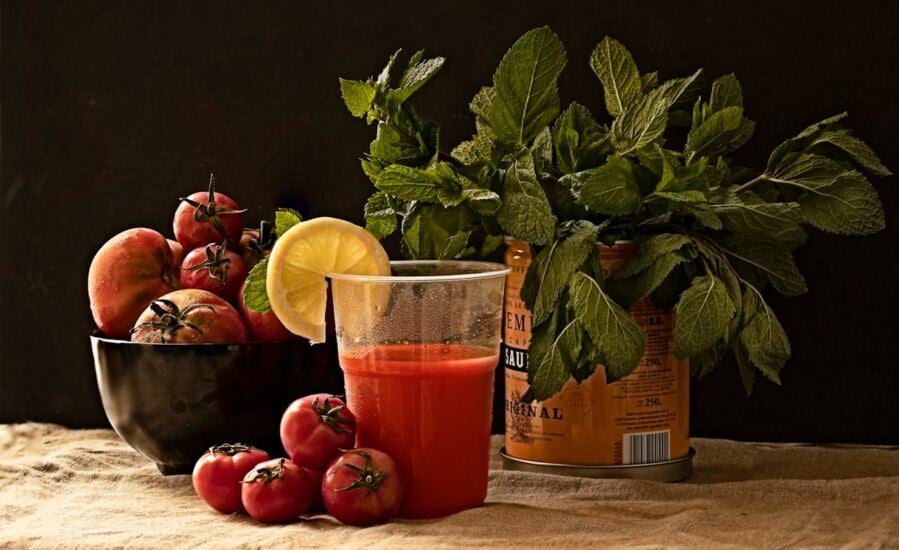
Every morning for four weeks, twelve adults with obesity drank two small cans of a deep-red juice, then had their blood drawn. The juice was thick with lycopene, enriched with powdered soy extract, salted for palatability. Jessica Cooperstone, an associate professor at Ohio State University who has spent years thinking about what tomatoes and soy might do to the human body, was not particularly interested in pleasantness. She wanted to know what was happening inside.
What she found was a measurable dampening of the kind of persistent, low-level inflammation that courses through bodies carrying excess weight. Three pro-inflammatory proteins, known as cytokines, fell significantly after four weeks on the tomato-soy juice. A fourth showed a downward trend that stopped just short of the threshold researchers use to call something statistically meaningful.
Chronic, low-grade inflammation sits at the root of an uncomfortable range of diseases. Obesity, type 2 diabetes, cardiovascular disease, certain cancers, chronic pancreatitis: all share this feature, an immune system that never quite stands down, producing a slow burn of cytokines that over years and decades erodes tissues and disrupts normal physiology. Diet is one of the few things known to influence this background signal, though exactly which foods do what, and why, has proven remarkably hard to pin down. Part of the problem is that people eat whole foods, not isolated compounds, and the interactions between molecules are fiendishly complex. “The idea is, can we use food-based interventions to modulate inflammation?” Cooperstone said. “And can we test this in a rigorous way so that we can really see this is affecting inflammation, versus just saying something is anti-inflammatory?”
A Juice 30 Years in the Making
The tomato-soy juice itself has a history. In the mid-1990s, an epidemiological study reported that men who ate at least ten servings of tomato products a week had roughly a third lower risk of advanced prostate cancer compared to those who ate almost none. Around the same time, researchers noticed that prostate cancer rates in Japan and China were far lower than in the United States, and pointed toward soy-rich diets as a possible factor. Ohio State researchers eventually bred high-lycopene tomatoes and combined their juice with a soy isoflavone extract to create a single functional beverage. Early trials showed the juice was safe and well absorbed; later work in men with prostate cancer found a dose-dependent trend toward lower PSA levels after only three weeks of drinking it.
For the new study, published in Molecular Nutrition and Food Research, the team wanted to test the same juice in a different context: obesity, where low-grade inflammation is pervasive and where dietary interventions might theoretically help. The crossover trial gave participants either the tomato-soy juice or a control juice made from a yellow-fleshed tomato variety engineered to produce almost no carotenoids, and containing no soy at all. After four weeks on one juice, a washout period, then four weeks on the other. “The hypothesis is that it’s the lycopene from the tomatoes and the isoflavones from the soy that’s inducing the effect,” Cooperstone explained, “so we didn’t want to have a control that’s just water.”
The doses were not modest. Participants received about 54 milligrams of lycopene per day (the typical American diet provides somewhere between 3 and 15 milligrams), plus roughly 190 milligrams of soy isoflavones (Western diets generally deliver fewer than 3 milligrams; traditional Japanese diets, by contrast, around 30 to 50). Blood plasma lycopene more than doubled after four weeks, reaching levels above 1,200 nanomoles per litre, concentrations that laboratory studies suggest are sufficient to inhibit inflammatory processes in cells.
Three Proteins Drop, a Fourth Nearly Follows
The cytokine findings are the headline result. Interleukin-5, interleukin-12p70, and granulocyte-macrophage colony-stimulating factor (GM-CSF) all declined significantly during the tomato-soy period; the same reductions were not seen during the control juice period. Tumour necrosis factor alpha fell too, though it landed at a p-value of 0.052, just outside the conventional cutoff. None of these proteins is especially famous outside immunology, but each plays a role in perpetuating the chronic inflammatory milieu of obesity. IL-12 stimulates the release of other cytokines from immune cells; GM-CSF, in obese animals, has been linked to inflammatory lung conditions; IL-5 is elevated in people with abdominal obesity and correlates with airway inflammation biomarkers. All three are regulated, at least in part, by a master inflammatory switch called NF-kB, which both lycopene and soy isoflavones have been shown, separately, to suppress in animal models.
But the study’s urine data complicated any simple two-compound story. Using an approach called untargeted metabolomics, the team screened thousands of molecular features in participants’ urine before and after each intervention. The tomato-soy juice produced a dramatically distinct urinary profile, dominated by soy isoflavone metabolites, particularly ethylphenol sulfates derived from genistein (a finding the researchers believe may be the first reported in human urine) and conjugates of a compound called O-desmethylangolensin produced from daidzein. Notably, though, both juice interventions, including the low-lycopene, soy-free control, raised urinary levels of naringenin glucuronides, a class of metabolites derived from flavonoids naturally present in tomatoes. Several putative phenolic catabolites also rose in response to both juices. “This is probably a function of the fact that there’s more to our intervention agents than just these two compounds,” Cooperstone said.
The metabolomics work also turned up a suggestive reduction in medium-chain acylcarnitines, a class of fatty acid metabolites typically elevated in low-grade chronic inflammation, in both intervention groups. Whatever is dampening inflammation here may not be lycopene and isoflavones alone.
Twelve People, and What That Means
Twelve participants is not a large clinical trial. Cooperstone and her colleagues are forthright about this. The study was originally designed to enrol at least 30 people, with the sample size calculated to detect changes in specific cytokines including TNF-alpha and IL-6. The Covid-19 pandemic made that target impossible, and several inflammation markers the study was powered to detect never reached significance. A post-hoc calculation suggests around 108 people would have been needed to detect differences in IL-6 specifically. The results should be read as hypothesis-generating rather than proof of an effect.
Whether those effects are clinically meaningful is also an open question. Metabolomics identifies molecular changes in urine, but the compounds detected here were not quantified in absolute terms, making it hard to say whether the biological effects implied by their presence are large or trivial. “Ultimately, we want to have a better understanding of how the foods that we eat are relating to our health,” Cooperstone said. “And when we really want to be sure, we need to test them in clinical trials. And that’s what we’re doing here.”
That next trial is already underway, in a different patient group. Cooperstone’s team has secured funding from the National Institute of Diabetes and Digestive and Kidney Diseases to test whether the same tomato-soy juice reduces inflammation in people with chronic pancreatitis, a condition managed mostly by treating symptoms rather than the underlying disease process. Animal model data from Cooperstone’s group suggests the juice reduces IL-5, TNF-alpha, and disease severity in pancreatitis models. “Care for patients with pancreatitis is palliative, focused on controlling pain and GI symptoms,” she said. “Our hypothesis is that the tomato-soy juice may serve as an intervention to decrease inflammation and hopefully increase patients’ quality of life.” If the urine metabolomics from the obesity study is any guide, the mechanisms driving those effects will be more complicated, and probably more interesting, than anyone initially assumed.
https://doi.org/10.1002/mnfr.70420
Frequently Asked Questions
Can drinking tomato juice actually reduce chronic inflammation?
The evidence is promising but early. A small clinical trial found that a tomato-soy juice high in lycopene and soy isoflavones significantly lowered three pro-inflammatory proteins in adults with obesity after four weeks, while a control tomato juice without those compounds did not produce the same effect. Whether this translates into long-term health benefits, and in what doses, is still being worked out in larger trials.
What is it about tomatoes and soy that might fight inflammation?
Both lycopene (the pigment that makes tomatoes red) and soy isoflavones are known to interfere with a molecular switch called NF-kB, which controls the production of many pro-inflammatory proteins. The new study found that metabolomics analysis of participants’ urine also revealed changes from compounds beyond just those two, suggesting the tomato matrix itself contributes something independent of lycopene. What those additional compounds are, and how much they matter, is an active area of research.
Why is tomato-soy juice being tested for pancreatitis?
Chronic pancreatitis is driven by persistent inflammation and is currently treated mostly by managing symptoms rather than the underlying disease. Ohio State researchers found in animal studies that the same tomato-soy juice reduced inflammatory markers and disease severity in pancreatitis models, and have now launched a funded clinical trial to test whether the same effect holds in humans. The hope is that a dietary intervention could improve quality of life for patients who have few other options.
Does everyone process soy compounds the same way?
No, and this is one of the complicating factors in interpreting dietary intervention studies. The metabolomics data from this study showed considerable variation between participants in how they metabolised soy isoflavones, particularly daidzein. About 17 per cent of participants were “equol producers,” able to convert daidzein into a distinct compound via gut bacteria, compared to roughly a quarter of Western adults in broader studies. Those differences in gut microbiome composition may well influence how much benefit any individual gets from soy-rich foods.