

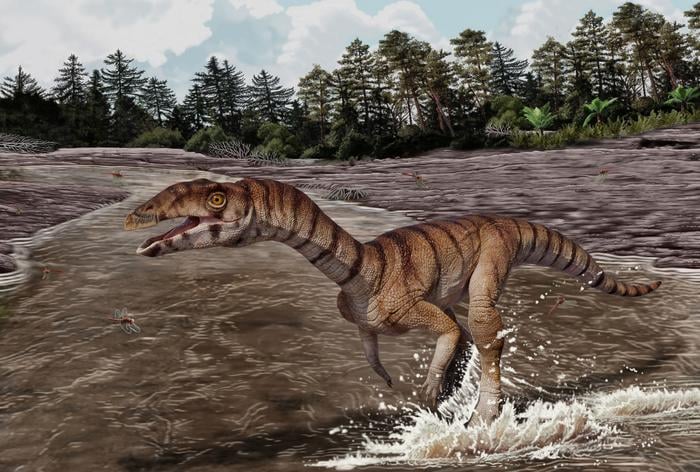
Crocodiles are, broadly speaking, a conservative bunch. Four legs, armored back, mouth full of teeth, attitude of total indifference to your wellbeing. They have looked roughly like this for 80 million years, which is either a tribute to the effectiveness of the design or a commentary on how little ambition a cold-blooded apex predator needs. But wind the clock back another 130 million years, to a world before the dinosaurs had fully taken hold, and the crocodile family tree gets considerably weirder. At its edges, you find animals like Labrujasuchus expectatus, which walked on two legs, had arms so reduced they were nearly vestigial, and had a beak where a snout full of teeth should have been.
The newly described species, unearthed from the iconic badlands of Ghost Ranch in northern New Mexico, is the fifth known member of Shuvosauridae, a group of Triassic crocodile relatives that evolved to look almost nothing like crocodiles. Their closest living relatives are the crocodilians; their body plan, however, rhymes far more closely with the ostrich-like ornithomimosaur dinosaurs that wouldn’t evolve for another hundred million years or so.
This is what palaeontologists call convergent evolution, and the Triassic is full of it. That period, roughly 252 to 201 million years ago, was a kind of evolutionary laboratory where body plans we think of as distinctively modern or distinctively dinosaurian kept cropping up in wildly unrelated lineages. “We see a lot of the successful strategies for modern animals and non-avian dinosaurs first arise in the Triassic, and shuvosaurs are a great example of that convergent evolution,” says Dr. Alan Turner of Stony Brook University, lead author on the paper describing the new species. “Bipedalism is certainly a unique path for crocodile relatives to take, but it’s a path well-trod by dinosaurs and later birds. It obviously worked for these animals.”
The paper, published in the Journal of Vertebrate Paleontology, gives the animal a name that owes as much to local folklore as to its anatomy. Labrujasuchus combines “la bruja,” witch, from the old Spanish name for the Ghost Ranch area, “Ranchos de los Brujos,” with the Greek suchus, meaning crocodile. The species name expectatus, from the Latin for “expected” or “awaited,” is a nod to something rarer in palaeontology than you might think: a prediction that came true.
That prediction was almost embarrassingly simple in retrospect. Two other North American shuvosaurids were already known, one from sediments about 218 million years old and one from rocks around 205 million years old. Between them sat a temporal gap of thirteen million years with no fossil record for the group. A third species had to exist somewhere in there; the fossil record just hadn’t yielded it yet. “…finding one shuvosaur from earlier in the Triassic and one from later meant that we paleontologists knew there were probably more from in-between waiting to be discovered and described,” says Dr. Nate Smith, co-author and Dinosaur Institute Director at the Natural History Museum of Los Angeles County. The holotype skeleton, discovered in 2006 in a tight cluster covering less than two square meters of ancient riverbed, slots neatly into that interval at roughly 212 million years old.
Ghost Ranch is, in geological terms, almost absurdly productive. The site has yielded more than 20,000 vertebrate fossils since excavation began, including fish, lagerpetids (bipedal dinosaur relatives whose cousins would eventually become pterosaurs), the strange tree-dwelling Drepanosaurus with its sloth-like claws and prehensile tail, and a dizzying array of early archosaurs. This summer marks the 20th anniversary of Smith and his colleagues coming out to excavate the Hayden Quarry. The site’s name carries its own peculiar history. “Legend has it, the local rancheros gave the site the name ‘Ranchos de Los Brujos’ to keep folks away from the cattle-rustling operations of the Archuleta brothers,” Smith says.
What makes Labrujasuchus interesting beyond its sheer improbability is how little it differs from its shuvosaurid relatives. The three named North American species, spanning at minimum ten million years of Triassic history, are startlingly similar to one another. A Bayesian analysis of archosaur evolutionary rates found the shuvosaurid lineage evolved morphologically at roughly one-third the rate of its archosaur contemporaries, meaning the group essentially locked in a body plan and stuck with it while everything around them was diversifying furiously. The teardrop-shaped humeral head, the hooked anteromedial tuber on the femur, the reduced forelimb proportions: all of these are present in Labrujasuchus just as they are in the earlier Shuvosaurus and the later Effigia okeeffeae. Whatever ecological niche these animals occupied in the Triassic American southwest, it seems to have rewarded consistency.
That consistency creates a taxonomic puzzle. Because shuvosaurids changed so slowly, isolated bones are almost impossible to assign to species. Most of the group’s fossil record consists of exactly these kinds of fragments, scattered across the Chinle Formation of Arizona and New Mexico and the Dockum Group of Texas. The authors suspect the actual number of shuvosaurid species is considerably higher than five, perhaps with each geological sub-unit of the Chinle hosting its own distinct form. But without associated skeletons, you can’t really prove it.
There is also the question of where the group came from and where it went. North American shuvosaurids appear to have been endemic to the American southwest; despite decades of searching, nothing convincingly placed within the clade has turned up elsewhere, though possible candidates have been reported from Zambia and India.
The Triassic is often described as the world before the world we know, a planet running an earlier version of itself where ecological solutions were still being field-tested. Bipedal herbivores with beaked mouths would become enormously successful in the Cretaceous as ornithomimosaurs, and again later as ostriches and emus and rheas. Shuvosaurids got there first, thriving for millions of years in the American southwest before vanishing entirely at or near the end-Triassic extinction, their particular branch of the crocodile family tree snipped off cleanly by whatever catastrophe closed the period. The dinosaurian lineage that would later reinvent the same body plan survived it. That’s not a moral, exactly. It’s just what happened.
Understanding why some lineages persist and others don’t is one of palaeontology’s enduring preoccupations, and Ghost Ranch keeps providing the raw material to think it through. Twenty years of digging, and the badlands are still giving up new witches.
https://doi.org/10.1080/02724634.2026.2618182
Frequently Asked Questions
How can a crocodile relative end up looking like an ostrich?
Convergent evolution. When two distantly related lineages face similar ecological pressures, they can independently arrive at similar body plans. Bipedalism with reduced forelimbs and a toothless beak suits a certain kind of fast-moving, plant-eating lifestyle, and both shuvosaurids and later ornithomimosaur dinosaurs seem to have found their way there by different evolutionary routes. The Triassic world was full of these kinds of parallels, which is part of what makes it so disorienting to study.
Why did shuvosaurids barely change for ten million years?
This is genuinely not fully understood, but the leading hypothesis is that they occupied a stable ecological niche that rewarded consistency rather than innovation. Statistical analyses of archosaur evolutionary rates suggest shuvosaurids evolved their skeleton at about one-third the pace of their contemporaries, a pattern that held across the entire group and across the full span of their known fossil record. Whether this reflects a particularly successful body plan, a lack of competitive pressure, or something else is still an open question.
Was Ghost Ranch always considered such an important fossil site?
It became famous in palaeontological circles relatively early, partly through the discovery of massive Coelophysis bonebeds in the 1940s, and partly through the landscape’s extraordinary preservation conditions. The site has now yielded over 20,000 vertebrate fossils, spanning fish, early dinosaurs, and bizarre Triassic reptiles that belong to no modern group. The Hayden Quarry specifically, where Labrujasuchus was found, has been continuously excavated for two decades and continues to produce new species.
Could there be more shuvosaurid species still undiscovered?
Almost certainly. The authors of the new study believe the actual species count is likely much higher than the five currently named, possibly with each geological subdivision of the Chinle Formation hosting its own distinct form. The problem is that shuvosaurids evolved so slowly that isolated bones are nearly impossible to assign to a particular species, and most of the fossil record consists of exactly those kinds of isolated fragments. New associated skeletons, like the Labrujasuchus holotype, are the only reliable way to add new names to the list.