

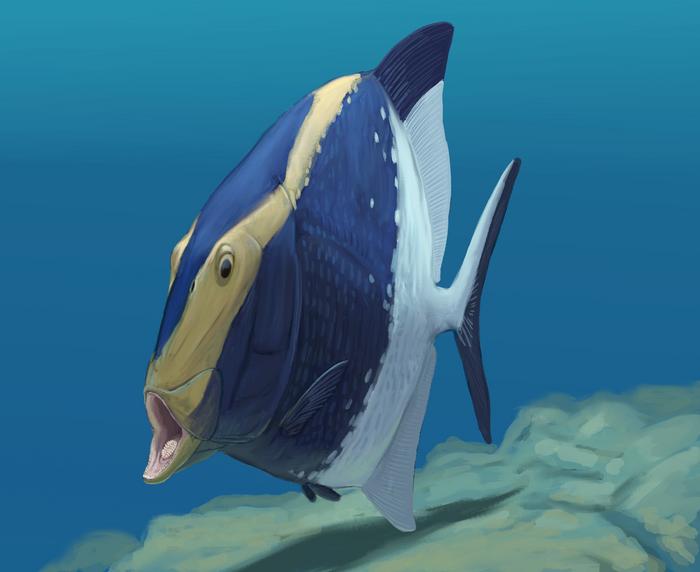
The earliest known tongue bite has turned up in a 310 million year old fish. Using high resolution CT scans of a three dimensional fossil from Staffordshire, an international team shows that the deep bodied ray finned fish Platysomus parvulus carried opposing tooth plates in its mouth and on its gill skeleton, a tongue bite that helped crush shells and insects.
The study, led by Sam Giles at the University of Birmingham and published in Biology Letters, places this innovation soon after the End Devonian extinction and suggests a stepwise path toward the more elaborate systems seen later in bobasatraniids.
The fossil that opens its mouth from the inside
In London, Birmingham, and Ann Arbor, a small fossil skull rode the humming belt of micro CT scanners as X rays stitched the interior into view. The scans reveal an oval field of lower tooth plates, six tightly packed pieces arranged in two rows of three, directly opposing a narrow upper plate on the vomer. Both bear a single layer of pointed cusps. It is a clean, almost surgical geometry, the kind of internal architecture that only a three dimensional specimen can keep intact. And it is old, Carboniferous old, when ray finned fishes were experimenting with new shapes and new ways to feed.
“Our discovery helps us understand how fish evolved after the End-Devonian Mass Extinction, which wiped out many species.”
— Sam Giles, University of Birmingham, in a University of Birmingham press release
What is a tongue bite in fish?
Unlike the jaw bite most of us picture, a tongue bite is an inner processing zone that uses opposing tooth fields on the roof of the mouth and midline gill elements to grip, rake, or crush prey. In Platysomus parvulus, the multi part basibranchial plate below meets a vomer centered upper field above. The study argues this represents a transitional phase toward the later bobasatraniids, which evolved massive, layered, grinding plates and even toothless, flow governing jaws. The primary keyword here is tongue bite, and the mechanism matters because it decouples prey processing from the jaws, opening new ecological possibilities.
A step before the crusher
Several details point to an intermediate, not yet fully specialized, system. The upper plate is narrow and relatively flat rather than broad and convex. The lower plate is a composite of six elements rather than a single block. And both plates show a single generation of teeth, not the stacked, phyllodont layers that scream heavy duty crushing. In other words, Platysomus still used its slender, toothed jaws, while the basibranchial plates added an inner station for food manipulation and reduction. That hybrid strategy reads as a bridge, a quiet engineering step that later allowed bobasatraniids to offload chewing inside and free their jaws for other tasks like fluid control.
“Later fish, like the Bobasatrania group, had more advanced tongue bites and did not use their jaws at all, relying on their tongue bite to crush hard food.” — Matthew Kolmann, University of Louisville, in a University of Birmingham press release
The long aftershock of an extinction
The timing is telling. Durophagy, eating hard prey, shows up in other Carboniferous ray fins earlier, including eurynotiforms with consolidated plates and beak like jaws. Platysomus arrives later, but it inaugurates a different solution, shifting work inward to the gill skeleton. That staggering of innovations supports a protracted, not explosive, diversification after the End Devonian. It also hints at convergence, the way multiple lineages found different mechanical answers to the same ecological prompt, hard food everywhere. If that sounds familiar, it should. Evolution repeats ideas when they work.
Why it matters beyond the fossil slab
The human stakes sit in the principle, not the fish. Tongue bites are about modularity, about adding a second processing line when one is not enough. From bonefish chewing crustaceans on robust inner plates to bony tongues that rake prey with fangs, the same trick recurs. For paleobiologists, Platysomus parvulus does more than push a record back by 150 million years. It lets us watch an assembly sequence, plate by plate, tooth by tooth, and situate it in a broader Carboniferous story that led to modern ray finned diversity. One might ask, what else is hiding inside the skulls we thought we already knew?
As co-author Matt Friedman notes, tongue bites were one among many feeding innovations in this interval, and Platysomus helps clarify how ancient ecosystems functioned and how modern lineages came to be. The repetition matters. Innovation, then repetition, then refinement. The rhythm is as old as fish and as current as any lab centrifuge.
Micro explainer: Tongue bites, in plain English
A tongue bite is an inner mouth tool. Think of it as a second bite station behind the jaws where two sets of teeth meet, one on the mouth roof, one on midline gill bones. Together, they grip, scrape, or crush food before it slides into the throat. In Platysomus parvulus, the lower part is a multi piece plate on the gill skeleton and the upper part sits on the vomer, a midline palate bone. Later relatives built thicker, layered plates for heavy crushing and even reduced jaw teeth, channeling water and food inward. The result is flexibility, a wider menu, and more ways to make a living.
Journal: Biology Letters. DOI: 10.1098/rsbl.2025.0270