

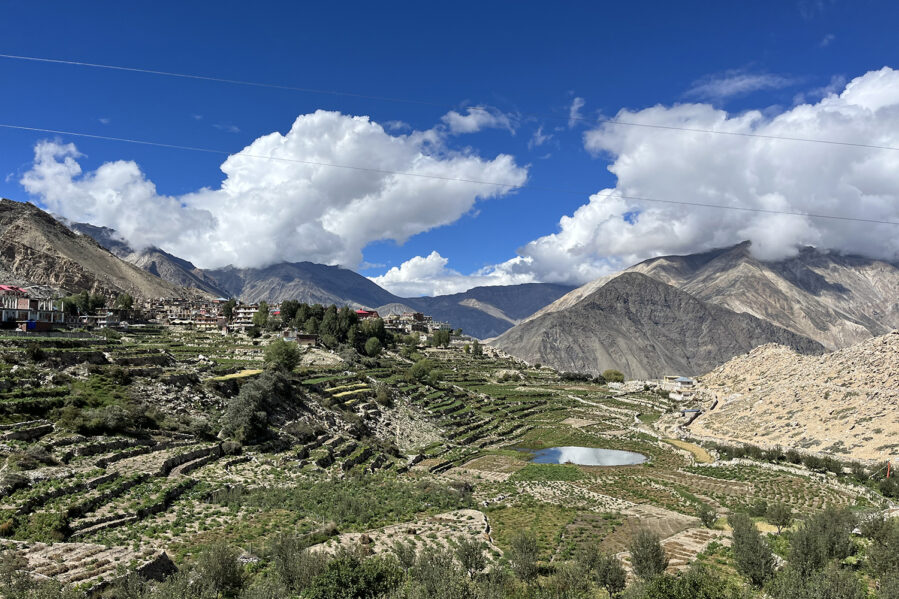
What if the seed of future food security has been hiding at 4,500 meters? In the Indian Trans-Himalaya, researchers working with farmers in Spiti Valley, Himachal Pradesh, report that a traditional crop known locally as black pea outperforms an introduced cash crop, green pea, across survival and reproduction measures.
The study, led by Harman Jaggi and colleagues and published August 15, 2025 in Science Advances, also delivers the first whole-genome sequencing data for the Himalayan black pea, revealing distinct genetic clusters. With biocultural vulnerability rising as market forces displace traditional crops, the findings point to an overlooked source of climate resilience and nutrition that could strengthen mountain food systems and beyond.
A Living Archive Of DNA And Culture
Black peas and barley are more than crops in the Trans-Himalaya. They are part of daily recipes, ceremonies, and farming know-how refined over millennia. The team’s participatory field experiments, designed with local farmers, compared black pea and barley to green pea across elevations near 4,000, 4,200, and 4,500 meters. Results echoed community experience, where traditional crops endure cold, drought, and thin air better than market varieties.
“This work is path-breaking in many respects,” said Tuljapurkar, the Dean and Virginia Morrison Professor in Population Studies in H&S and the study’s senior author. “I think our results are promising for the study population and also suggest many generalizations and extensions to other populations that are balanced between traditional and modern lifestyles.”
Key Findings At A Glance
- Higher establishment and survival: Black peas and barley showed greater establishment rates than green peas across sites, including a 0.51 mean establishment for black pea at Kiamo (about 4,000 m).
- Reproductive edge at mid elevations: At 4,000 m and 4,200 m, black pea had a higher survival-weighted flowering proportion than green pea. At 4,500 m, green pea edged black pea in flowering (0.30 vs 0.20), and both performed worse overall.
- Faster growth: Linear mixed models estimated growth rates of 0.8951 for black pea, 0.604 for barley, and 0.428 for green pea.
- Genetic distinctness: First whole-genome data for black pea (approximately 15× coverage, 86.6% breadth) revealed chromosome-wide PCA and clustering patterns that did not group with domesticated P. sativum var. arvense. Black pea clustered with traditional Asian landraces, suggesting a distinct genetic resource.
- Dense nutrition: Black pea measured about 21.20% protein per 100 g, with 15.9% dietary fiber, plus notable magnesium (109.28 mg/100 g), calcium (108.09 mg/100 g), iron (9.11 mg/100 g), and vitamins C, B1, and B3.
Why It Matters
Traditional crops carry biocultural heritage and adaptive traits tuned to place. In the Trans-Himalaya, climate is warming fast, water is scarce, and livelihoods are tightly bound to local ecology. The study documents how market transitions that began in the 1980s pushed green peas and apples into fragile systems, elevating risk. Protecting and advancing black pea and barley could reduce vulnerability while honoring the knowledge that shaped these crops.
From Farm Plots To Policy
The authors recommend recognition of Trans-Himalayan agroecosystems within the FAO’s Globally Important Agricultural Heritage Systems framework. Such designation could help safeguard traditional practices, stimulate markets for resilient crops like black pea, and support eco-cultural tourism in landscapes that also shelter snow leopards. The genetic signals uncovered here strengthen the case for breeding programs that tap black pea diversity to improve drought and heat tolerance in commercial varieties.
Methods In Brief
Participatory field experiments ran March through September 2023 across three elevations, with water treatments tailored to farmer practice. Growth, flowering, and pod data were recorded throughout the season. Genomics work generated the first whole-genome dataset for black pea and compared it to published Pisum accessions using chromosome-wide PCA and multiple clustering approaches. A standardized nutritional profile was developed with the Council of Scientific and Industrial Research’s Central Food Technological Research Institute in Mysuru, India.
A Familiar Playbook, A New Crop
Quinoa rose from overlooked Andean staple to global climate-crop symbol through a mix of science, markets, and respect for origin communities. Black pea may follow a similar arc in Asia if research, breeding, and fair-market development move in step with local priorities. The difference, and the opportunity, is to center mountain farmers from the start.
Citation
Science Advances, 15 Aug 2025, Vol 11, Issue 33. DOI: 10.1126/sciadv.adu6611
Data and materials: NCBI BioSample accession SAMN44380099; project PRJNA1176116. Code and data: Dryad, https://doi.org/10.5061/dryad.6t1g1jx88.