

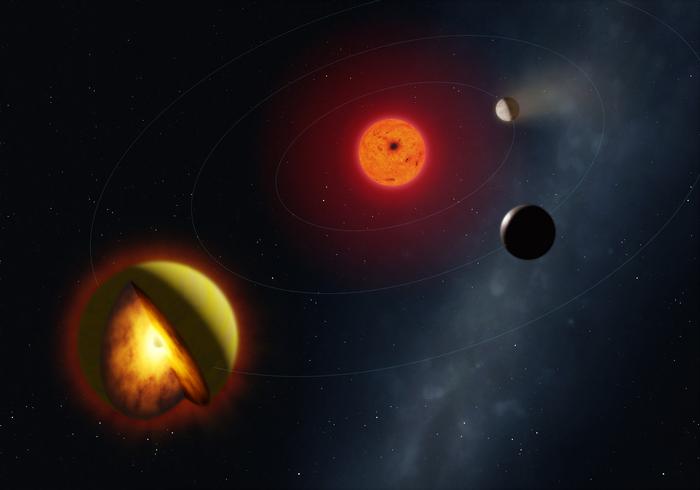
The numbers didn’t add up. When astronomers trained the James Webb Space Telescope on a small world called L 98-59 d, roughly 35 light-years away, they got back something that made them reach for the textbooks, and then set those textbooks aside. The planet was too light for its size. Its atmosphere carried the chemical signature of hydrogen sulfide, the same compound responsible for the smell of rotten eggs. And neither of the two categories that planetary scientists have used for decades, rocky gas-dwarf or water-rich ocean world, could account for what the data were showing.
That puzzle is what sent Harrison Nicholls and his colleagues at the University of Oxford, the University of Groningen, the University of Leeds and ETH Zurich to their computers. Their answer, published today in Nature Astronomy, is that L 98-59 d belongs to something new entirely: a world with a permanent ocean of magma thousands of kilometres deep, soaked in sulfur, wrapped in a thick hydrogen-rich atmosphere that really shouldn’t still be there.
To work out what the planet actually looks like inside, the team ran nearly 900 computer simulations, each tracing the world’s history from its molten infancy roughly five billion years ago to the present. Planetary interiors can’t be visited, obviously; what we can measure from Earth is a planet’s size, its mass, and the composition of its atmosphere. So the researchers worked backwards, building models that began with different starting conditions and asking which ones produced a planet matching what JWST actually observed. Only a narrow range of scenarios made it through. They all had one feature in common: a mantle still almost half molten today, kept that way by atmospheric blanketing and the kneading of tidal forces from the host star.
The sulfur part is where it gets genuinely odd.
In a solid planet, sulfur eventually escapes. Volatile gases get stripped away by radiation from the star, and over billions of years, a rocky world sheds its more delicate chemistry. But in a magma ocean, sulfur has somewhere to hide. It dissolves into the melt, stored in the deep interior rather than exposed to the stellar winds overhead. As the planet slowly cools and parts of the magma ocean crystallise, sulfur gets squeezed back out into the atmosphere, replenishing what escapes. The result is a world that has maintained its sulfurous character across geological time in a way a solid planet simply couldn’t.
The sulfur dioxide detected high in L 98-59 d’s upper atmosphere adds another layer to this. SO2 isn’t simply bubbling up from the surface; the team’s photochemical models show it’s being manufactured in situ, when ultraviolet light from the host star converts hydrogen sulfide into something rather more noxious. That ultraviolet-driven chemistry only works in the presence of water vapour as well, which means the atmosphere probably isn’t as dry as some earlier analyses suggested. Future JWST observations are likely to test that.
“What’s exciting is that we can use computer models to uncover the hidden interior of a planet we will never visit,” says Professor Raymond Pierrehumbert of Oxford. “Although astronomers can only measure a planet’s size, mass and atmospheric composition from afar, this research shows that it is possible to reconstruct the deep past of these alien worlds, and discover types of planets with no equivalent in our own Solar System.”
That phrase, no equivalent in our own Solar System, is worth sitting with for a moment. The Earth, Venus and Mars all started with magma oceans; that’s more or less universal for rocky planets in the early, violent stages of formation. But all of them solidified. Tidal heating from Jupiter doesn’t keep Io in a truly global melt, and none of our neighbours has managed to sustain the combination of atmospheric pressure and interior warmth that seems to be keeping L 98-59 d molten after nearly five billion years. In a sense, the planet is a snapshot of something our own world passed through and left behind, preserved in amber.
It was also, the models suggest, probably considerably bigger once. Early in its history, L 98-59 d likely sat on the sub-Neptune side of what planetary scientists call the radius valley, a gap in the size distribution of exoplanets that marks a rough boundary between worlds with thick atmospheres and those that have been stripped bare. Radiation from the star has been slowly eroding the atmosphere ever since, shrinking the planet towards its current size. At some point in the next billion years or so, it may lose enough of its volatile budget to solidify and join the stripped rocky planets on the other side of that divide.
“Our computer models simulate various planetary processes, effectively enabling us to turn back the clock and understand how this unusual rocky exoplanet, L 98-59 d, evolved,” says Dr Richard Chatterjee of the University of Leeds. “Hydrogen sulphide gas, responsible for the smell of rotten eggs, appears to play a starring role there. But, as always, more observations are needed to understand this planet and others like it. Further investigation may yet show that rather pungent planets are surprisingly common.”
That last possibility is perhaps the most interesting part. If L 98-59 d represents a class of planet that astronomers have been misidentifying, filing it under ‘gas-dwarf’ or ‘water world’ when it belongs somewhere else entirely, then the same misidentification has probably been happening for dozens or hundreds of similar worlds. The next generation of telescopes, including the ESA missions Ariel and PLATO, should deliver enough new atmospheric data to start testing that. Nicholls and colleagues plan to run their simulations against those future datasets using machine learning methods, effectively building a map of how this kind of volatile-rich, sulfurous world might be distributed across the galaxy.
“This discovery suggests that the categories astronomers currently use to describe small planets may be too simple,” says Nicholls. “We may then ask: what other types of planet are waiting to be uncovered?”
DOI / Source: https://doi.org/10.1038/s41550-026-02815-8
Frequently Asked Questions
L 98-59 d is an exoplanet about 35 light-years from Earth, roughly 1.6 times the size of our planet but unexpectedly low in density. New research shows it has a permanent global ocean of molten rock thousands of kilometres deep and an atmosphere rich in hydrogen sulfide, the compound responsible for the smell of rotten eggs. This combination doesn’t match either of the two categories astronomers have traditionally used for small planets.
What is a magma ocean and why does this planet still have one?
A magma ocean is exactly what it sounds like: a global layer of molten silicate rock, similar to lava, covering the planet’s interior. In L 98-59 d’s case, it persists because tidal forces from the host star and the insulating effect of a thick atmosphere keep the interior hot enough to stay liquid. All rocky planets, including the early Earth, began with magma oceans, but most solidified within a few hundred million years. This world appears to have maintained one for nearly five billion years.
The planet’s atmosphere contains significant amounts of hydrogen sulfide, a sulfur-bearing gas with a distinctive unpleasant odour. This gas is produced when the magma ocean degasses sulfur, which dissolves into the melt and is slowly released as parts of the interior crystallise. Sulfur dioxide is also present higher in the atmosphere, generated by ultraviolet light from the host star driving chemical reactions among the sulfur compounds.
By running nearly 900 computer simulations of the planet’s possible history from birth to present day, then comparing the outcomes against what the James Webb Space Telescope actually observed. Each simulation tested a different starting composition and tracked how the planet’s size, density and atmospheric chemistry would evolve over roughly five billion years. Only scenarios with a permanent magma ocean and a large initial sulfur and hydrogen content matched the observations.
Possibly. The researchers suspect that planets like L 98-59 d may have been miscategorised in the past, lumped in with gas-dwarfs or water worlds when they actually represent a distinct third type. Data from the upcoming ESA missions Ariel and PLATO should help settle this. If sulfur-rich magma-ocean worlds turn out to be common, it would significantly expand our picture of the variety of planets that exist in the galaxy.
Key Takeaways
- L 98-59 d is a unique exoplanet with a permanent ocean of magma and a hydrogen sulfide-rich atmosphere, defying traditional planet classifications.
- Researchers used 900 computer simulations to determine L 98-59 d’s structure, revealing a nearly half-molten mantle maintained by tidal heating and atmospheric conditions.
- Sulfur remains dissolved in the magma ocean, allowing L 98-59 d to sustain its sulfurous atmosphere over billions of years.
- The discovery suggests that many similar planets may exist, previously misidentified as gas-dwarfs or water worlds, expanding our understanding of exoplanets.
- Future observations from new telescopes will help validate these findings and may reveal other unique planetary types.