

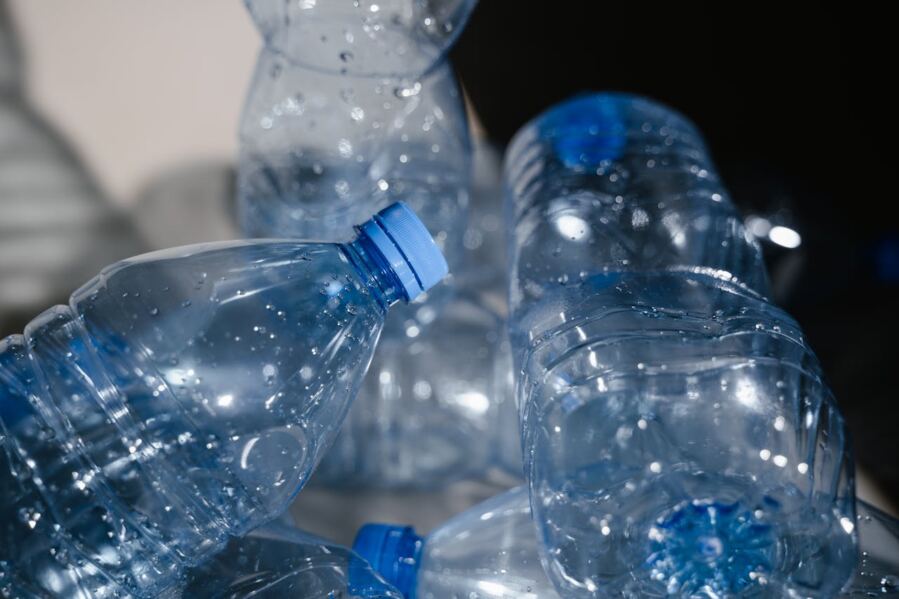
In a lab at the University of Edinburgh, a discarded plastic bottle sits in a flask of alkaline solution, slowly coming apart. Not recycled, exactly. Something stranger than that. Within hours the bottle’s polymer chains have broken down into their chemical building blocks, and within a few days, engineered bacteria will have transformed those molecules into a drug that helps Parkinson’s patients move, speak, and live.
The drug is L-DOPA, a frontline treatment for Parkinson’s disease taken by millions of people worldwide. The plastic is polyethylene terephthalate, or PET, the material in nearly every drinks bottle you’ve ever touched. Researchers at Edinburgh have now demonstrated, for the first time, that a biological process can convert post-consumer PET waste directly into this neurological medicine, publishing the results this week in Nature Sustainability.
The chemistry starts at the monomer level. When PET breaks down, it yields terephthalic acid, the aromatic compound that gives the polymer its backbone. The Edinburgh team, led by Professor Stephen Wallace, engineered strains of the common laboratory bacterium Escherichia coli to take that molecule through a four-step transformation, using seven genes drawn from organisms as varied as a soil bacterium from Japan and a microbe found in the human mouth. The end product is L-DOPA, a molecule that brain cells use as a precursor to dopamine. In Parkinson’s disease, dopamine-producing neurons die off progressively, and the drug helps compensate for what’s lost.
Getting bacteria to perform this particular chemical trick turned out to be harder than it sounds. Two serious bottlenecks appeared early on. First, terephthalic acid doesn’t diffuse readily across bacterial cell membranes at neutral pH, so the team added a transporter gene borrowed from another species to help it through. Then a more subtle problem: an intermediate compound in the pathway, protocatechuate, was silently poisoning the final enzyme before it could finish the job.
The solution the researchers hit upon was almost elegant in its simplicity. Rather than trying to engineer their way around the inhibition in a single bacterial strain, they split the pathway across two separate strains and ran them sequentially. The first strain converts terephthalic acid to catechol; the second converts catechol to L-DOPA. By keeping the troublesome intermediate away from the final step, they got the reaction to completion. At their best, the engineered bacteria produced 5 grams of L-DOPA per litre of reaction mixture, all at room temperature in water, without the solvents and high pressures that conventional pharmaceutical synthesis typically requires.
“Turning plastic bottles into a Parkinson’s drug isn’t just a creative recycling idea,” said Dr Liz Fletcher, Director of Impact at the Industrial Biotechnology Innovation Centre, which co-funded the work. “It’s a way of redesigning processes that work with nature to deliver real-world benefits.”
The process was tested on actual rubbish. A bottle retrieved from a waste bin at the university was chemically broken down, and its terephthalic acid fed into the bacterial reactor. So was a batch of industrial hot stamping foil waste, the thin PET film used to apply metallic finishes to packaging and labels, which generates an estimated 40,000 tonnes of plastic waste per year globally and currently has almost nowhere to go. Both worked. From roughly 260 milligrams of stamping foil-derived material, the team isolated 193 milligrams of solid L-DOPA, enough for several clinical doses of the kind typically prescribed in early-stage Parkinson’s disease. The aromatic ring structure of the original plastic molecule, intriguingly, is preserved throughout the entire synthesis and ends up embedded in the drug itself, meaning no new carbon from fossil sources is needed at any point.
There’s a further wrinkle worth noting. The process releases CO2 at one stage, when an intermediate is decarboxylated. As a proof of concept, the team showed that a species of green alga could be grown alongside the bacterial reactor and would absorb that CO2 through photosynthesis, pulling it back out of the equation. They also powered the bacterial transformation using glucose recovered from surplus bread waste, replacing the standard laboratory glucose entirely. Neither of these sustainability add-ons is fully developed yet, and the researchers are careful to say so; the life-cycle economics of the full system still need rigorous independent assessment.
The numbers illustrate the limits too. L-DOPA is produced commercially at roughly 250 tonnes per year worldwide. Global PET waste runs to about 50 million tonnes annually. The maths make clear this pathway isn’t meant to replace conventional recycling or eat meaningfully into the plastic mountain; it’s more useful as a model for what high-value biological manufacturing might look like when the feedstock is waste carbon rather than petroleum. The team’s own paper notes that the pathway is being proposed as one component of a broader bio-upcycling portfolio, not a standalone solution.
What the Edinburgh group has perhaps most clearly demonstrated is that the chemical information locked inside plastic waste is more interesting than anyone thought. PET’s aromatic backbone, a structural feature that makes it durable and difficult to break down, turns out to be metabolically useful once you know how to approach it. Other research teams have already used similar biological routes to make vanillin, paracetamol, and adipic acid from PET-derived monomers. The Wallace lab has previously converted PET waste into vanillin and adipic acid themselves. L-DOPA, a genuine therapeutic for a serious neurological disease, is a step up in complexity and clinical relevance.
“Plastic waste is often seen as an environmental problem,” said Wallace, “but it also represents a vast, untapped source of carbon… By engineering biology to transform plastic into an essential medicine, we show how waste materials can be reimagined as valuable resources that support human health.” The next stages involve scaling up the process, integrating the pathway into bacterial genomes to remove the need for antibiotic selection, and conducting the kind of cost and environmental analyses that would tell you whether this could ever work outside a university lab. Whether it gets there depends partly on whether the chemistry scales and partly on how pharmaceutical manufacturers reckon the economics. But the bottle has already become the drug. That part, at least, has been shown to work.
DOI / Source: https://doi.org/10.1038/s41893-026-01785-z
Frequently Asked Questions
Not at large scale in the near term, but the Edinburgh study demonstrates the chemistry is real and workable. L-DOPA is currently produced at around 250 tonnes per year globally, mostly from fossil fuel-based chemical synthesis, so a biological route using plastic waste could in principle offer a more sustainable alternative for part of that demand. The bigger question is whether the process can be made economically competitive at industrial scale, something the researchers acknowledge requires significant further development.
The plastic first has to be chemically broken down into its monomer, terephthalic acid, the aromatic building block of PET. Engineered strains of E. coli then run that molecule through a four-step biochemical pathway, using enzymes borrowed from several different organisms, ultimately forming L-DOPA through a carbon-carbon bond-forming reaction. The process runs in water at room temperature, which is notably gentler than the industrial chemistry typically used to make pharmaceuticals.
Several fermentation routes to L-DOPA have been known for decades, including pathways starting from sugar or the amino acid tyrosine, but each has run into problems with yield, cost, or regulatory complexity. Commercial production has stuck with chemical synthesis from petrochemical precursors because it is well-established, scalable, and economically reliable. The PET-based route is the first to start from a waste material, which changes the cost and sustainability calculation, though it still needs to prove itself at larger scale.
During one step of the bacterial pathway, a carbon atom is released as CO2. The Edinburgh team showed that green algae grown alongside the reactor could absorb this CO2 through photosynthesis, potentially making the overall process carbon-neutral or close to it. This is currently a proof-of-concept only; the quantities are small and the system-level accounting hasn’t been done rigorously. It does, however, point toward a design principle where multiple biological systems are coupled together to handle waste streams from each other.
Chemically, yes. The researchers isolated it as a solid salt and verified its structure, and the quantity produced from a single scaled-up reaction was equivalent to several clinical doses. The molecule itself is identical regardless of how it was made. For pharmaceutical use, additional analysis would be needed to confirm the absence of contaminants from the plastic feedstock, particularly residual plasticizers, before the material could be used in medicine.
Key Takeaways
- Researchers at the University of Edinburgh convert discarded plastic bottles into L-DOPA, a drug for Parkinson’s disease.
- The process involves breaking down PET into terephthalic acid and using engineered bacteria to transform it into L-DOPA.
- The research demonstrates a biological method to synthesize medication from plastic waste, potentially offering a sustainable alternative to traditional pharmaceuticals.
- The system was tested with actual rubbish, yielding enough L-DOPA for several clinical doses, showcasing the feasibility of this approach.
- Finding ways to scale this process and ensure economic viability remains a key challenge for future development.