

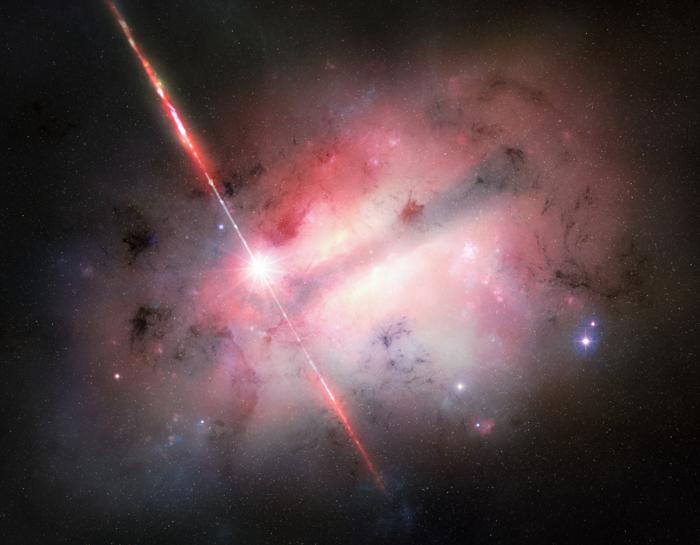
The universe, it seems, still enjoys tearing up the rulebook. Astronomers at the University of North Carolina at Chapel Hill have recently helped uncover new clues about the longest-lasting cosmic explosion ever observed, a gamma-ray burst that lasted nearly seven hours. This single event, known as GRB 250702B, now challenges decades of accepted understanding about how and why these apocalyptic bursts occur. You would think seven hours of data would give us answers. Instead, it’s given us more questions.
Most gamma-ray bursts are brief, violent flares. They announce the deaths of massive stars or the collision of dense stellar corpses. A typical burst might flash for seconds, maybe a couple minutes at most. Then it’s over, leaving behind only a fading afterglow and a few puzzled astronomers. GRB 250702B, on the other hand, kept screaming for nearly seven hours straight, long enough for research teams to wake up, mobilize, and actually catch it in the act.
After space-based observatories flagged the event, researchers scrambled to point ground-based telescopes at its fading afterglow. The effort drew in an international team using some of the world’s most powerful instruments: the European Southern Observatory’s Very Large Telescope, NASA’s Hubble Space Telescope, and several X-ray observatories. They captured images, spectra, and timing data across multiple wavelengths. What they found doesn’t fit any neat category.
“This was the longest gamma-ray burst that humans have observed, long enough that it does not fit into any of our existing models for what causes gamma-ray bursts.”
The explosion might have come from a collapsing star, a collision between exotic stellar remnants, or even a star being shredded by a black hole. Current data can’t settle the question. For cosmologists who spend their careers building models to explain these events, that’s both fascinating and a little maddening.
A Dust-Shrouded Mystery
The event’s unusual duration gave scientists a rare chance to study both the blast itself and its home galaxy in detail. What they saw was unexpected: the explosion originated in a distant, massive galaxy choked with dust. Imagine trying to watch fireworks through a thick fog. Visible light couldn’t escape, so only infrared and high-energy emissions made it through to our detectors.
This dusty environment is precisely the kind of place where massive stars form and die, their stellar nurseries thick with gas and debris. But it also obscures crucial details. The researchers had to piece together the story from whatever light could punch through the cosmic haze, like forensic investigators working a crime scene where half the evidence is buried.
Igor Andreoni, a co-author and assistant professor at UNC-Chapel Hill, described what emerged from the data. An ultra-relativistic jet, moving at nearly the speed of light, punched through the dusty stellar nursery like a high-powered drill boring through concrete. The jet was aimed almost directly at Earth, which explains both the intensity and the duration of what we saw.
“Our data revealed that an energetic phenomenon launched a narrow jet of material in our direction that traveled at least 99% the speed of light, piercing through thick layers of cosmic dust.”
That alignment turned out to be both a blessing and a curse. It gave us a front-row seat to the event, but it also made it harder to determine what kind of engine was driving the jet in the first place.
The Extreme Environment of a Cosmic Explosion
Events like this probe some of the universe’s most extreme conditions. Matter races at nearly light speed. Densities exceed those of atomic nuclei. Gravity warps spacetime like a funhouse mirror. These are the kinds of environments where the laws of physics get pushed to their absolute limits, where Einstein’s equations become essential rather than merely elegant.
And in the process, these explosions forge and scatter heavy elements across the cosmos, including the building blocks for planets and, eventually, life. The iron in your blood, the calcium in your bones, the gold in any jewelry you might be wearing, all of it was likely created in events like this. We owe our existence, in part, to cosmic violence.
Lead author Jonathan Carney acknowledged the lingering uncertainty. “Our analysis shows this event could have several different causes, including the death of a massive star, the collision of a helium star, or even a star being ripped apart by a black hole,” he said. “But we can’t yet tell which explanation is correct.”
The inability to pin down a single explanation might seem like a failure, but it’s actually revealing. It suggests that our current models for gamma-ray bursts are too narrow, too tidy. The universe, as usual, is messier and more diverse than our theories predict.
For now, GRB 250702B remains an outlier, a cosmic oddball that refuses to play by the rules. It might represent a new class of event entirely, or it could be an extreme edge case of something we already know. Either way, it’s rewriting the textbooks. Future observations, perhaps with next-generation telescopes like the James Webb Space Telescope or upcoming X-ray missions, may finally crack the case. Until then, this seven-hour siren stands as a benchmark for what the universe’s most powerful events can do, and a reminder that even after decades of studying these cosmic catastrophes, we’re still just beginning to understand them.