

The primordial seas that nurtured early life were far more carbon-starved than anyone imagined. New research from ETH Zurich has overturned decades of assumptions about ancient ocean chemistry, revealing that dissolved organic carbon levels plummeted to nearly nothing during a critical period when complex life was emerging on Earth.
The discovery comes from an unlikely source: tiny egg-shaped iron oxide stones that rolled across ancient seafloors like microscopic snowballs, accumulating layers of organic molecules as they grew. These geological time capsules, called ooids, have preserved a 1.65-billion-year record of ocean carbon that contradicts everything scientists thought they knew about early Earth’s biochemistry.
Rolling Stones Tell Ancient Tales
Professor Jordon Hemingway’s team developed a revolutionary method to read these ancient witnesses. As ooids tumbled across primordial seabeds, organic carbon molecules stuck to their surfaces and became embedded in their crystal structure, creating what amounts to a natural archive of ocean chemistry.
“Our results contradict all previous assumptions,” Hemingway summarizes.
The findings, published in Nature, show that between 1,000 and 541 million years ago, Earth’s oceans contained 90 to 99 percent less dissolved organic carbon than they do today. This massive carbon shortage occurred during the Neoproterozoic Era, precisely when the planet was experiencing its most extreme ice ages and life was evolving its first complex, multicellular forms.
The implications ripple through our understanding of how ice ages, oxygen levels, and biological complexity are interconnected. Current theories had relied on the assumption of a carbon-rich ancient ocean to explain how snowball Earth events occurred and how atmospheric oxygen reached modern levels through two dramatic surges known as “oxygen catastrophes.”
The Great Carbon Crash
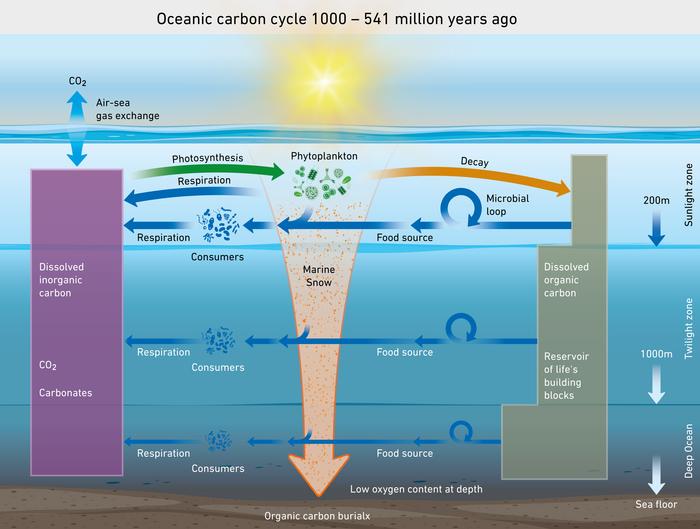
Lead author Nir Galili explains the carbon collapse through an evolutionary lens. As life graduated from simple single-celled organisms to larger, more complex forms, the marine food web fundamentally changed. Bigger organisms sank faster when they died, creating more efficient “marine snowfall” that transported carbon to the seafloor before it could be recycled.
“We need new explanations for how ice ages, complex life and oxygen increase are related,” says Galili.
But here’s the twist: the deep ocean lacked sufficient oxygen to break down this sinking organic matter. Instead of being recycled back into the water column as dissolved carbon, it accumulated on the seafloor and was buried. This created a feedback loop where the evolution of larger life forms actually depleted the ocean’s carbon reservoir.
The carbon famine persisted until the second oxygen catastrophe finally brought enough oxygen to the deep sea to restart the recycling process. Only then did dissolved organic carbon levels climb back to today’s massive reservoir of 660 billion tonnes.
This research challenges fundamental assumptions about early Earth’s chemistry and biology. The traditional narrative suggested that ancient oceans were carbon-rich, fueling the evolution of complex life. Instead, Hemingway’s team reveals an ocean system operating under entirely different rules, where biological innovation drove carbon scarcity rather than abundance.
The findings also carry modern relevance. Human activities are currently reducing oxygen levels in many ocean regions, potentially setting up conditions similar to those that created the ancient carbon crash. While the timescales differ dramatically, the mechanisms underlying ocean carbon cycling remain surprisingly consistent across geological time.
These microscopic iron stones have rewritten the story of early Earth, revealing that life’s greatest innovations occurred not in carbon-rich seas, but in an ocean system pushed to its chemical limits. The discovery opens new questions about how life adapts to extreme environmental constraints and what drove the biological breakthroughs that ultimately led to the complex ecosystems we see today.