

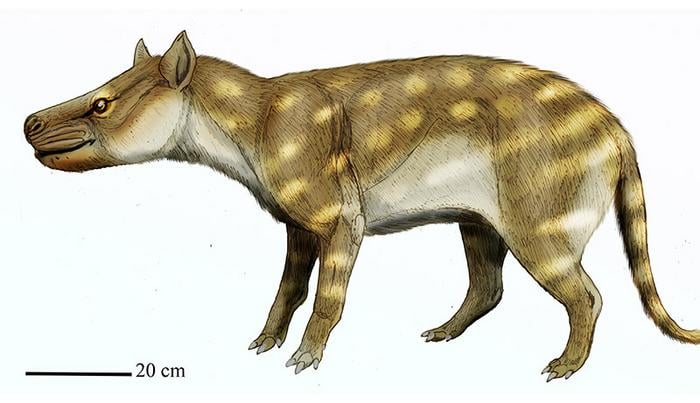
About 56 million years ago, as global temperatures surged and ecosystems unraveled, a coyote-sized predator made a quiet but crucial adjustment: it started crunching bones.
This subtle change in diet may have helped it weather one of the fastest and hottest climate events in Earth’s history, and it could hold important clues for how animals today might adapt to modern climate change. A new study led by Rutgers University researchers reveals that the extinct mammal Dissacus praenuntius shifted its feeding habits during the Paleocene–Eocene Thermal Maximum (PETM), offering a rare glimpse into evolutionary resilience during environmental upheaval.
Reading Fossil Teeth for Survival Stories
Using a technique called dental microwear texture analysis, researchers examined fossil molars collected from Wyoming’s Bighorn Basin. These tiny scratches and pits on the enamel surface act like a deathbed diary of what the animal last ate. Before the PETM, Dissacus mostly tore through flesh. But during and after the event, its teeth show signs of grinding and cracking more brittle food, likely bones.
“We found that their dental microwear looked more like that of lions and hyenas,” said lead author Andrew Schwartz, a doctoral student in Rutgers’ Department of Anthropology. “That suggests they were eating more brittle food, which were probably bones, because their usual prey was smaller or less available.”
The study, published in the journal Palaeogeography, Palaeoclimatology, Palaeoecology, also found that the predator’s body size shrank during the PETM. Earlier theories had attributed this reduction to rising temperatures. But the new data suggest that food scarcity, not heat alone, drove the change.
Lessons from a Long-Extinct Carnivore
The Paleocene–Eocene Thermal Maximum lasted around 200,000 years, triggered by a rapid release of carbon dioxide and a global temperature spike of more than 5 degrees Celsius. Fossil records from that era, including those of Dissacus, provide a window into how mammals responded to sudden environmental stress.
- Dissacus began consuming more bone-like materials during the PETM
- Its tooth wear patterns resemble those of modern scavengers
- Body size decreased by about 20 percent, likely due to lower food availability
- These adaptations persisted even after the climate stabilized
“What happened during the PETM very much mirrors what’s happening today and what will happen in the future,” Schwartz said. “Carbon dioxide levels are rising, temperatures are higher and ecosystems are being disrupted.”
Generalists vs. Specialists
One of the study’s key takeaways is the advantage of being a dietary generalist. Animals that can shift their diets tend to survive better in times of change. This has direct implications for conservation today.
“In the short term, it’s great to be the best at what you do,” Schwartz said. “But in the long term, it’s risky. Generalists, meaning animals that are good at a lot of things, are more likely to survive when the environment changes.”
Species like raccoons or jackals, which are famously adaptable, may fare better in a warming world than diet specialists like pandas. In fact, Schwartz’s earlier research in Africa found that jackals have recently begun eating more bones and insects, likely a response to human-driven habitat loss and climate stress.
What Fossils Teach Us About the Future
Even with its adaptability, Dissacus eventually went extinct, probably due to competition and continued environmental change. But its long survival through the PETM highlights how short-term flexibility can extend a species’ lifespan even during major disruptions.
Schwartz conducted the research using fossil specimens from institutions including the University of Florida, the University of Michigan, and the Yale Peabody Museum. His work builds on a childhood fascination with fossils, sparked by fossil-hunting trips with his father.
“I love sharing this work,” he said. “If I see a kid in a museum looking at a dinosaur, I say, ‘Hey, I’m a paleontologist. You can do this, too.'”
As modern warming continues to accelerate, studies like this offer more than historical trivia. They help pinpoint which species might endure, which could falter, and how ecosystems may bend or break under pressure.
Journal and DOI
Journal: Palaeogeography, Palaeoclimatology, Palaeoecology
DOI: 10.1016/j.palaeo.2025.113089