

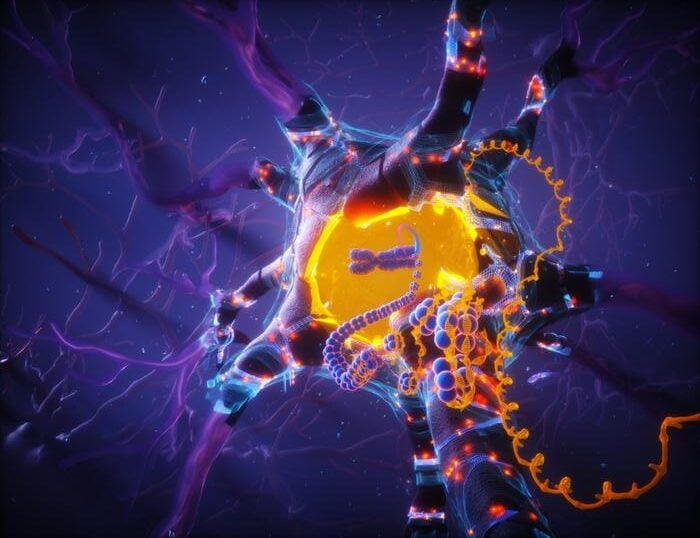
Two amino acids. That is all that separates the APOE2 and APOE4 versions of the apolipoprotein E gene, a difference so small it seems almost irrelevant. Yet carriers of APOE2 are dramatically more likely to reach their nineties and beyond, and they develop Alzheimer’s disease at a fraction of the rate of people who carry APOE4, which is the single largest genetic risk factor for the disease. For decades, researchers assumed the explanation had to involve cholesterol, since APOE’s main job is to ferry lipids around the brain. New findings from the Buck Institute for Research on Aging suggest they were looking in the wrong place entirely.
The real difference, it turns out, may lie in how well your neurons can hold their DNA together.
Lisa Ellerby, a professor at the Buck and senior author of the new study, has spent years working on the molecular biology of aging and neurodegeneration. Her team set out to do something deceptively simple: grow human brain cells carrying either the APOE2 or APOE4 version of the gene and watch what happens. Not in patients, not in whole organisms, but in isogenic cells, meaning cells that are genetically identical except at the one APOE locus. Strip away every other variable and see what the gene itself does. “We’ve known for years that APOE2 carriers tend to live longer and have a lower risk of Alzheimer’s,” Ellerby says, “but the protective mechanism has been a black box.”
The box is starting to open.
What the Buck team found, published this week in Aging Cell, is that APOE2 neurons are running a fundamentally different molecular programme from their APOE4 counterparts. When researchers sequenced the RNA of inhibitory GABAergic neurons, the cells that put the brakes on runaway brain activity, they found more than 1,400 genes expressed at different levels between the two genotypes. In APOE2 neurons, the genes clustered around DNA repair and damage response. In APOE4 neurons, they clustered around synaptic activity, a pattern that chimes with the synaptic dysfunction that marks early Alzheimer’s pathology. The APOE2 neurons had cranked up their molecular maintenance machinery. The APOE4 neurons, by contrast, were tuned for communication while quietly neglecting the plumbing.
The consequences of that neglect showed up clearly in the comet assay, a technique that measures actual DNA strand breaks by watching how far damaged genetic material migrates through a gel under an electric field. APOE4 neurons had significantly more broken DNA than their APOE2 counterparts, even under ordinary, unstressed conditions. The team also stained for a protein called phospho-gamma-H2AX, a molecular flag that cells plant at the site of double-strand breaks, arguably the most dangerous type of DNA damage a cell can sustain. APOE4 neurons were bristling with flags. APOE2 neurons were comparatively clean.
Stress Tests and Senescence
To push the comparison harder, the researchers turned to a second neuronal model: excitatory glutamatergic neurons, grown from CRISPR-edited stem cells carrying homozygous versions of all three common APOE alleles, APOE2, APOE3, and APOE4. At day 18 of an 28-day differentiation protocol, they hit the cultures with either radiation or doxorubicin, a chemotherapy drug notorious for shredding DNA, and measured the fallout. Ellerby says her team showed that APOE2 neurons are better at preventing and repairing DNA damage, and that they resist the cellular aging program that drives so much of late-life decline.
Cristian Gerónimo-Olvera, a postdoctoral fellow at the Buck and co-first author on the paper, describes what that looked like across the data. “What surprised us was how consistent the picture was across two very different neuron types and across human cells and mouse brain tissue,” he says. “APOE2 neurons aren’t just less damaged at baseline, they recover faster when stressed.”
The stress tests revealed something else worth pausing on: the cells’ nucleoli. Every neuron has a nucleolus, a dense structure inside the nucleus where the machinery for making ribosomes is housed. In long-lived animals, from nematode worms to primates, nucleoli are consistently smaller than in their shorter-lived relatives. Smaller nucleolus, more stable genome, longer life: the correlation holds across an improbable range of species. In the Buck experiment, APOE2 and APOE3 neurons had significantly smaller nucleoli than APOE4 neurons under both normal and stressed conditions. APOE4 neurons also had elevated levels of ribosomal RNA, a sign of nucleolar overactivity that has been linked to the kind of cellular senescence that accumulates in aging brains. The APOE2 neurons, in short, were displaying the molecular signature of longevity. The APOE4 neurons were ageing faster at the subcellular level.
Nuclear architecture told a similar story. Lamin A/C is a scaffolding protein that lines the inside of the nuclear envelope and keeps the genome physically organised. Its levels fall with normal aging, and mutations that eliminate it cause Hutchinson-Gilford progeria, the premature aging syndrome. Under irradiation, APOE3 and APOE4 neurons lost Lamin A/C. APOE2 neurons resisted the drop. The nuclear envelope in APOE4 cells, it seems, is in some sense less well-defended, more susceptible to the kind of architectural collapse that lets DNA come unstuck.
A Protein That Can Be Transferred
Perhaps the most clinically pointed result came from a rescue experiment. The team took APOE4 glutamatergic neurons and bathed them in recombinant APOE2 protein, the purified molecule itself, not the gene. After irradiation, those treated cells had measurably less DNA damage signalling than untreated APOE4 controls. The protection, in other words, is not only encoded in the genome; it can, at least in part, be delivered from outside.
What the field has been fixated on, Ellerby notes, is not irrelevant. APOE’s role in amyloid-beta clearance, its influence on neuroinflammation, its effects on synaptic structure, those mechanisms all matter. But they have not yet yielded therapies that substantially slow Alzheimer’s progression. “Until now, the APOE field has focused largely on lipid handling and amyloid-beta biology,” she says. “By showing that APOE alleles also tune how neurons defend their genome, this study connects a major longevity gene to two of the most actively studied hallmarks of aging.” Those hallmarks are DNA damage and cellular senescence, and both are now attracting serious therapeutic interest through senolytics (drugs that clear senescent cells) and small molecules that boost DNA repair pathway activity.
The study does not resolve everything. The precise molecular mechanism by which APOE2 stabilises the nuclear envelope remains unknown. Whether an APOE2-mimetic compound could protect APOE4-carrying brains in living humans is a question that clinical trials have not yet addressed. The nucleolar and senescence findings are correlative in the aged mice, not causally dissected. These are honest limitations, and the authors name them.
Still, the internal consistency of the results is striking. Two neuron types, two genotoxic stressors, human cells and mouse tissue, all pointing in the same direction. The genome of an APOE2 neuron is an unusually well-tended place. What scientists are now trying to figure out is whether the tools that tend it can be handed to everyone else.
https://doi.org/10.1111/acel.70494
Frequently Asked Questions
Does this mean APOE2 carriers are immune to Alzheimer’s disease?
Not immune, but substantially protected. People who carry two copies of APOE2 have markedly reduced rates of Alzheimer’s disease compared to those with the more common APOE3 or the risk-associated APOE4. The new research suggests this protection stems partly from APOE2 neurons being better at repairing DNA damage and resisting the senescent changes that accumulate with age, though other biological factors also contribute to individual risk.
Why has it taken so long to understand what APOE2 actually does in the brain?
Most research attention went to APOE4 because it dramatically raises Alzheimer’s risk, and the leading hypothesis has been that APOE variants affect how the brain clears amyloid-beta plaques. The new finding that APOE alleles shape neuronal DNA repair capacity was not on most researchers’ radar, in part because APOE’s lipid-transport function seemed like the obvious starting point. Isogenic stem cell models, where only the APOE gene differs between cells, made it possible to isolate the gene’s direct effects clearly for the first time.
Could APOE2 protein be turned into a drug to protect APOE4 carriers?
The rescue experiment in the study is an early proof of concept: purified APOE2 protein added to APOE4 neurons reduced DNA damage signalling after radiation. Whether that translates to a deliverable therapy in humans is a significant open question, since getting proteins into brain cells at therapeutic doses is technically hard. The finding does, however, suggest that the protective effect is not locked solely in the genome and could in principle be conferred externally.
What are senescent cells and why do they matter for dementia?
Senescent cells are cells that have stopped dividing in response to damage but have not died. They accumulate with age and secrete a cocktail of inflammatory signals that disrupt surrounding tissue, contributing to neurodegeneration. The Buck study found that APOE4 neurons are more prone to acquiring this senescent state, even under ordinary conditions, while APOE2 neurons resist it. Drugs that clear senescent cells, known as senolytics, are already in clinical trials for various age-related conditions.
Is the DNA repair effect specific to brain cells, or might APOE2 protect other tissues too?
The study focused exclusively on neurons because the brain is where APOE’s association with longevity and Alzheimer’s risk is most clinically relevant. Whether the DNA repair advantage extends to other cell types is unknown. APOE is expressed most abundantly in the liver and plays systemic roles in lipid metabolism, so it would not be surprising if the genome-maintenance effects extended beyond neurons, but that remains to be tested.