

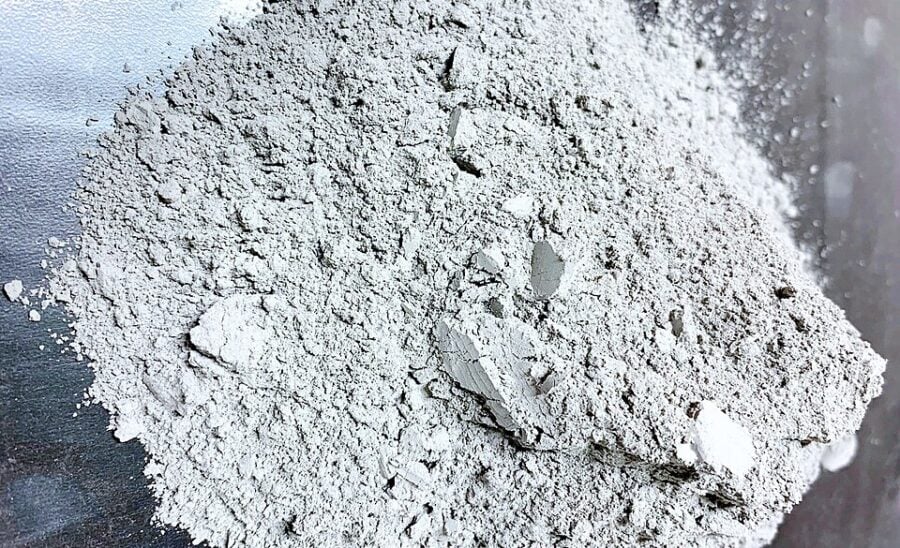
Concrete has a guilt problem. Every tonne of cement you pour into a dam, a bridge, a housing block, carries with it roughly 800 kilograms of carbon dioxide released during manufacture, roughly twice the weight of the cement itself. The industry accounts for about 8 percent of global CO2 emissions, which puts it on a par with all the world’s cars put together, or thereabouts. And yet fixing it has proven stubbornly, almost comically difficult. The problem isn’t just the energy needed to heat kilns; it’s the limestone at the heart of the process, which releases CO2 simply by existing as cement’s raw material. Heat it to break it down, and the carbon comes out regardless of where the heat comes from.
Which makes the numbers coming out of the University of British Columbia genuinely startling. Curtis Berlinguette and his colleagues report in ACS Energy Letters that they’ve manufactured cement using a process that, when run on waste cement as a feedstock, emits just 20 kilograms of CO2 per tonne. A 98% reduction. The secret isn’t some exotic new chemistry; it’s an electrolyzer sitting at 60 degrees Celsius, barely warmer than a hot bath, quietly doing the chemical work that normally requires a kiln running at nearly ten times that temperature.
The problem buried in the rock
To understand what makes this awkward, it helps to know what ordinary Portland cement actually is. Limestone (calcium carbonate) gets heated to 900 degrees Celsius in a calciner, which drives off CO2 and leaves calcium oxide, or lime. That lime then reacts with silica in a kiln at 1,500 degrees to form the crystalline phases that give concrete its strength, chief among them a compound called alite. The process is brutally energy-intensive, consuming roughly 3.3 gigajoules of thermal energy per tonne of cement. And the CO2 doesn’t just come from burning fuel. A large chunk comes from the limestone itself, liberated chemically and unavoidable.
This is what makes decarbonising cement different from, say, decarbonising steel. You can swap in green electricity to power an electric arc furnace. You can’t easily swap out the basic chemistry of limestone. Carbon capture has been proposed as a fix, but bolting it onto a cement plant increases total energy consumption to about 6.5 gigajoules per tonne, and even then residual emissions remain. You’ve solved one problem by creating another.
Berlinguette’s group took what might seem like an obvious but previously impractical route: get the chemistry done at a much lower temperature by changing the chemistry. Rather than blasting limestone and silica into their reactive forms through sheer heat, they built a multi-chamber electrolyzer that uses electricity to dissolve the feedstocks into calcium and silicate ions in separate chambers. Those ions then combine in a third reactor to precipitate calcium silicate hydrate, a mineral precursor that converts into the cement phase belite at only 650 degrees Celsius. Conventional belite production requires 1,200 degrees. That 550-degree gap is where most of the savings live.
Why belite, and why it holds up a dam
Belite is the understudy of cement chemistry, less celebrated than alite but in some applications more useful. Alite hydrates quickly and gives concrete its early strength, which is why the construction industry loves it. Belite is slower, but builds greater long-term mechanical strength: the kind you want when you’re pouring something the size of Hoover Dam or Three Gorges. Both of those, as it happens, are belite-rich structures. So this isn’t a niche material; it’s the cement of choice for the largest built structures on the planet.
“Our team was motivated to address cement production emissions at the source,” Berlinguette says. The team found that by tuning the electrolyzer’s temperature and the ratio of calcium to silicon in the feedstock, they could control the composition of the precursor and, in turn, optimise how easily it converts to belite. At 60 degrees Celsius, the electrolyzer yields about 90% of the target precursor. Below that, the figure drops sharply, because silica dissolves poorly in cooler conditions. It’s a detail that sounds technical but matters enormously for anything approaching industrial scale.
The electrolyzer also does something that will appeal to engineers trying to close the energy loop. As it runs, it produces hydrogen gas as a byproduct. That hydrogen can be combusted to supply the thermal energy needed for the 650-degree kiln step, potentially making the second stage of the process independent of fossil fuels. “We used electricity and recycled cement to make precursors that formed a type of cement called belite at lower temperatures than were previously known,” Berlinguette says. The thermal energy demand, overall, falls by 70 percent compared to conventional cement production.
The most striking result comes when you swap out limestone entirely and use waste cement as the feedstock. Old concrete, crushed back into powder, contains calcium in a form that doesn’t release CO2 when dissolved in the electrolyzer. The team ran the process on lab-prepared waste cement and detected no measurable CO2 at the reactor outlet. Modelled over the full process, that drops total emissions to those 20 kilograms per tonne. Berlinguette calls it the most decarbonised cement manufacturing route reported to date: “This work defines an electrified path for cement production that could reduce the industry’s massive carbon footprint by as much as 98% when using waste cement as a feedstock.”
Between the lab bench and the quarry
The caveats are real, and the paper doesn’t hide them. The electrolyzer tested here has an active area of 4 square centimetres per electrode, roughly the size of a postage stamp. Industrial cement plants process millions of tonnes a year. Cell voltages are also higher than you’d ideally want, partly because ohmic losses in the membranes eat up a significant fraction of the electrical input; at higher current densities those losses account for roughly half the total cell voltage. After two hours of continuous operation, voltage creeps up by about 2 volts as calcium-containing phases accumulate on electrodes and membranes. The researchers flag several engineering paths forward, including better flow management and modified electrode designs, but none has been demonstrated beyond bench scale yet.
There’s also a practical question about the waste cement supply chain. Demolition waste is plentiful in principle, but getting it into a form clean and consistent enough to feed an electrolyzer at scale is a logistics problem the chemistry alone can’t solve. And belite-rich cement isn’t a drop-in replacement for ordinary Portland cement in most applications; the construction sector would need convincing.
Two of the paper’s authors are co-founders of a company working to commercialise the technology, and the University of British Columbia has filed an international patent on the process. The fundamental chemistry is, at minimum, credible in a way it wasn’t before. The question of whether a 4-square-centimetre proof of concept can become a tonne-per-hour process is, for now, a question for engineers rather than chemists. Whether concrete’s guilt problem has finally met its match depends on how quickly those engineers get to work.
Frequently Asked Questions
Why does cement production release so much CO2 in the first place?
A large share of cement’s emissions are chemically unavoidable with traditional methods: limestone (calcium carbonate) releases CO2 simply by being heated to break it down into lime. This is separate from, and additional to, the CO2 produced by burning fossil fuels to heat the kilns. Both sources contribute to the roughly 800 kilograms of CO2 emitted per tonne of conventional cement clinker.
How does the electrochemical process avoid releasing that CO2?
Instead of heating limestone to extreme temperatures to decompose it, the electrolyzer uses electricity to dissolve limestone and silica into ions in separate chambers at around 60 degrees Celsius. The ions then combine to form a cement precursor. When waste cement is used rather than fresh limestone, the calcium source contains almost no carbonate, so there’s essentially no CO2 released during dissolution at all.
Is belite-rich cement as strong as ordinary concrete?
It depends on the application and the timescale. Belite builds strength more slowly than the alite that dominates ordinary Portland cement, but ultimately achieves superior long-term mechanical strength. It’s the preferred type for massive structures like hydroelectric dams, including Hoover Dam and Three Gorges Dam, where longevity and strength over decades matter more than early set times.
Could this process work with renewable electricity to make it truly zero-carbon?
In principle, yes. The electrolyzer runs on electricity, and the hydrogen it produces as a byproduct can be combusted to supply the thermal energy needed for the kiln step. If both the electricity and the kiln heat come from zero-carbon sources, and waste cement is used as feedstock, the residual emissions could be very close to zero. The 20 kilograms per tonne figure already assumes this kind of system integration.
What’s stopping this from being used in cement plants right now?
Scale, primarily. The electrolyzer demonstrated in this research has electrodes measured in square centimetres; industrial cement production happens in millions of tonnes per year. Voltage losses in the membranes also need to be reduced for the process to be economically competitive, and the engineering of continuous, large-scale slurry-based electrolysis hasn’t been solved yet. The researchers and the company commercialising the technology see these as engineering challenges rather than fundamental barriers, but bridging that gap will take time and significant investment.