

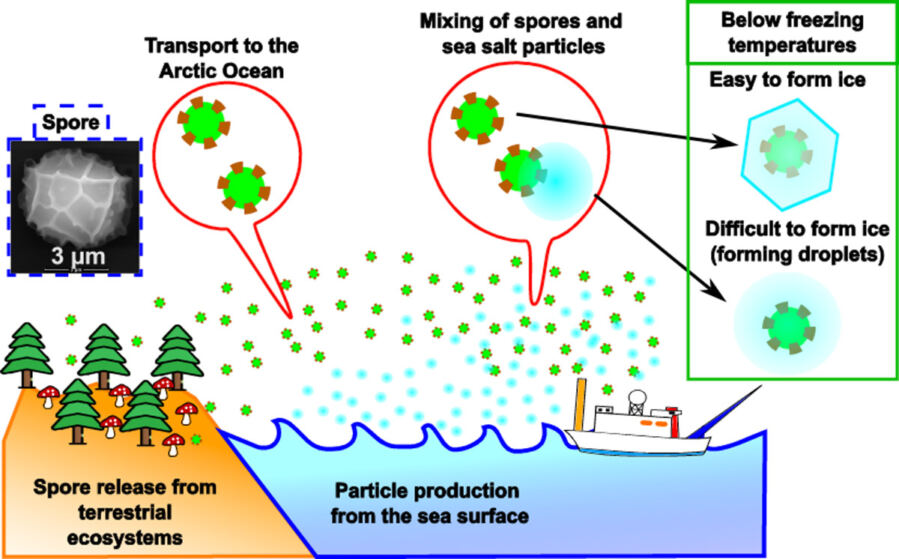
A spore travels a long way to make a cloud. Released by a fungus in the boreal forests of Alaska or Canada, it drifts upward, catches a wind, and begins a journey of hundreds of kilometres over open ocean — all the way to the Arctic, where it will eventually, if conditions are right, become the seed around which an ice crystal forms.
That journey, and what happens at the end of it, has been documented for the first time. Takeshi Kinase at the Japan Agency for Marine-Earth Science and Technology and colleagues spent five weeks aboard the research vessel Mirai in the late summer of 2022, collecting aerosol particles across the Bering Strait, the Chukchi Sea, and the Beaufort Sea. What they found has implications for how we understand Arctic cloud formation — and by extension, how the warming Arctic feeds back on itself.
The particles that matter here are called ice-nucleating particles, or INPs. Between roughly 0°C and −38°C, liquid water droplets can persist in a supercooled state, refusing to freeze unless they encounter something to crystallise around. INPs are those somethings: mineral dust, sea spray, biological material. In the Arctic’s low-level clouds — the kind that form within two kilometres of the surface — the balance between ice crystals and supercooled droplets shapes how much solar radiation gets absorbed or reflected. Get the balance wrong in your climate model and your predictions go awry. The problem is that nobody has had a particularly good handle on where Arctic INPs come from.
The conventional candidates are local. Sea spray carries organic material up from the ocean surface; glacially sourced dust drifts from high latitudes. Terrestrial sources — forests, tundra, anything biological on land — are understood in principle, but observational evidence from over the ocean itself has been sparse. A few shore-based studies had pointed fingers at land ecosystems. One paper found that fungal spores contributed to INPs at Arctic monitoring stations. Another linked biological particles from Siberian forest fires to elevated INP concentrations over the northwestern Pacific. But tracking these particles all the way out to sea, in real-time, with the physical evidence to back it up — that hadn’t been done.
Kinase’s team did it by combining three lines of evidence. They used filters to measure how many INPs were active at different temperatures in a given volume of air. They collected individual particles on electron microscopy grids, cooling them on a microscope stage to watch which ones formed ice crystals — then examining their composition in detail. And they ran atmospheric models backwards from the ship’s position, tracing where the air masses had spent their time before arriving.
On certain days, INP concentrations jumped noticeably. These high-concentration periods — the team called them case-H samples — were found near the Bering Strait and off the coast of Mackenzie Bay. The electron microscope told a revealing story about what was in the air. Among the larger particles (greater than two micrometres across) that formed ice crystals, about a third turned out to be biological in origin. Morphologically they were unmistakeable: flattened spheroids, crumpled edges, occasional protrusions that fungal spore researchers would recognise as the hilar appendix, the little stub where a spore attaches to its parent structure. Their diameters clustered between two and five micrometres, right in the range typical of fungal spores rather than bacteria (which run smaller) or pollen (which runs larger). A fluorescence sensor on deck, designed specifically to light up biological aerosols, showed concentrations spiking to roughly 49 particles per litre during these periods — and the fluorescence signatures matched those reported for fungal spores in Arctic studies elsewhere.
Then there was the model. The FLEXPART-WRF atmospheric transport simulation, running backward from each ship location, tracked where the sampled air masses had been over the previous five days. During the high-INP periods, air had been flowing over the forests and tundra of Alaska and Canada for a median of 39 hours — substantially longer than during the low-INP periods, when trajectories traced mostly over Arctic ocean and high-latitude islands. The correlation between time over forest and biological particle fraction was striking enough to be more than coincidence.
So: fungal spores, released from North American terrestrial ecosystems, transported more than 100 kilometres offshore, arriving over the Arctic Ocean and seeding ice crystals in low-level clouds. Straightforward enough in outline, but there was a complication.
Not every spore the team found was an effective ice nucleator. When Kinase and colleagues examined the spores closely, they noticed something. Among those that had not formed ice crystals, nearly a quarter were attached to or coated by fresh sea salt — salt aerosol produced by wave action as the air mass crossed the ocean. Among those that had formed ice crystals, none showed this kind of mixing. It’s a significant distinction. Sea salt, it seems, suppresses the biological particle’s ability to catalyse freezing, possibly by interfering with the surface chemistry that makes INPs work. Lab experiments had hinted at this, but the field evidence was new.
The implication is that a spore’s effectiveness as an INP degrades during its ocean crossing. The longer it travels over salt water, the more likely it is to pick up sea salt particles, and the less useful it becomes as a cloud-seeder by the time it arrives. The team found a tentative correlation: the fraction of INP-active biological particles tended to fall as estimated transport time over the ocean increased. A spore that reaches the Arctic in 12 hours is a better ice nucleator than one that took three days.
All of this becomes more pressing as the Arctic warms. Snow-free periods are extending. Vegetation is advancing northward. Both changes should increase the production of fungal spores from terrestrial ecosystems, which are tied to plant cover and leaf area. At the same time, retreating sea ice means more open ocean, which means more wave action, which means more sea salt aerosol. More spores plus more sea salt equals a complex feedback that current climate models are not capturing. Most models that include biological INPs at all use mineral dust as a proxy for Arctic ice nucleation; terrestrial fungal spores are largely absent from these calculations.
There is an irony buried in the physics. A warming Arctic that generates more biological INPs from its expanding green belt would, in principle, promote more ice formation in low-level clouds. More ice means less supercooled water, which changes how reflective those clouds are — less reflected solar radiation, which is a warming feedback. But if those same spores are progressively contaminated by sea salt during an ever-longer ocean crossing (as sea ice retreats further), their effectiveness as INPs diminishes. The two processes cut against each other in ways that remain, for now, poorly quantified.
What Kinase’s team has provided is the first direct observational evidence that the forests of Alaska and Canada are actively supplying the Arctic Ocean with cloud seeds — biological, surprisingly capable, and subject to chemical modification in transit. Whether that supply grows as the Arctic changes, and whether it ultimately warms or cools the region, depends on a competition between processes unfolding across thousands of kilometres of forest, ocean, and sky.
Study link: https://www.nature.com/articles/s41612-025-01291-7