

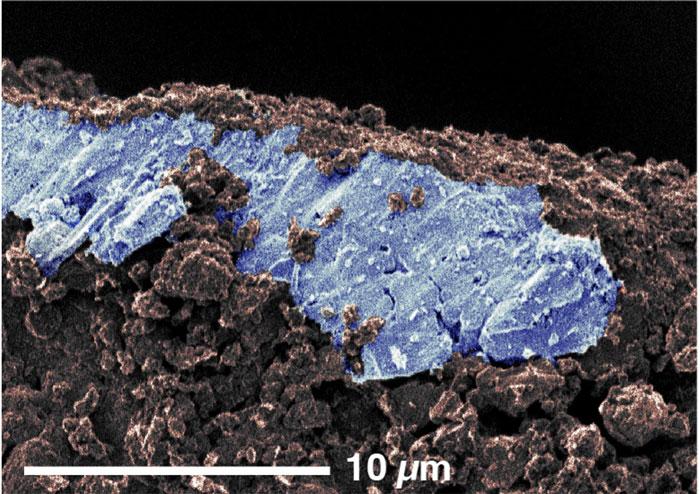
The grains were smaller than a millimetre. Fragments of a shattered world, returned to Earth in a sealed capsule by the Hayabusa2 spacecraft in December 2020, then parcelled out — particle by particle — to laboratories around the planet. Masahiko Sato at Tokyo University of Science received his share and spent weeks preparing them for something extraordinarily delicate: measuring the magnetic memory locked inside minerals that haven’t been seriously disturbed since the solar system was young.
What he and his colleagues found, published last month in the Journal of Geophysical Research: Planets, has finally untangled a dispute that had been quietly simmering for years.
The asteroid Ryugu, a small rubble-pile body orbiting between Earth and Mars, is thought to be the scattered debris of a much larger parent body that broke apart early in solar system history. That violence, paradoxically, is part of what makes it so valuable: the fragments preserve chemistry and structure dating back nearly to the beginning, unaltered by the geological churning that has long since erased such records on Earth. Among those preserved structures, it now seems, is something rather remarkable — a record of the magnetic field that threaded through the protoplanetary disc when the planets were still forming.
Ancient magnetic memory works like this. When certain minerals crystallise or grow in the presence of a magnetic field, they lock in a record of that field’s direction and strength. Provided the material isn’t subsequently heated, shocked, or contaminated, that record can survive for billions of years. The process is called natural remanent magnetisation, and it’s the same basic principle palaeomagnetic researchers use on Earth to reconstruct the history of our own planet’s shifting poles.
Doing it on asteroid material, though, is considerably harder. The samples are tiny — most of Sato’s particles measured just a few hundred micrometres across — and the magnetic signals correspondingly faint. More problematic, there had been genuine scientific disagreement about what the signals in Ryugu particles actually meant. Earlier studies, working with only seven particles between them, produced contradictory results. One group found no stable magnetic components and concluded the field during remanence acquisition had been weak or essentially nonexistent. Another found stable components but attributed them to contamination from the spacecraft or Earth’s magnetic field. With only seven particles to argue over, there was no obvious way to settle it.
Sato’s team measured 28. Using a superconducting quantum interference device (SQUID) magnetometer at the University of Tokyo — one of the most sensitive instruments of its kind — they systematically subjected each tiny grain to progressively stronger alternating magnetic fields, watching how the stored magnetisation responded as the fields stripped away components of different stability. Twenty-three of the 28 particles yielded stable magnetic signatures. “Our highly sensitive magnetic measurements on microsamples collected from the asteroid Ryugu provided sufficient magnetic data to finally clarify the differing interpretations obtained by previous research groups,” says Sato. “Thereby, offering important clues for understanding the evolution of the early solar system.”
The key to ruling out contamination came from a slightly unexpected quarter. When one of the particles was split into two daughter pieces for separate analysis, the two halves pointed in different magnetic directions. That’s not what you’d expect if the magnetisation had been picked up recently — a visiting magnetic field would tend to magnetise both pieces the same way. The only way to explain opposite directions within what was once a single grain is if the magnetisation was acquired before the particle solidified into its current form, back when its constituent minerals were still growing in the presence of ancient water. The spacecraft’s magnetic components, Earth’s field, lab contamination: none of these can explain what Sato’s team found.
The culprit mineral, it turns out, is framboidal magnetite — tiny spherical clusters of magnetic crystals that form when water moves through rock and chemically alters it. Electron holography has shown these structures exist in a so-called single vortex state, which means they can hang onto a magnetic record with remarkable fidelity across geological time. The magnetite in Ryugu’s parent body appears to have grown alongside dolomite crystals during a period of aqueous alteration; dating of those carbonates (using the decay of manganese-55 to chromium-53) puts the crystallisation event roughly 3.1 to 6.8 million years after the formation of calcium-aluminium-rich inclusions — the oldest solids yet identified in the solar system, and the conventional anchor point for solar system chronology.
That timing matters. Three to seven million years after the solar system began condensing, the gas-and-dust disc that surrounded the young Sun was in the process of dispersing. Some of the framboidal magnetite may have grown early enough to record the field of that nebula itself, threads of magnetism woven through the ionised gas of the proto-planetary disc. Some may have formed just as the nebula was clearing, catching instead the solar wind, which carries its own weak field. Disentangling which is which will require considerably more work. “This means that these particles preserve a record of the magnetic field of the very early solar system, potentially within ~3–7 million years after its formation,” says Sato — which is about as close to the beginning as planetary science has ever managed to read.
Estimated field strengths ranged from about 16 to 174 microtesla across the particles, with an average of roughly 86 microtesla. That spread probably reflects the chequered history of the material: some fragments carrying the memory of different moments, some containing brecciated domains with randomly oriented signatures that partially cancel each other out. The variation is a feature, not a flaw. It’s telling researchers that the early solar system’s magnetic environment was neither uniform nor static — that the field shifted as the disc evolved and material moved around.
For a long time, understanding how planets assembled from the swirling chaos of the solar nebula has meant working largely from simulations. Magnetic fields govern much of that process — they influence how gas and dust are transported, how material clumps together, how angular momentum is lost to allow discs to collapse inward. The Ryugu particles offer something simulations cannot: a direct measurement of the magnetic conditions in the planet-forming region, frozen into minerals smaller than a grain of sand, waiting patiently in space for 4.5 billion years to be collected and measured.
Study link: https://agupubs.onlinelibrary.wiley.com/doi/10.1029/2025JE009265