

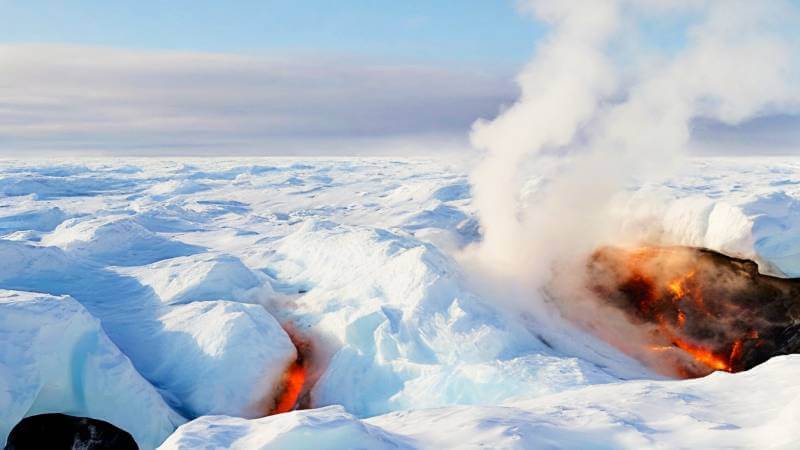
Carbon is leaking from the Arctic’s deep freeze. In Alaska’s boreal forests, wildfires burn down through the spongy organic layer atop the permafrost, scorching 11 or 12 centimetres into ancient soils that have been frozen, in some cases, for thousands of years. The thaw that follows isn’t dramatic. It is slow, quiet, and — according to a study published this week in Nature Geoscience — rather more dangerous than the fires themselves.
Max van Gerrevink, a doctoral student at Vrije Universiteit Amsterdam, spent years trying to account for everything a boreal fire does to the climate: the immediate blast of carbon dioxide, the smoke aerosols, the decades of snow-brightened land that follows a burned forest. What he found was that these forces pull in opposite directions, and that where you are matters enormously.
The study, which Scott Goetz at Northern Arizona University described as “the most comprehensive attempt to date to document the myriad factors that play a role in the influence of fire on the climate system,” covered fires across Alaska and western Canada between 2001 and 2019. It combined historical fire records, satellite observations and machine learning to build, in effect, a 70-year post-fire accounting ledger for each burn. On one side: the greenhouse gases released by combustion, the methane seeping from thawed permafrost for years after the flames die. On the other: the pale, snow-covered land left behind, reflecting winter sunlight back into space.
That second effect is the surprise. In Canada, it wins.
Canadian burns, even during the record-breaking fire seasons of 2023 and 2025, left landscapes that brightened substantially during the long Arctic spring — the snow-covered cleared ground reflecting far more solar energy than the dark-canopied forest it replaced. On average, Canadian fires turned out to have a cooling influence of roughly −2.88 watts per square metre of burned area over 70 years. Alaska’s fires, by contrast, warmed the climate at around +0.35 W/m². Not dramatically, but enough. Persistently.
The reason lies underground. Much of Canada escaped the last ice age with comparatively shallow permafrost; fires there don’t penetrate deeply enough into organic soils to trigger the kind of sustained thaw that really matters for carbon. Alaska is different. Its interior sits atop discontinuous permafrost, and its forests are dominated by black spruce — slow-recovering, thick-soiled trees that burn hot and deep. When those forests go up, the permafrost beneath them starts to thaw, and keeps thawing, releasing carbon for years in a sort of low-level exhalation long after the smoke has cleared. Without accounting for that permafrost feedback, Alaskan fires would look like a net climate cooler (around −1.05 W/m²). Factoring it in flips the sign entirely.
“When rich organic soils are combusted in fires, there is a big pulse of carbon dioxide in the atmosphere,” says Goetz. “Then, as permafrost thaw follows, it continues to emit more carbon over the years that follow fire.”
There is a bigger worry lurking behind all of this. About 70 percent of the terrestrial Arctic sits in Siberia and Eurasia, and — Michelle Mack at Northern Arizona University points out — those landscapes look a lot more like Alaska than Canada. Extensive permafrost, vulnerable organic soils, black spruce-type forests. If fire activity intensifies there under continued warming, the climate consequences could be severe in ways the North American data only hint at. The study covers a relatively modest fraction of the boreal world; the numbers it produces, already unsettling, may be conservative.
The fires themselves are mostly natural. Lightning ignition has increased as the north warms, and most burns start in remote country far from any road or town. Fire managers don’t rush to suppress them. “Maybe we need to think about slowing down these natural fires,” says Mack. “It would buy us time while we figure out other solutions to decarbonize the atmosphere.”
That’s a significant shift in how land managers think about wildfire — in most of Canada and Alaska, the default has been to let remote fires burn. Perhaps that made sense when they were mostly cooling events. The picture looks somewhat different now.
Goetz is more specific about where intervention might actually pay off: “Fire managers and fire suppression efforts could attempt to prioritise fighting fires in areas that are permafrost-rich, because that’s where the bulk of the carbon is stored and vulnerable post-fire.” Not all fires, in other words. The ones in the deep organic soils of Interior Alaska and, perhaps, in whatever analogues emerge in Siberia.
Van Gerrevink’s broader finding — that fire’s climate impact varies wildly depending on landscape, season, and soil — suggests the comfortable assumption that boreal fires are roughly carbon-neutral (they burn, they recover, roughly it balances out) needs revisiting. “While the majority of northern forest fires in North America are currently exerting a climate-cooling influence,” he says, “this is likely to change as northern forests continue to warm.” Snow cover is the crux of it: the cooling effect depends on bare, bright land reflecting spring sunlight, and climate change is shortening the snow season. The balancing force in Canadian fires is already losing ground.
Study link: https://www.nature.com/articles/s41561-026-01940-3