

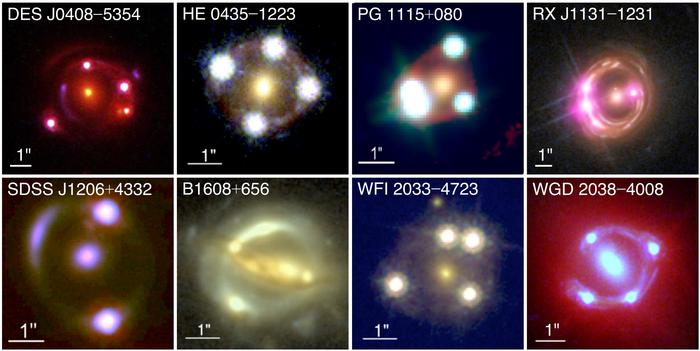
Eight distant quasars, their light bent and delayed by massive galaxies in the foreground, have given astronomers a new measurement of how fast the universe is expanding. The number: 74.3 kilometers per second per megaparsec, give or take about 3 to 4 km/s/Mpc.
What that means is this: Pick any galaxy 3.3 million light-years away (one megaparsec in astronomer-speak). Now pick another one twice as far. The second galaxy appears to be racing away from us 74 km/s faster than the first one. Go out another 3.3 million light-years, add another 74 km/s. The universe isn’t just expanding—it’s accelerating as you look deeper into space.
The measurement comes from gravitational lensing, where a massive galaxy bends light from something bright behind it. In this case, the bright objects are quasars: supermassive black holes actively feeding on gas and dust, shining across billions of light-years. When their light wraps around a foreground galaxy, we see multiple distorted images of the same quasar arranged in arcs or rings.
Here’s where it gets useful for cosmology. Quasars flicker. Their brightness changes over days or weeks as material spirals into the black hole. When that happens, each lensed image shows the same brightness change—but not at the same time. One image’s light might have taken a path 20 days longer than another’s. By measuring these delays (and they’ve clocked delays ranging from days to months in different systems), astronomers can calculate absolute distances without needing the usual ladder of Cepheid variables and supernovae that has to be calibrated step by step from nearby stars.
The mass problem, and JWST’s solution
There’s a catch, though. It’s called the mass sheet degeneracy, which is a technical way of saying you can’t tell from the lensed images alone exactly how the galaxy’s mass is distributed. Different mass arrangements produce identical-looking Einstein rings. And that ambiguity propagates directly into your measurement of cosmic distances—which means it affects the Hubble constant you calculate.
The team, led by researchers from multiple institutions including the University of Tokyo and UCLA, broke the degeneracy with stellar kinematics. They measured how fast stars are moving inside the lensing galaxies. For six systems, that meant new infrared spectra from the James Webb Space Telescope, capturing absorption lines from calcium in the stellar atmospheres. One system, RX J1131-1231, got especially detailed treatment: spatially resolved velocity maps from both JWST and the Keck Observatory’s integral field spectrograph.
To measure the Hubble constant using time-delay cosmography, you need a really massive galaxy that can act as a lens. The gravity of this lens deflects light from objects hiding behind it around itself, so we see a distorted version of them.
Kenneth Wong, a project assistant professor at Tokyo’s Research Center for the Early Universe, explained that when circumstances are right, multiple distorted images appear, each having taken a slightly different pathway to reach us. Those different paths mean different travel times. Coupling the time-delay data with estimates of how mass is distributed in the lensing galaxy is what allows the calculation.
The tension isn’t going away
So why does this matter, given that we already had measurements of the Hubble constant? Because those measurements don’t agree with each other, and the disagreement is getting harder to dismiss as experimental error.
When you use the cosmic microwave background—the afterglow of the Big Bang, released 380,000 years after the universe began—to infer the expansion rate today, you get 67 km/s/Mpc. The Planck satellite’s data gives that number to high precision: 67.4 ± 0.5. But when you measure the expansion rate using objects in the relatively nearby universe (supernovae, for instance, calibrated against Cepheid variable stars), you get something closer to 73. The SH0ES collaboration’s latest: 73.04 ± 1.04.
That’s a 5-sigma discrepancy. In particle physics, 5 sigma is the threshold for claiming a discovery.
Our measurement of the Hubble constant is more consistent with other current-day observations and less consistent with early-universe measurements. This is evidence that the Hubble tension may indeed arise from real physics and not just some unknown source of error in the various methods.
The time-delay measurement—completely independent of both the distance ladder and the CMB—lands squarely on the high side. Which suggests either that something about how we model the early universe is wrong, or that dark energy (the mysterious stuff driving cosmic acceleration) behaves differently than the simplest cosmological constant would predict. Both options would be, to put it mildly, interesting.
The biggest remaining uncertainty is still that mass distribution in the lensing galaxies. Even with stellar kinematics, there’s ambiguity about how dark matter and stars are arranged. The team addressed this by using the most conservative assumptions possible—essentially maximizing their error bars by allowing for all the flexibility the data permit.
Eric Paic, a postdoctoral researcher and co-author, noted that the precision currently sits around 4.5%. To really nail down the Hubble constant to a level that would settle whether the tension is real, they need to reach 1-2% precision. That means more lenses. The current study used eight quasars with measured time delays. Expanding to dozens of systems, with similarly high-quality data, should get them there. And with multiple sky surveys turning up new gravitationally lensed quasars—plus lensed supernovae, which Refsdal originally proposed for this purpose back in 1964—the sample size problem looks solvable.
Whether solving it will deepen the mystery or resolve it, we’ll find out.