

Key Takeaways
- Astronomers have significantly increased the known catalog of Lyman-alpha nebulae from about 3,000 to over 33,000, marking a pivotal shift in understanding cosmic structures.
- The Hobby-Eberly Telescope Dark Energy Experiment (HETDEX) discovered these halos while mapping dark energy, using an untargeted approach across large regions of the sky.
- Cosmic Noon, a period when galaxies formed stars rapidly, reveals that hydrogen gas reservoirs were crucial for star formation, now supported by direct evidence from the new catalogue.
- This extensive sample allows researchers to study the morphological variety of halos, shedding light on different physical processes involved in galaxy formation.
- A systematic shortfall in measuring Lyman-alpha emission was identified, indicating standard methods may underestimate galaxy brightness by about 30%.
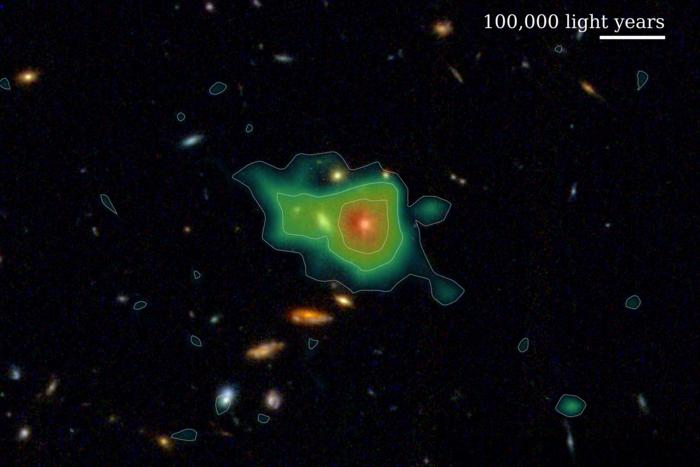
For roughly two decades, astronomers studying the early universe’s enormous halos of glowing hydrogen gas had been working from a sample so small it barely qualified as one. A few hundred objects, painstakingly gathered by pointing powerful telescopes at known galaxies and hoping to catch something faint around the edges. The instruments that could detect these structures, called Lyman-alpha nebulae, were exquisitely sensitive but also exquisitely narrow: they saw only what they were pointed at. And what they found, again and again, were the same extreme, brilliant examples, the behemoths, the outliers. The typical halo remained elusive. “We’ve been analyzing the same handful of objects for the past 20 or so years,” says Erin Mentuch Cooper, data manager for the Hobby-Eberly Telescope Dark Energy Experiment and lead author of a new study in The Astrophysical Journal. That era, apparently, is now over.
A single survey, running on a single telescope in the Texas hill country, has just expanded the catalogue of known hydrogen halos by more than a factor of ten. From roughly 3,000 confirmed structures to more than 33,000. The change is not incremental. It is the kind of shift that forces a field to stop and recalibrate its assumptions about what’s normal.
Cosmic Noon is the name astronomers give to the period roughly 10 to 12 billion years ago when galaxies were forming stars at a furious rate, faster than at any other point in cosmic history. Something had to be fuelling all of that star formation, and the obvious candidate was hydrogen, the universe’s most abundant element and the primary building block for new suns. The presumption, built over decades of theory and observation, was that young galaxies sat within vast reservoirs of hydrogen gas, drawing on it the way a city draws on a reservoir during a drought. The problem was direct evidence. Hydrogen gas in isolation doesn’t produce its own light. You can’t just point a telescope at empty space and expect to see it.
Lyman-alpha nebulae are enormous halos of hydrogen gas surrounding distant galaxies, glowing at a specific wavelength called Lyman-alpha emission. They form when ultraviolet radiation from a galaxy, or from multiple galaxies within the same region, energises the surrounding hydrogen, causing it to fluoresce. Because hydrogen gas doesn’t produce its own light, these halos can only be detected when there’s a sufficiently bright energy source nearby to illuminate them.
Cosmic Noon refers to the period roughly 10 to 12 billion years ago when galaxies were forming stars faster than at any other time in cosmic history. Understanding where galaxies got the raw material for all that star formation, primarily hydrogen gas, is one of the central questions in galaxy evolution. Finding widespread hydrogen reservoirs around galaxies from this era supports the long-standing theoretical picture that galaxies were drawing on large gas supplies during their most productive phase.
HETDEX uses a specialised instrument array that captures 100,000 spectra simultaneously across a wide field of sky. Rather than pointing at known galaxies, it surveys large regions without preselecting targets. This untargeted approach is what allowed it to find halos of all sizes, not just the brightest, most extreme examples that previous targeted surveys detected. The survey covers a region equivalent to more than 2,000 full Moons on the sky.
Possibly, yes. The study found that standard pipeline methods, which extract light from a compact central region, underestimate total Lyman-alpha emission by roughly 30 percent on average because they miss the flux distributed across the surrounding halo. That systematic shortfall flows through estimates of star formation rates and other quantities that depend on knowing how much light a galaxy actually produces. Correcting for it could require revisiting earlier measurements made with the same extraction approach.
Quite a bit. The physical mechanisms that produce Lyman-alpha halos probably include several overlapping processes: scattered ultraviolet radiation, gravitational cooling of inflowing gas, and contributions from satellite galaxies within the same halo. Disentangling which mechanism dominates in which environment will require detailed follow-up observations of individual halos from the new catalogue. The team also suspects that fainter halos in the sample are probably also extended but too dim for current sensitivity to fully confirm, meaning the true fraction of halos may be higher than the 47 percent already found.
You can, however, catch it glowing. When hydrogen gas sits near a sufficiently energetic object, an actively star-forming galaxy or a cluster of them throwing off ultraviolet radiation, those photons can excite the hydrogen atoms, which then re-emit light at a very specific wavelength. Lyman-alpha emission, it’s called. The signal is real, but detecting it faintly and at cosmological distances requires both extraordinary sensitivity and, more importantly, the willingness to look at very large swathes of sky without deciding in advance where the interesting things are supposed to be.
HETDEX was not built to find hydrogen halos. It was built to map dark energy, to track the positions of more than a million galaxies across billions of light years and use that three-dimensional map to understand the universe’s accelerating expansion. But dark energy experiments need wide fields and deep exposures, and those happen to be exactly what you need to find faint extended emission around distant galaxies. The Hobby-Eberly Telescope at McDonald Observatory in the Davis Mountains of West Texas is one of the largest optical telescopes in the world, and the instrument array HETDEX uses produces 100,000 spectra in each observation. “Our observations cover a region of the sky measuring over 2,000 full Moons,” says Karl Gebhardt, the principal investigator and chair of UT Austin’s astronomy department. Nearly half a petabyte of data, covering not just the bright galaxies but the dimmer regions in between, and the enormous voids around them.
From the more than 1.6 million early galaxies HETDEX has catalogued so far, Mentuch Cooper’s team selected the 70,000 brightest, ran their spatial profiles through supercomputers at the Texas Advanced Computing Center, and looked for something very specific: a compact central core of hydrogen emission with a fainter, extended cloud surrounding it. Nearly half showed it. “It has really allowed us to create an amazing statistical catalogue,” she says. The halos range in size from tens of thousands to hundreds of thousands of light years across. Some are compact football-shaped clouds around single galaxies. Others are something else entirely. “They look like giant amoebas with tendrils extending into space,” Mentuch Cooper says.
The morphological variety matters because different shapes point to different physical processes. A compact halo might be powered by a galaxy’s own ultraviolet radiation, scattering off surrounding gas like light through fog. A multi-galaxy blob, sprawling and irregular, could be tracing the cosmic web itself, the filaments of matter along which gas flows into forming structures, possibly glowing from the heat released as it falls in under gravity. Theorists have proposed several mechanisms, and they probably all operate to some extent, in different environments, at different scales. The trouble is that distinguishing between them has been nearly impossible with samples of a few hundred objects. With 33,000, it becomes tractable.
There’s a subtler finding buried in the paper, easy to overlook but perhaps consequential. When the team compared the Lyman-alpha light measured directly from halos against estimates from standard pipeline extractions, the pipeline was coming up short. By about 30 percent, on average. Point the instrument at a galaxy, use the standard extraction method, and you’ll likely undercount the total hydrogen emission because you’re missing the flux in the halo that extends beyond the central core. That systematic error flows through any calculation that depends on the measured brightness: estimates of star formation rates, reconstructions of the luminosity function, anything that requires knowing how much light a galaxy is actually producing. It’s a quiet correction, but not a small one.
Dustin Davis, a postdoctoral fellow at UT Austin and co-author on the study, is fairly sanguine about what this means for existing galaxy formation models. The models for this epoch mostly hold, he reckons, but they have gaps. “And then we can fix or throw out the models and try again,” he says. The faintest halos in the sample are almost certainly larger than they appear: Mentuch Cooper suspects that the many halos that couldn’t be fully resolved are probably also extended, just too dim for the survey’s current sensitivity to fully trace. Deeper observations would likely push the numbers higher still.
What the new catalogue reveals, above all, is that hydrogen halos around Cosmic Noon galaxies are not exotic exceptions. They’re routine. The previous sample of a few thousand was biased toward the most extreme examples, systems so bright and extended that even targeted searches could find them. HETDEX’s untargeted approach, sweeping across the sky without preconceptions about where to look, finds halos around nearly half of all bright Lyman-alpha emitters in its survey volume. That fraction is probably conservative, for the reasons above. The assumption underlying decades of galaxy formation theory, that young galaxies drew on large hydrogen reservoirs, now has something closer to a statistical foundation.
The team has released the full catalogue publicly, with positions, redshifts, and size measurements for all 70,000 galaxies in the sample, extended and unextended alike. For researchers who’ve spent careers hunting individual halos, it’s a different kind of abundance problem. The question used to be: where do we find one? Now, it’s something more interesting: which 33,000 do you start with?
Source: https://iopscience.iop.org/article/10.3847/1538-4357/ae44f3