

Key Takeaways
- The University of Cambridge found a way to use spent lead-acid battery acid to recycle plastics like PET, nylon, and polyurethane.
- By breaking down plastics into their building blocks with concentrated sulfuric acid, they produced hydrogen fuel and acetic acid using sunlight and a stable photocatalyst.
- This process operates faster than traditional methods and could be profitable by recovering valuable materials from waste.
- The system demonstrated effectiveness with real battery acid, addressing concerns about needing fresh chemicals for scaling up the process.
- While it won’t replace conventional recycling, it offers a solution for hard-to-recycle plastic waste, potentially solving two waste streams.
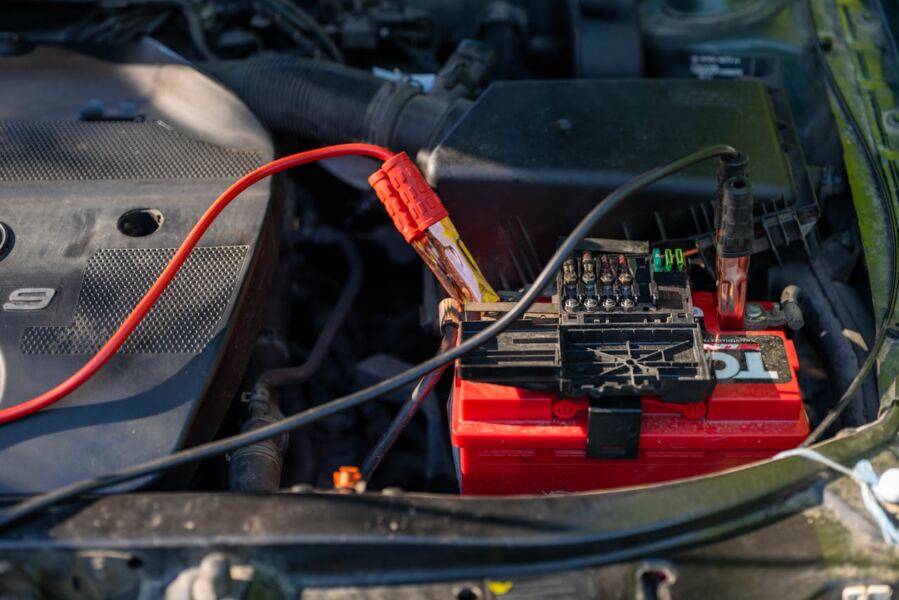
Every three to five years, a lead-acid car battery reaches the end of its useful life. The lead gets extracted and sold. The sulfuric acid inside, which can make up a third of the battery’s volume, gets carefully neutralised and discarded. That neutralisation step is an expense, not a choice: you cannot simply pour concentrated acid into a drain. So the acid becomes waste, on top of the waste. About 600 million vehicle batteries are replaced globally each year. That is a lot of sulfuric acid going nowhere.
Now a team at the University of Cambridge has found a rather different use for it. Working with a photocatalyst they designed to survive corrosive conditions that would destroy most materials, they have shown that spent battery acid can dissolve hard-to-recycle plastics and that sunlight can then convert the resulting chemical soup into hydrogen fuel and acetic acid, a useful industrial solvent. One waste stream, in other words, eating another.
The work, published in Joule, covers plastics that conventional recycling struggles to handle: PET (the clear polymer of drinks bottles), nylon, and polyurethane foam. Together these account for a substantial slice of the roughly 400 million tonnes of plastic produced each year, most of which ends up in landfill, incinerated, or leaking into natural ecosystems. Only around 18% is recycled worldwide.
The Cambridge team demonstrated it on PET (the clear plastic used in drinks bottles), Nylon 66, and polyurethane foam. These are difficult cases for conventional recycling: nylon is a polyamide that most upcycling technologies ignore, and polyurethane is a thermoset that cannot be remelted and remoulded. Hydrogen yields varied by plastic type, with polyurethane producing the most per gram of catalyst and PET generating the most useful combination of hydrogen and acetic acid.
Alkaline conditions (sodium hydroxide, potassium hydroxide) consume large amounts of base, which must then be disposed of, and require a neutralisation step to recover the acidic monomers. Acid works catalytically rather than being consumed: it survives the reaction and can be reused. It also breaks PET apart roughly 3.5 times faster than comparable alkaline hydrolysis under lab conditions, and causes the useful monomer terephthalic acid to precipitate out of solution, making recovery straightforward.
The acid remains in solution and can be recovered and reused for further hydrolysis cycles. In experiments using real spent battery acid, the team filtered and concentrated the electrolyte from a used car battery and applied it directly to PET. Performance was comparable to that with fresh laboratory-grade sulfuric acid, suggesting the process could genuinely close a loop between battery waste and plastic waste without requiring fresh chemical inputs.
The catalyst contains no precious metals: no platinum, no palladium, no iridium. It is built from cobalt, molybdenum, and carbon nitride, all relatively inexpensive industrial materials. The synthesis method, which uses potassium thiocyanate to simultaneously introduce cyanamide groups and sulfidize the metal oxides in a single heating step, was designed to be scalable. Whether it remains cheap enough once engineering requirements (acid-resistant reactor materials, gas handling, product separation) are added is a question the team has modelled but not yet demonstrated at scale.
In principle, sulfuric acid from other industrial waste streams, including fluorochemical production, petroleum refining, and metal processing, could serve the same function. The team focused on spent lead-acid batteries because they represent a globally abundant, well-characterised source with relatively consistent acid concentrations. Adapting the process to other acid waste streams would require checking that contaminants in those sources do not deactivate the photocatalyst or interfere with product chemistry, which remains an open experimental question.
The Cambridge approach works in two stages. First, the battery acid, concentrated sulfuric acid at around 140 degrees Celsius, breaks the long polymer chains apart into their constituent molecular building blocks. For PET, that means ethylene glycol and terephthalic acid. This step is actually faster than the alkaline hydrolysis that similar photoreforming systems have used, roughly 3.5 times quicker under comparable conditions. The acid also precipitates the terephthalic acid out of solution, making it easy to recover separately as a saleable monomer.
The second stage is where the photocatalyst comes in. Sunlight, or a 405-nanometre LED, drives the conversion of ethylene glycol into hydrogen gas and acetic acid. The catalyst that makes this possible is a material the team calls CoMoS2-CNx: cobalt-promoted molybdenum disulfide embedded in cyanamide-functionalized carbon nitride. Precious-metal-free (platinum is conspicuously absent), synthesised from inexpensive precursors, and, crucially, stable in the kind of strongly acidic conditions that would corrode most photocatalysts within hours.
“The discovery was almost accidental,” said Professor Erwin Reisner, who led the research. The team had assumed acid was completely incompatible with solar-powered chemistry, that it would simply eat through any catalyst before useful reactions could occur. When their new material survived, and then performed well, the implications began to multiply. Lead author Kay Kwarteng, a PhD student in Reisner’s group who developed the photocatalyst, says the industrial community has used acid to break plastics apart for decades; the missing piece was always a catalyst that could withstand the conditions long enough to do something with the fragments.
In lab tests, the system generated up to 2.9 millimoles of hydrogen per gram of catalyst per day from PET hydrolysate, with 89% selectivity for acetic acid as the main organic product. The catalyst ran for eleven days and eight cycles without significant loss of performance, which is rather longer than most photocatalyst stability demonstrations in this field. The quantum yield, a measure of how efficiently the system converts incoming photons to chemical products, reached 9.0% for acid-hydrolyzed PET waste, among the highest reported for any plastic photoreforming system.
The same approach extended to nylon and polyurethane, plastics for which photoreforming systems have historically shown limited activity. This matters because current upcycling technologies have largely been optimised around PET, the most studied plastic in this context. Whether the catalyst would handle the more complex chemistries of polyamides and polyurethanes was an open question; in lab tests, it did, though yields varied by plastic type.
The technoeconomic picture is, on paper, encouraging. When revenues from the recovered terephthalic acid, acetic acid, and hydrogen are combined, the analysis suggests the process could be profitable rather than merely cost-neutral, particularly if paired with photovoltaic panels to run LEDs continuously through day and night. Kwarteng is measured about what this means in practice. “These acids are already handled safely in industry,” he said. The engineering questions, how to build reactors that resist long-term corrosion and handle genuinely messy real-world waste rather than cleaned-up polymer powder, are the ones that will determine whether the chemistry becomes a process.
Spent lead-acid batteries were used directly in some experiments: the electrolyte drained, filtered, concentrated under vacuum, and applied to PET powder. Hydrogen and acetic acid production rates were comparable to those obtained with laboratory-grade acid. That result matters because it removes one of the obvious objections, that scaling the process would require buying fresh acid rather than diverting waste. “It’s an untapped resource,” Kwarteng said of the battery acid, arguing that diverting it before neutralisation sidesteps the disposal problem while putting it to productive use.
The system will not replace conventional mechanical recycling, which remains more efficient for clean, sorted plastics. Reisner is explicit about the limits of what the work claims. “We’re not promising to fix the global plastics problem,” he said. But contaminated or mixed plastics, the kinds of waste that already have no viable recycling route, are the ones where a process like this could find its role. The question of whether two intractable waste streams, corroded batteries and hard-to-recycle polymers, can solve each other remains genuinely open at industrial scale. At lab scale, at least, the answer appears to be yes.
DOI / Source: https://doi.org/10.1016/j.joule.2026.102347