
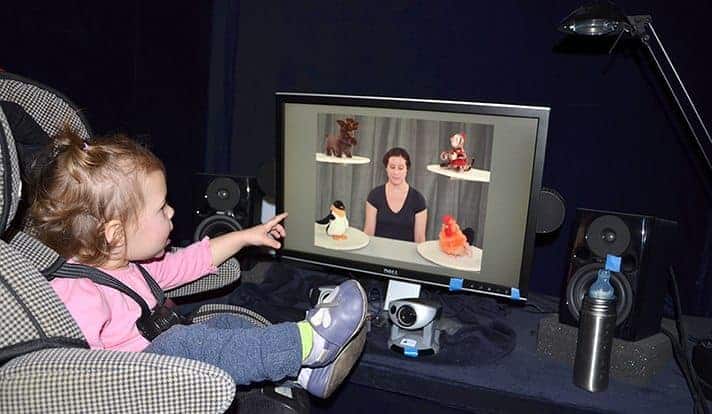
Infant girls at risk for autism pay more attention to social cues in faces than infant boys, according to a Yale School of Medicine study — the first one known to prospectively examine sex-related social differences in at-risk infants.
This difference in observational skills could help protect female siblings of children with autism from developing the disorder themselves, according to lead author Katarzyna Chawarska, associate professor in the Yale Child Study Center and in the Department of Pediatrics. The findings are published in the Journal of the American Academy of Child & Adolescent Psychiatry.
Chawarska and her colleagues measured spontaneous social attention conducted a prospective study to measure social attention in 101 infants between the ages of 6 and 12 months who have older siblings with autism. The team also studied 61 infants with no risk of autism. Chawarska said high-risk siblings are about 15 to 20 times more likely to have autism than those without history of autism in the family.
The infants were all shown a video of a woman smiling and cooing at them, while doing other activities like pointing to toys in different parts of the screen, and preparing a sandwich. The team tracked where the infants focused their gazes, and for how long.
“We found that the girls in the high-risk group displayed more attention to people and their faces than all other infants,” said Chawarska, who is also director of the Early Social Cognition Laboratory at Yale. “This increased access to social experiences during a highly formative developmental period predicted fewer social impairments at 2 years of age. It is important to note however, that this may not prevent ASD in high-risk females, but could mitigate the severity of autism symptoms.”
Chawarska’s lab is now pursuing several leads they hope will help reveal the mechanisms underlying this attentional advantage in girls.
Other authors on the study include Suzanne Macari, Kelly Powell, Lauren DiNicola, and Frederick Shic.
The study was funded by the National Institute of Child Health and Development, P01 HD003008, Project 1, National Institutes of Mental Health R01 MH087554, and the SFARI Grant 187398. An author on the study also receives funding from the Yale Clinical and Translational Science Award (CTSA) grant from the National Center for Advancing Translational Sciences (NCATS) at the National Institutes of Health.
ScienceBlog.com has no paywalls, no sponsored content, and no agenda beyond getting the science right. Every story here is written to inform, not to impress an advertiser or push a point of view.
Good science journalism takes time — reading the papers, checking the claims, finding researchers who can put findings in context. We do that work because we think it matters.
If you find this site useful, consider supporting it with a donation. Even a few dollars a month helps keep the coverage independent and free for everyone.