

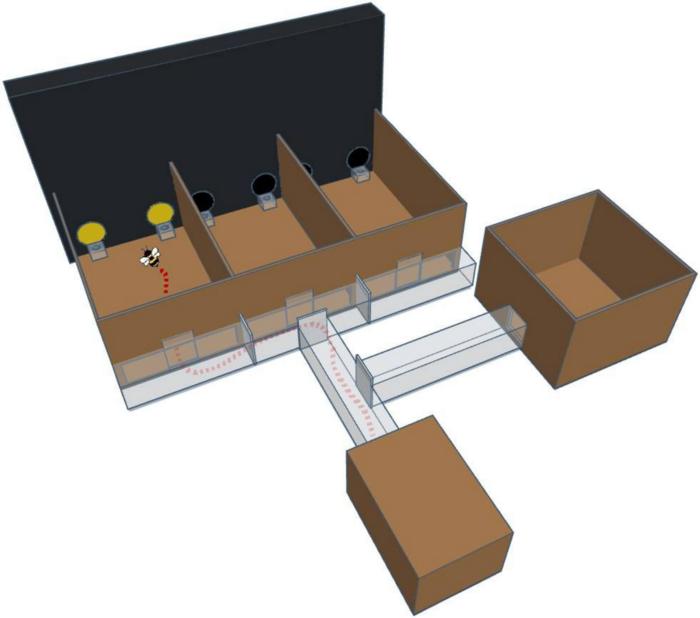
Inside a wooden box threaded with clear acrylic tunnels, a bumblebee pauses at the mouth of a tiny chamber lit by blinking yellow circles. The scene looks like an arcade scaled for insects, but it is a biology experiment with a provocative question: can a bee learn to read time the way humans parse dot and dash?
A new study in Biology Letters from Queen Mary University of London says yes. Working with Bombus terrestris, researchers trained individual foragers to choose between two flashing signals, one with a short-on pattern and the other with a long-on pattern, then switched to unrewarded tests to see whether the bees kept choosing by duration alone. The answer was striking. Even when sugar was removed, most bees went straight to the light duration that had previously predicted a sweet payoff.
In practical terms, the team asked whether an insect could discriminate between what Morse operators would call a dot and a dash. That ability has been demonstrated in humans and a handful of vertebrates, including macaques and pigeons. Now it shows up in a brain smaller than a cubic millimetre. The researchers built a compact maze: a nest box, an observation chamber where bees fed, and three test compartments outfitted with a monitor displaying the stimuli. During training, a correct choice led to sucrose, while the alternative paired with a bitter quinine solution taught rapid avoidance.
“We wanted to find out if bumblebees could learn to the difference between these different durations, and it was so exciting to see them do it.”
That excitement rests on careful controls. In one set of trials, the long signal lasted 5 or 2.5 seconds per cycle and the short signal 1 or 0.5 seconds. In a tougher follow-up, the total amount of light across a cycle was matched, removing the option to simply choose the brighter or longer-looking display. Bees still discriminated, implying they were tracking the duration of individual on states, not just the amount of stimulation. A generalized linear mixed model confirmed that as a group the insects chose above chance in both experiments, with no systematic bias for short or long.
Timing Without A Clockface
How does a miniature brain keep time at sub-second to multi-second scales? The authors note that circadian machinery is far too slow to explain these choices. Classic models of interval timing in vertebrates invoke either pacemaker pulses that accumulate over a window or neural trajectory codes in which populations ramp and reset. Insects may rely on analogous dynamics, but the details remain open. What the data do show is flexibility: bees solved a novel visual timing task that has no obvious ecological counterpart, suggesting they can extend domain-general learning to arbitrary temporal cues.
That fits a broader pattern. Bees already use time to schedule flower visits as nectar replenishes, and they decode temporal features in the waggle dance during social communication. Here, though, time is embedded in the conditioned stimulus itself, not the delay before a reward. That distinction matters for how we think about cognitive economy. If an insect can parse duration on the fly, then compact neural circuits can implement surprisingly sophisticated computations without lavish resources.
“It will be important to use a broad comparative approach across different species, including insects, to shed light on the evolution of those abilities.”
The apparatus details are refreshingly transparent. Light was delivered by a monitor facing the compartment, with stimuli rendered as 4 cm yellow circles on black. Before each choice, the bee was held for 10 seconds in a clear tunnel to view the flashes, then released through a removable door to commit to a feeding chip aligned with one of the two signals. Doors and paths were shuffled to eliminate spatial cues. Between bouts, surfaces were cleaned with ethanol and solutions refreshed to avoid scent contamination. In short, the maze was tidy, controlled, and surprisingly cinematic: a bright, pulsing target in a stark box, a forager zipping in to decide.
A Miniature Model For Efficient Intelligence
One subtlety did appear. In the first experiment, performance dipped in the compartment farthest from the nest box, a hint that distance or order effects can nibble at accuracy. But when the researchers equalized total light in the second experiment, performance held and location effects vanished. That resilience makes the system a promising test bed for competing theories of timing, from single to multiple internal clocks, and for exploring how frequency and duration cues trade off in the same time window.
The implications stretch beyond entomology. If bees can resolve dot from dash using minimal circuitry, then artificial systems might do more with less by borrowing principles from biological timing. Efficient temporal coding could help small, battery-constrained robots or neuromorphic chips navigate and decide in dynamic environments. The study, by mapping a clean behavioral assay onto a compact brain, offers a rare bridge between mechanistic timing theories and scalable engineering.
In the end, the charm of the work is simple. A bee looks up at two blinking coins of light, hesitates, and goes for the one that used to mean sugar. No clockface, no words, just duration. From that small choice, an old assumption blinks off and a new line of inquiry lights up.