

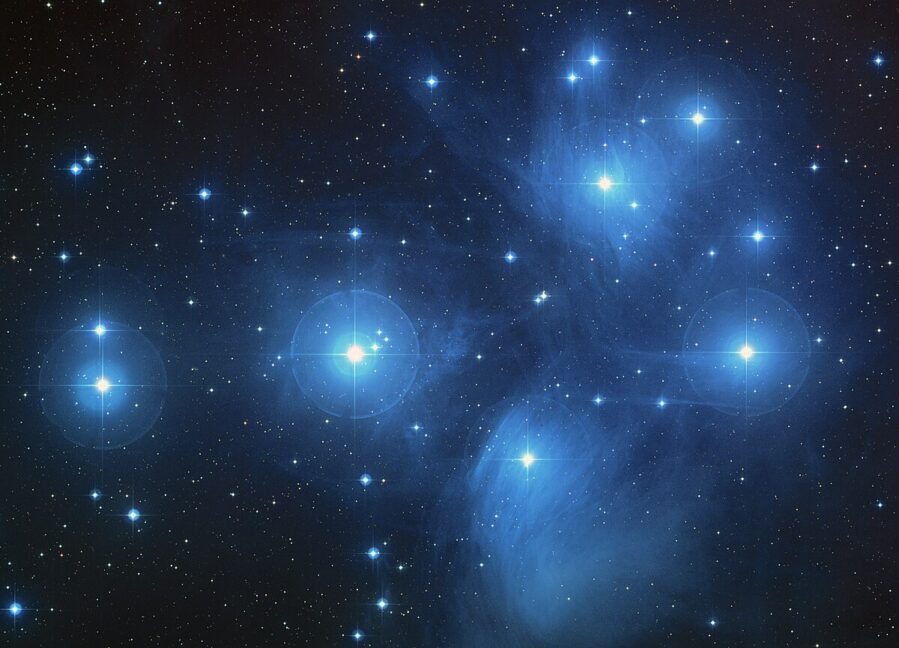
On cold winter nights, the Pleiades sparkle like a tight-knit family of stars in the shoulder of Taurus. Known across cultures as the Seven Sisters, this glittering cluster has guided farmers, navigators, and storytellers for millennia. Now astronomers at the University of North Carolina at Chapel Hill have revealed that those seven jewels are only the bright heart of a far larger cosmic clan.
By merging data from NASA’s Transiting Exoplanet Survey Satellite (TESS) and the European Space Agency’s Gaia observatory, the team discovered thousands of faint stellar siblings dispersed across the sky. They form a sprawling structure twenty times larger than the classical Pleiades, a hidden web of stars that UNC researchers call the Greater Pleiades Complex.
Most stars, including the Sun, are born in groups inside collapsing clouds of gas and dust. Over time, gravity and galactic tides pull these stellar siblings apart. Tracing them back to their shared birthplace is one of the hardest problems in astronomy. The UNC team found a way to do it by using stellar spin as a kind of clock. Young stars spin fast, while older ones slow down. By measuring these rotations, astronomers can spot which stars were born together even if they are now scattered across hundreds of light-years.
“This study changes how we see the Pleiades, not just seven bright stars, but thousands of long-lost siblings scattered across the whole sky,” said Andrew Boyle, lead author and graduate student in physics and astronomy at UNC-Chapel Hill.
The researchers combined TESS observations of stellar rotation with Gaia’s exquisite maps of position and motion. The result redefines the Pleiades as the dense nucleus of a much greater, dissolving association. The cluster’s extended family spans roughly 600 parsecs (about 2,000 light-years) and includes several known moving groups such as AB Doradus and UPK 303. Statistical modeling confirmed that these stars share common ages, motions, and even chemical fingerprints, all evidence of a shared birth cloud more than one hundred million years ago.
A Galaxy of Connections
The findings carry implications well beyond the Pleiades itself. Astronomers use clusters like it as benchmarks to test theories of stellar aging, planetary formation, and galactic structure. If many clusters turn out to be only fragments of much larger families, the map of our local galaxy may need to be redrawn. Boyle’s team developed a Bayesian framework that links rotational age and stellar motion, a method that can now be applied to other star groups dissolving into the Milky Way.
Visualizing the discovery is awe-inspiring. Imagine standing under a December sky in North Carolina, where the Seven Sisters glint near Orion’s shoulder. If the human eye could see all of their kin revealed by TESS and Gaia, the cluster would stretch from horizon to horizon, filling the sky with faint, silvery cousins of Alcyone and Electra. The stars we once saw as a small, perfect knot are only the visible tip of a vast ancestral web.
“We’re realizing that many stars near the Sun are part of massive extended stellar families with complex structures,” said Andrew Mann, co-author and professor of physics and astronomy at UNC-Chapel Hill. “Our work provides a new way to uncover these hidden relationships.”
Tracing Our Own Stellar Roots
Future surveys may reveal that the Sun itself was born in a similar family, its siblings long dispersed across the Galaxy. The UNC method offers a way to track them down by comparing spin rates and motion patterns. Such discoveries could help reconstruct the Sun’s original nursery, offering clues to how Earth and its planetary neighbors formed in the first place.
By blending two space missions into a single genealogical tool, the team has transformed an ancient constellation into a modern laboratory for cosmic origins. What once looked like a small gathering of seven bright sisters is now known to be an immense reunion of thousands, a stellar diaspora stretching across the heavens.