

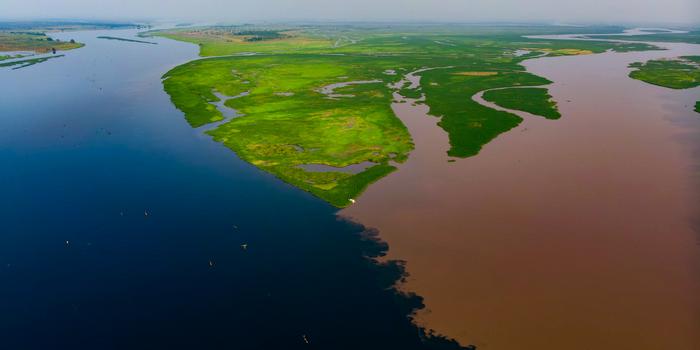
The water of Lac Mai Ndombe looks like cold tea. Dark, nearly opaque, stained deep brown by millennia of decaying vegetation washing in from the surrounding swamp forests — Africa’s largest blackwater lake sits in the heart of the Democratic Republic of Congo, four times the size of Lake Constance, largely unvisited, largely unmeasured. Getting there requires boats and dugout pirogues through one of the most remote stretches of rainforest on Earth. Which partly explains why nobody had asked the obvious question: where exactly is all that CO₂ coming from?
When Travis Drake at ETH Zurich and his colleagues finally got onto the water and started collecting samples, they expected to confirm what everyone already assumed. Lakes like this one release carbon dioxide because the surrounding forests shed organic matter — leaves, roots, decomposing wood — that washes in and gets broken down by microbes. The carbon involved is recent. Photosynthesised in the last few decades, cycled through living vegetation, back into the air. A fast, tight loop.
The radiocarbon dating told a different story. The dissolved inorganic carbon in Lake Mai Ndombe had a mean age of around 2,170 years. In Lake Tumba, the smaller neighbour to the north, the figure was even older: roughly 3,500 years. Carbon that last circulated through living plants when the Roman Republic was still a going concern is, right now, bubbling out of these lakes into the atmosphere.
“We were surprised to find that ancient carbon is being released via the lake,” says Drake. His colleague Matti Barthel puts it more vividly: “The carbon reservoir has a leak, so to speak, from which ancient carbon is escaping.”
The leak matters because of what sits beneath these lakes. The Congo Basin’s central depression — the Cuvette Centrale — contains the largest known tropical peatland complex on Earth, an estimated 29 petagrams of carbon locked into thick layers of compressed, waterlogged plant material built up over thousands of years. That is roughly the same amount of carbon dioxide the entire world emits from fossil fuels in around three years. Scientists had assumed this reservoir was, under normal conditions, stable. The organic matter in deep peat is old and already heavily decomposed; the logic ran that microbes would preferentially break down fresher, more labile material at the surface, leaving ancient stocks largely untouched. The only time old peat carbon was thought to escape was during droughts, when falling water tables expose peat to oxygen and decomposition accelerates dramatically.
The new measurements, published in Nature Geoscience, suggest this picture is incomplete. Something is mobilising carbon from deep within the peat and routing it into the lakes even in the absence of obvious disturbance. The mechanism remains uncertain. The researchers’ best hypothesis involves methanogenesis — anaerobic microbes deep in the peat producing CO₂ and methane as they respire ancient organic carbon, with the resulting gases transported laterally through subsurface flows until they reach the open water of the lake, where they outgas efficiently to the atmosphere. The lake, as Drake and colleagues put it, acts as a chimney.
What makes this particularly tricky to pin down is that the different forms of carbon in the water tell contradictory stories. The dissolved organic carbon in both lakes — the actual chunks of plant matter and humic substances dissolved in the water — is essentially modern, with radiocarbon values close to 1.0. The dissolved inorganic carbon, which is what actually escapes as CO₂, is the ancient stuff. These two pools appear largely decoupled, a two-lane system in which fresh surface carbon and ancient subsurface carbon travel separately and reach the lake through different pathways. The team ran 100,000 Monte Carlo simulations to pin down the proportions, arriving at roughly 39 to 40 per cent of the outgassing CO₂ originating from old peat across both lakes. Lake Mai Ndombe alone may be releasing upwards of 150 gigagrams of ancient peat carbon every year.
Whether this represents a natural steady state — old carbon out, new peat forming fast enough to compensate — or the early signs of something more alarming is, for now, an open question. The Congo peatlands are not pristine in any geological sense. Palaeoenvironmental studies of peat cores show that past drying events caused substantial carbon losses, and some researchers have argued these systems may currently sit near a climatically driven drought threshold. If that is right, what the new study documents might be one end of a spectrum that could tip rapidly given the wrong conditions.
A parallel study from the same group, published in the Journal of Geophysical Research, adds another layer of concern. The volume of methane escaping from Lake Mai Ndombe turns out to be strongly dependent on water level. When the lake is high, microbes in the water column break methane down before it reaches the surface. When water levels drop during the dry season, that microbial scrubbing becomes less effective and more methane escapes directly to the air. “Our fear is that climate change will also upset this balance,” says ETH Professor Jordon Hemingway. “If droughts become longer and more intense, the blackwater lakes in this region could become significant sources of methane that impact on the global climate. At present we do not know when the tipping point will be reached.”
The population of the Democratic Republic of Congo is projected to roughly triple by 2050, which places enormous pressure on land currently occupied by swamp forest. Deforestation in the catchment would reduce transpiration from tree canopies — a process that recycles vast quantities of water back into the atmosphere, feeding rainfall that keeps the lake levels stable. As Barthel explains it, forests “are not only responsible for gas exchange like our lungs… but they also evaporate water through their leaves, thereby enriching the atmosphere with water vapour. This promotes cloud formation and precipitation, which in turn feeds rivers and lakes.” Remove the trees, and the water cycle starts to unravel; lake levels fall; peat dries; old carbon escapes faster.
There is an additional reason the findings carry weight beyond the Congo. The Ruki River, a large blackwater tributary that joins the Congo downstream, also showed slightly aged dissolved inorganic carbon in the team’s measurements — not as old as the lake water, but old enough to suggest this is not simply a quirk of two particular lakes. If the lake-as-chimney mechanism holds elsewhere, it may be operating in other regions where large bodies of water sit atop or alongside peatlands: the Hudson Bay lowlands, the West Siberian lowlands, other parts of the tropical belt. Climate models have historically underrepresented these systems. “Our results help to improve global climate models,” says Johan Six, the ETH professor who leads the group, “because tropical lakes and wetlands have been underrepresented in these models so far.”
The carbon was locked away when those forests were young, when the peat began to accumulate, when none of this was a question anyone needed to ask. Now it is resurfacing through black water that looks, from above, like it holds no secrets at all.
Study link: https://www.nature.com/articles/s41561-026-01924-3