

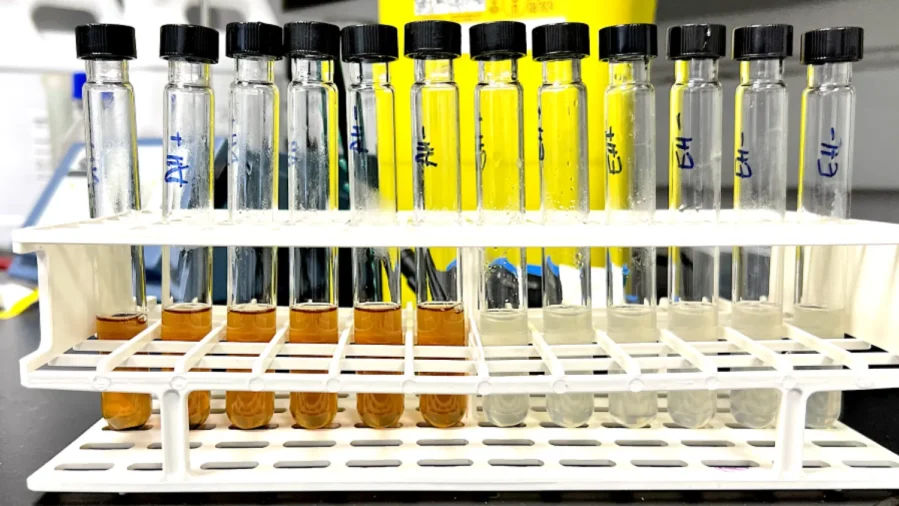
Somewhere in a sealed flask at the University of Edinburgh, a colony of E. coli is doing something rather useful with its lunch. Fed sugars extracted from stale naan bread, the bacteria are fermenting away in the dark, generating hydrogen gas as a metabolic byproduct. A palladium catalyst is waiting nearby. And together, microbe and metal are quietly running one of the chemical industry’s most energy-hungry reactions — at room temperature, without a drop of fossil fuel.
Hydrogenation is the workhorse of modern manufacturing: it hardens vegetable oils into margarine, synthesises roughly 14 per cent of all pharmaceutical compounds, and underpins the production of everything from plastics to perfume. The catch is that the hydrogen it requires is almost entirely derived from coal and natural gas, at enormous energetic and carbon cost.
Stephen Wallace and his team at Edinburgh’s Wallace Lab set out to change that, and what they found — published this week in Nature Chemistry — was perhaps more straightforward than anyone expected. Rather than engineering elaborate new strains of bacteria, they discovered that ordinary, off-the-shelf laboratory E. coli could do the job rather well; some strains achieved conversion rates of over 90 per cent, comfortably outperforming a heavily modified strain that had previously been the benchmark. The bacteria produce hydrogen via a native metabolic pathway that has been there all along. Nobody, it seems, had thought to put it to work quite like this.
The bread angle is more than a headline. Britain alone generates around 900,000 tonnes of waste bread every year, most of it destined for landfill or incineration, where it contributes somewhere between 80,000 and 560,000 tonnes of CO2 emissions annually.
When the team ran a full life cycle assessment of the process using waste bread as feedstock, the numbers came out better than almost any alternative route — including electrolysis powered by renewable energy. Using waste glucose improved the global warming potential of one key reaction by more than 135 per cent compared with using commercial glucose. Carbon-negative. From bread.
The elegance of the system lies in what happens at the bacterial cell surface. When E. coli ferments sugars without oxygen, it channels electrons through a pathway encoded by a cluster of genes called the hyc operon, ultimately spitting out hydrogen gas; the Wallace lab found that a palladium catalyst, added to the same flask, sits against the cell membrane and uses that hydrogen to reduce chemical double bonds in nearby target molecules.
There’s a more audacious version of the experiment, too. In a second strand of the work, the team engineered bacteria to produce not just the hydrogen reagent but also the chemical substrate that needs hydrogenating — effectively making both the fuel and the feedstock inside the same cell, then letting the palladium catalyst intercept both at the membrane. One pot, one organism, glucose in, useful pharmaceutical precursor out. Wallace puts it plainly: “Hydrogenation underpins huge parts of modern manufacturing, but it still relies almost entirely on hydrogen made from fossil fuels. What we’ve shown is that living cells can supply that hydrogen directly, using waste as a feedstock, and do so in a way that can actually be carbon-negative.” The approach could, in principle, be extended to terpenes, flavonoids, and other classes of molecule where no enzymatic shortcut currently exists.
There are caveats, of course. The current system works at laboratory scale, and the palladium catalyst — however biocompatible — is still a precious metal that needs to be accounted for in any serious industrial calculation.
The team is working on that. Ongoing research aims to engineer bacterial strains that could eventually remove the need for a metallic catalyst altogether.
What makes the work notable is its simplicity. The bacteria need no modification. The feedstock is a waste product. And the reaction, which normally requires temperatures of several hundred degrees and pressures comparable to the deepest ocean trenches, runs in a flask at body temperature.
If the approach can be scaled — and that remains a considerable if — it could quietly reshape how we think about the boundary between living chemistry and industrial synthesis. The cell as factory; the breadcrumb as raw material.
Study link: https://www.nature.com/articles/s41557-025-02052-y